Millettia pinnata
(Linnaeus) Panigrahi
Poona Oil Tree, Pongamia
iNaturalist· cc-by-nc
(c) Chen Shu, some rights reserved (CC BY-NC)
iNaturalist· cc-by-nc
(c) ehstachowiak, some rights reserved (CC BY-NC)
iNaturalist· cc-by-nc
(c) myomyintthu, some rights reserved (CC BY-NC)
Description
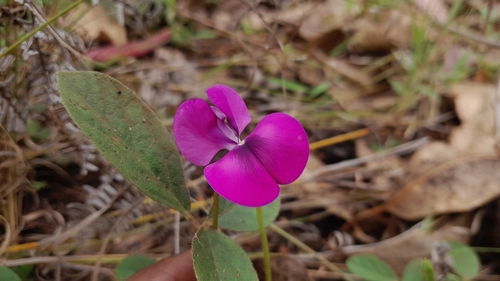
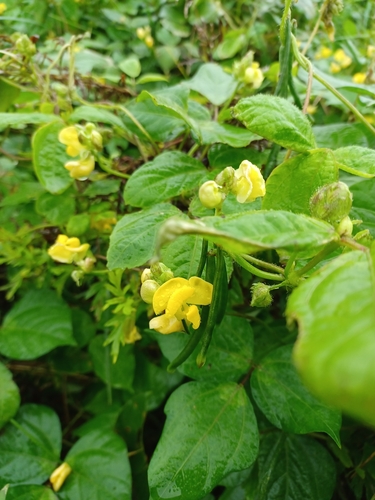
A tree up to 15-25 m high and 45 cm across the trunk. It loses its leaves during the year. The bark is soft and greyish green. It is smooth or covered with rounded swellings. The leaves are alternate and compound with 3 or more leaflets. There is a leaflet at the end. They are smooth and pointed at the tip. They are 7 to 10 cm long. The leaves have a bitter smell when squashed. The flowers are purplish and about 1.5 cm long in racemes. The pods are oval and with one seed. The pod tapers on both sides to sharp points. The seeds are kidney shaped.
Edible Uses
The seeds are eaten when cooked.
Traditional Uses
The seeds are edible cooked. CAUTION: It is probably poisonous with a toxin which causes vomiting. The seeds have a bitter oil.
This uses section is brief — help expand it
Medicinal Uses
The seed oil has been found to be useful in diesel generators, and along with Jatropha and castor, it was explored in hundreds of projects throughout India and the third world as feedstock for biodiesel. P. pinnata as a biofuel is commercially valuable to the rural populations of places such as India and Bangladesh, where the plant grows abundantly, because it can support the socioeconomic development of these areas. Research indicates potential use of P. pinnata as a food source for cattle, sheep, and poultry, as its byproduct contains up to 30% protein. As adaptive uses are increasing, the tree is being planted in former citrus growing regions that have declined in Florida and California because of disease and climate change conditions.
Known Hazards
Pongamia pinnata is well-adapted to arid zones, and has many traditional uses. It is often used for landscaping as a windbreak or for shade due to the large canopy and showy, fragrant flowers. The flowers are used by gardeners as compost for plants. The bark may be used to make twine or rope, and it also yields a black gum that has historically been used to treat wounds caused by poisonous fish. The wood is said to be beautifully grained, but splits easily when sawn, thus relegating it to firewood, posts, and tool handles. The tree's deep taproot and drought tolerance makes this tree ideal for controlling soil erosion and binding sand dunes. Rumphius writes the Malaparius (from Moluccan malapari) bark can be used to neutralize eeltail catfish venom, Seram Timur and Banda peoples infuse it with garlic, massoy and clover to treat beri-beri. Pongamia pinnata seeds generally contain oil (27-39%), protein (17-37%), starch (6-7%), crude fiber (5-7%), moisture (15-20%), and ash content (2-3%). Nearly half of the oil content of P. pinnata seeds is oleic acid. Oil made from the seeds, known as pongamia oil, has been used as lamp oil, in soapmaking, and as a lubricant. The oil has a high content of triglycerides. Its disagreeable taste and odor are due to bitter flavonoid constituents, including karanjin, pongamol, tannin, and karanjachromene. These compounds induce nausea and vomiting if ingested in its natural form. The fruits, sprouts and seeds are used in traditional medicine. Some studies have identified hiragonic acid in Pongamia pinnata seed oil. It can be grown in rainwater harvesting ponds up to 6 m (20 ft) in water depth without losing its greenery and remaining useful for biodiesel production. Studies have shown seedlings with tolerance to salinity levels between 12 and 19 dS/m, with an ability to tolerate salinity stresses of 32.5 dS/m.
Distribution
A tropical plant. It can grow on a wide range of well-drained soils. They are found along the coastal regions from northern Luzon to southern Mindanao in the Philippines. In Samoa it grows from sea level to 100 m altitude. In India it grows along the banks of streams. In the Cairns Botanical Gardens. It is salt tolerant. It suits hardiness zones 9-11.
Where It Grows
Andaman Islands, Asia, Australia, Bangladesh, East Timor, Fiji, Hawaii, Himalayas, India, Indonesia, Malaysia, Micronesia, Myanmar, Nepal, Northeastern India, Pacific, Pakistan, Palau, Papua New Guinea, PNG, Philippines, Samoa, SE Asia, Sri Lanka, Timor-Leste, USA,
Cultivation
Plants are grown from seed.
Production
Plants are fast growing.
Notes
There is only one Pongamia species. It grows in the tropics. It is used in medicine. Pongamia pinnata (L.) Pierre is an accepted name while Pongamia pinnata (L.) Merrill is unresolved.
Synonyms
Also Known As
Bangkong, Bangkongan, Gaanuga, Honge, Indian Beech, Jadar, Kachang kayu laut, Karanj, Karanj, Karanja, Karchaw, Karum oil tree, Kepik, Ki pahang, Koranjo, Mabai, Malapari, Paphri, Pari-pari, Pawda paki, Pita-qaria, Ponga, Pongam, Pongamia, Pungu, Punnu, Ra yot, Sukhchein
References (32)
- Ambasta, S.P. (Ed.), 2000, The Useful Plants of India. CSIR India. p 483
- Argent, G et al, nd, Manual of the Larger and More important non Dipterocarp Trees of Central Kalimantan Indonesia. Volume 2 Forest Research Institute, Samarinda, Indonesia. p 366
- Bhargava, N., 1983, Ethnobotanical Studies of the Tribes of Andaman and Nicobar Islands, India. 1. Onge. Economic Botany 37(1): 110-119 (As Pongamia pinnata)
- Bodkin, F., 1991, Encyclopedia Botanica. Cornstalk publishing, p 822
- Borrell, O.W., 1989, An Annotated Checklist of the Flora of Kairiru Island, New Guinea. Marcellin College, Victoria Australia. p 92
Show all 32 references Hide references
- Brickell, C. (Ed.), 1999, The Royal Horticultural Society A-Z Encyclopedia of Garden Plants. Convent Garden Books. p 820
- Brock, J., 1993, Native Plants of Northern Australia, Reed. p 286
- Burkill, I.H., 1966, A Dictionary of the Economic Products of the Malay Peninsula. Ministry of Agriculture and Cooperatives, Kuala Lumpur, Malaysia. Vol 2 (I-Z) p 1828
- Chakraborty, S. & Chaturbedi, H. P., 2014, Some Wild Edible Fruits of Tripura- A Survey. Indian Journal of Applied research. (4) 9
- Cooper, W. and Cooper, W., 2004, Fruits of the Australian Tropical Rainforest. Nokomis Editions, Victoria, Australia. p 213
- Cowie, I, 2006, A Survey of Flora and vegetation of the proposed Jaco-Tutuala-Lore National Park. Timor-Lests (East Timor) www.territorystories.nt/gov.au p 48
- Elliot, W.R., & Jones, D.L., 1997, Encyclopedia of Australian Plants suitable for cultivation. Vol 7. Lothian. p 44
- Flora of Pakistan. www.eFloras.org (As Pongamia pinnata)
- Franklin, J., Keppel, G., & Whistler, W., 2008, The vegetation and flora of Lakeba, Nayau and Aiwa Islands, Central Lau Group, Fiji. Micronesica 40(1/2): 169–225, 2008
- Hearne, D.A., & Rance, S.J., 1975, Trees for Darwin and Northern Australia. AGPS, Canberra p 99, Pl 30
- Jackes, B.R., 2001, Plants of the Tropics. Rainforest to Heath. An Identification Guide. James Cook University. p 55
- Jones D, L, 1986, Ornamental Rainforest Plants in Australia, Reed Books, p 159
- Lazarides, M. & Hince, B., 1993, Handbook of Economic Plants of Australia, CSIRO. p 196
- Llamas, K.A., 2003, Tropical Flowering Plants. Timber Press. p 221
- Lord, E.E., & Willis, J.H., 1999, Shrubs and Trees for Australian gardens. Lothian. p 20
- Monsalud, M.R., Tongacan, A.L., Lopez, F.R., & Lagrimas, M.Q., 1966, Edible Wild Plants in Philippine Forests. Philippine Journal of Science. p 486 (As Pongamia pinnata)
- Pandy, R. K. & Saini, S. K., 2007, Edible plants of tropical forests among tribal communities of Madhya Pradesh. Indian Journal of Traditional Knowledge. 6(1), pp 185-190 (As Pongamia pinnata)
- Panigrahi & Murti, Fl. Bilaspur Distr. 1:210. 1989
- Singh, H.B., Arora R.K.,1978, Wild edible Plants of India. Indian Council of Agricultural Research, New Delhi. p 79
- Staples, G.W. and Herbst, D.R., 2005, A tropical Garden Flora. Bishop Museum Press, Honolulu, Hawaii. p 333
- Townsend, K., 1994, Across the Top. Gardening with Australian Plants in the tropics. Society for Growing Australian Plants, Townsville Branch Inc. p 321
- Townsend, K., 1999, Field Guide to Plants of the Dry Tropics. Society for Growing Australian Plants, Townsville Branch Inc. p 80
- Verdcourt, B., 1979, Manual of New Guinea Legumes. Botany Bulletin No 11, Division of Botany, Lae, Papua New Guinea. p 312
- Whistler, W.A., 2004, Rainforest Trees of Samoa. Isle Botanica Honolulu, Hawaii. p 74
- Wightman, G. M. & Andrews, M.R., 1989, Plants of Northern Territory Monsoon Vine Forests (Vol 1). Conservation Commission of Northern Territory. p 74
- World Checklist of Useful Plant Species 2020. Royal Botanic Gardens, Kew
- www.efloras.org Flora of China (As Pongamia pinnata (L.) Merrill)