Polypodium glycyrrhiza
D. C. Eaton
Licorice fern
iNaturalist· cc-by-nc-sa
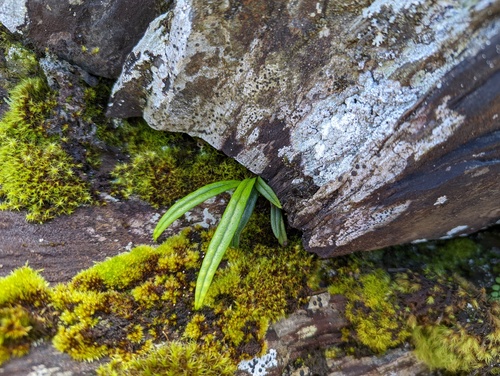
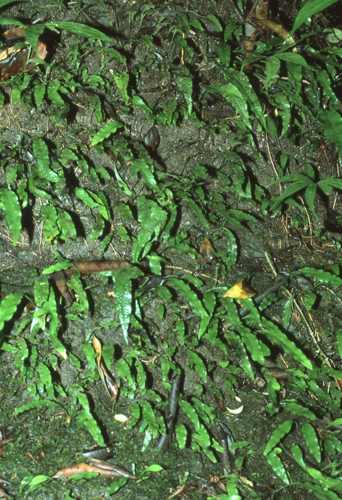
(c) Rich Hoyer, some rights reserved (CC BY-NC-SA), uploaded by Rich Hoyer
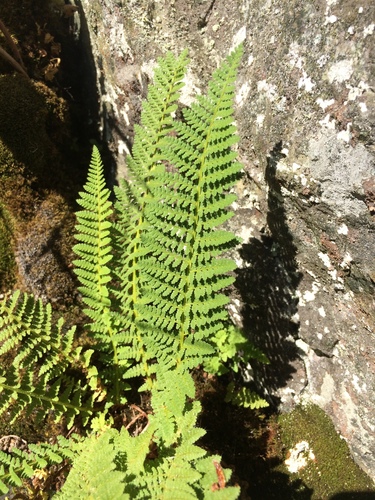
iNaturalist· cc-by
(c) Ed Alverson, some rights reserved (CC BY)
iNaturalist· cc-by
(c) Ed Alverson, some rights reserved (CC BY)
Summary
Source: WikipediaPolypodium glycyrrhiza, commonly known as licorice fern, many-footed fern, and sweet root, is a summer deciduous fern native to northwestern North America, where it is found in shaded, damp locations. Spores are located in rounded sori on the undersides of the fronds, and are released in cool weather and high humidity.
Description
A fern. It grows attached to other plants. It grows 30-60 cm high and spreads 30-60 cm wide. It loses its leaves in summer. The rhizomes are shallow and branching. They are yellowish-green and 6 mm thick. The fronds are 35 cm long. They are thin and sword shaped and have 10-20 offset pointed segments.
Edible Uses
The root can be eaten raw or cooked, and has a pleasantly sweet, liquorice-like flavour, though it is thin and fibrous and virtually inedible as a food. It was widely chewed by native North American Indian tribes for its agreeable taste and was often used as an appetiser, particularly for children reluctant to eat. Beyond its use as a flavoursome chew, the root was regarded as a famine food, turned to only when better foods were scarce.
Traditional Uses
The root or rhizome has a licorice flavour and is used for flavouring. The roots can be dried and stored. They are eaten as a famine food.
This uses section is brief — help expand it
Medicinal Uses
Liquorice fern was used medicinally by several native North American Indian tribes, primarily for chest complaints, and sees little or no use in modern herbalism. The rhizomes are alterative, carminative, haemostatic, and pectoral. Raw rhizomes were eaten and infusions were taken for coughs, colds, chest pains, shortness of breath, and venereal disease. The roots were chewed and the juice swallowed to relieve sore throats and to treat spitting or vomiting of blood. A tea of pounded boiled rhizomes mixed with fir needles was used to treat measles, and coughs were treated by chewing the roasted rhizome and slowly swallowing the juice.
Known Hazards
Although we have found no reports of toxicity for this species, a number of ferns contain carcinogens so some caution is advisable. Many ferns also contain thiaminase, an enzyme that robs the body of its vitamin B complex. In small quantities this enzyme will do no harm to people eating an adequate diet that is rich in vitamin B, though large quantities can cause severe health problems. The enzyme is destroyed by heat or thorough drying, so cooking the plant will remove the thiaminase.
Distribution
It is a temperate plant. It grows on wet mossy logs and rocks. It suits hardiness zones 6-9.
Where It Grows
Alaska, Australia, Canada, North America, USA,
Cultivation
Tolerates short periods of drought and direct sunlight, but it prefers bright filtered light. Plants can be grown on a drystone wall. Members of this genus are rarely if ever troubled by browsing deer. There are several named varieties selected for their ornamental value. Polypodium glycyrrhiza hybridizes with P. calirhiza and with P. hesperium to produce sterile triploids with misshapen spores. An evergreen. Licorice Fern is not self-fertile. It reproduces via spores rather than seeds. Licorice Fern has a moderate growth rate, establishing itself over a few years, especially in suitable moist, shaded environments.
Propagation
Sow spores as soon as they are ripe on the surface of a humus-rich sterilized soil. Keep the compost moist, preferably by covering the pot with a plastic bag. Pot on small clumps of plantlets once they are large enough to handle and keep them humid until well established. Do not plant outside until the ferns are at least two years old, and then only in a very well sheltered position. Can also be propagated by division in spring.
Other Uses
Licorice fern can be used as ground cover in shaded garden areas and may assist with soil stabilization and improvement over time. The sweet root serves as a food source for various wildlife including some mammals and birds, and the dense fronds can provide shelter for small animals. The fronds also offer habitat for invertebrates, and the leaf litter can serve as overwintering sites.
Other Information
The roots are eaten especially by children.
Notes
There are about 75 Polypodium species.
Nutrition
| Part | Moisture | kJ | kcal | Protein | Vit A | Vit C | Iron | Zinc |
|---|---|---|---|---|---|---|---|---|
| Rhizome | 70 | 578 | 141 | 0.9 | — | — | 4.4 | 0.7 |
Synonyms
References (10)
- Amer. J. Sci. Arts ser. 2, 22:138. 1856
- Cundall, P., (ed.), 2004, Gardening Australia: flora: the gardener's bible. ABC Books. p 1068
- Guil-Guerrero, J. L., et al, 2001, Edible Wild Plants. in Recent Progress in Medicinal Plants Vol. 8 Sci. Tech publishing, Texas
- Keller, H. A. & Prance, G. T., 2015, Ethnobotany of Ferns and Lycophytes. Fern Gazette 20(1): 1-13
- Kermath, B. M., et al, 2014, Food Plants in the Americas: A survey of the domesticated, cultivated and wild plants used for Human food in North, Central and South America and the Caribbean. On line draft. p 676
Show all 10 references Hide references
- Kuhnlein, H. V., et al, 2009, Indigenous Peoples' food systems. FAO Rome p 33
- MacKinnon, A., et al, 2009, Edible & Medicinal Plants of Canada. Lone Pine. p 381
- Moerman, D. F., 2010, Native American Ethnobotany. Timber Press. p 424
- Plants for a Future database, The Field, Penpol, Lostwithiel, Cornwall, PL22 0NG, UK. http://www.scs.leeds.ac.uk/pfaf/
- Turner, N., 1995, Food Plants of Coastal First Peoples. Royal BC Museum Handbook p 27