Persicaria pulchra
(Blume) Sojak
Watersmart weed
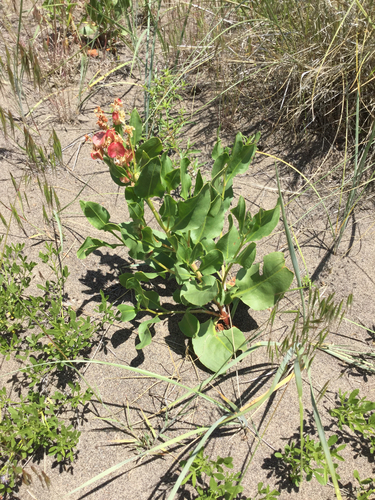
iNaturalist· cc-by-nc
(c) Shin-Ming Ku, some rights reserved (CC BY-NC), uploaded by Shin-Ming Ku
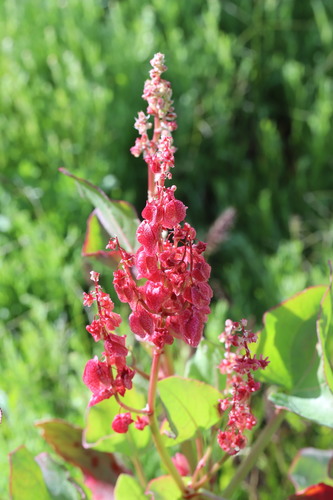
iNaturalist· cc-by-nc
(c) Shin-Ming Ku, some rights reserved (CC BY-NC), uploaded by Shin-Ming Ku
Description
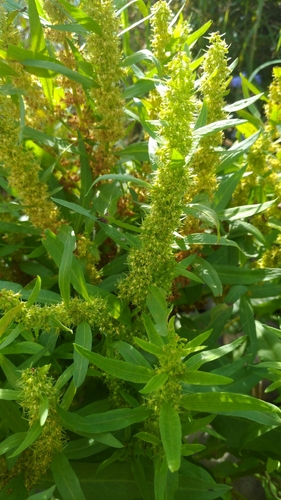
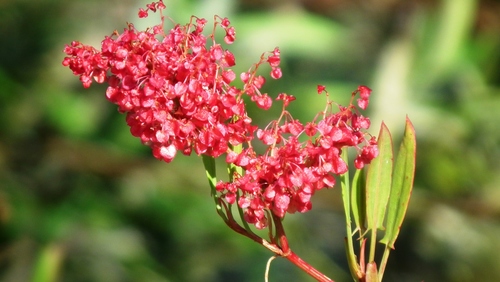
A creeping herb that grows in water. It has hollow stems. It roots at the nodes. It can be 2 m long. Much of the plant is under water. The leaves are very hairy. They are sword shaped and taper to the tip. They sheath the stem at the base. The flowers are small and white. The occur in clusters which are erect and nodding.
Edible Uses
The leaves are eaten raw in salads or cooked as a vegetable, and are also used as a flavouring.
Traditional Uses
The leaves are used in salads. The leaves are cooked and eaten as a vegetable.
This uses section is brief — help expand it
Medicinal Uses
The leaves are used traditionally in salads and as a cooked vegetable.
Distribution
A tropical plant. It occurs widely throughout the tropics. It grows in marshes and roadside ditches. It grows in wet grass savannah. It grows between 100-300 m above sea level.
Where It Grows
Africa, Asia, Benin, Burkina Faso, China, East Africa, Guinea, Guinée, Guinea-Bissau, India, Indochina, Indonesia, Kenya, Malaysia, Myanmar, Nigeria, Philippines, SE Asia, Sierra Leone, Sri Lanka, Tanzania, Thailand, Uganda, West Africa,
Notes
There are about 50 Polygonum species.
Nutrition
| Part | Moisture | kJ | kcal | Protein | Vit A | Vit C | Iron | Zinc |
|---|---|---|---|---|---|---|---|---|
| Leaves | 74.5 | 292 | 70 | 13.8 | — | — | — | — |
Synonyms
Also Known As
Bakoan, Bendet, Chachabean, Dekerngude, Funte, Jangkong, Johong beraleh, Lukantamila, Musokapale, Nyakisumbi, Pai-nam, Pukut chareng
References (12)
- Ambasta, S.P. (Ed.), 2000, The Useful Plants of India. CSIR India. p 481 (As Polygonum pulchrum)
- Burkill, H. M., 1985, The useful plants of west tropical Africa, Vol. 4. Kew. (As Polygonum pulchrum)
- Burkill, I.H., 1966, A Dictionary of the Economic Products of the Malay Peninsula. Ministry of Agriculture and Cooperatives, Kuala Lumpur, Malaysia. Vol 2 (I-Z) p 1824 (As Polygonum pulchrum)
- Crevost & Lemarie, 1917, p 183 (As Polygonum pulchrum)
- Flora of China @ efloras.org Volume 5 (As Polygonum pulchrum)
Show all 12 references Hide references
- Malaisse, F., 1997, Se nourrir en floret claire africaine. Approche ecologique et nutritionnelle. CTA., p 67 (As Polygonum pulchrum)
- McMakin, P.D., 2000, Flowering Plants of Thailand. A Field Guide. White Lotus. p 85 (As Polygonum pulchrum)
- Ojelel, S. & Kakudidi, E. K., 2015, Wild edible plant species utilized by a subsistence farming community in the Obalanga sub-county, Amuria district, Uganda. Journal of Ethnobiology and Ethnomedicine. 11:7 (As Polygonum pulchrum)
- Ruffo, C. K., Birnie, A. & Tengnas, B., 2002, Edible Wild Plants of Tanzania. RELMA p 534 (As Polygonum pulchrum)
- Singh, H.B., Arora R.K.,1978, Wild edible Plants of India. Indian Council of Agricultural Research, New Delhi. p 33 (As Polygonum pulchrum)
- World Checklist of Useful Plant Species 2020. Royal Botanic Gardens, Kew
- Zon, A.P.M. van der, Grubben, G.J.H., 1976, Les legumes-feuilles spontanes et cultives du Sud-Dahomey, Communication 65, Royal Tropical Institute, Amsterdam, p 85, 86 (As Polygonum pulchrum)