Persicaria bistorta
(L.) Samp.
Meadow bistort
iNaturalist· cc-by-nc
(c) Сергей, some rights reserved (CC BY-NC)
iNaturalist· cc-by-nc
(c) Сергей, some rights reserved (CC BY-NC)
iNaturalist· cc-by-nc
(c) Сергей, some rights reserved (CC BY-NC)
Description
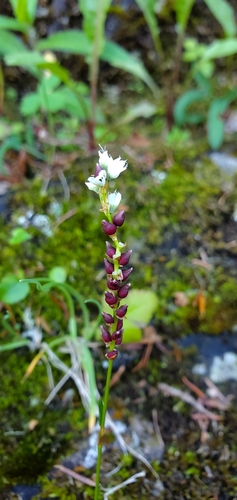
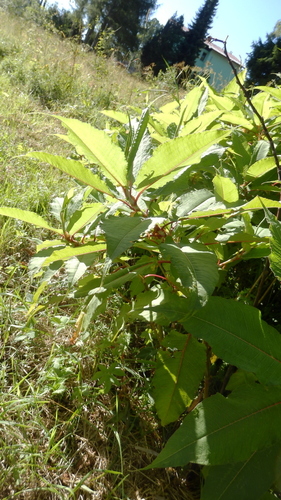
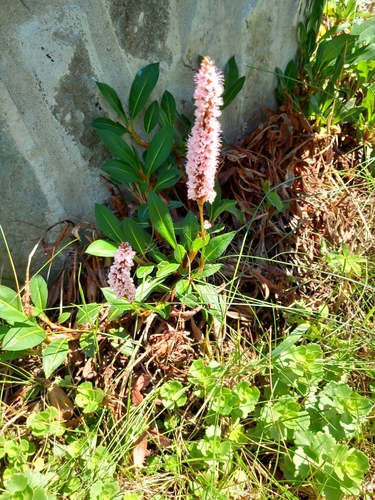
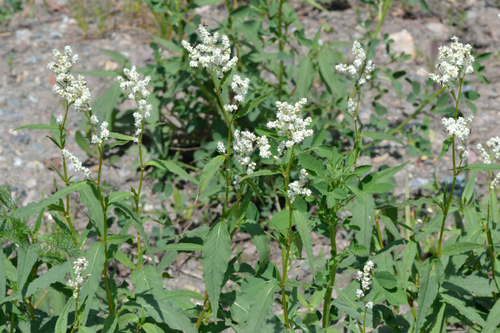
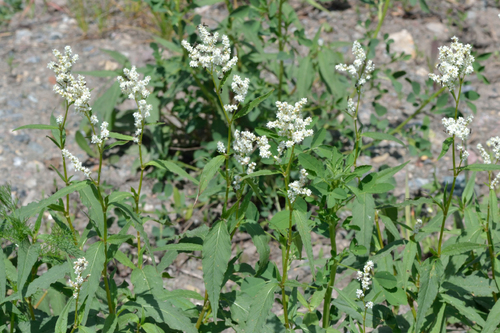
A small herb. It grows 1-75 cm high and spreads 15-75 cm wide. It keeps growing from year to year. It has stout rootstocks. The rhizomes are black to brown. They are large and curved and 1-3 cm across. The leaves at the base have long stalks and the leaves on the stem do not have stalks. The leaves are oval and wavy. They are 10-20 cm long. They have rounded tips and flattened bases. They have a stiff leathery texture. They are on winged stalks. The flowers are in dense spikes. The flowers are small and pink. They are on a spike 8 cm long and 1 cm wide. These are cylinder shaped.
Edible Uses
The thick starch-rich rhizomes are dried, ground into flour, and added to stews, or eaten raw or cooked. Shoots are used in soups, stews, and Easter ledger pudding. Roots and young leaves are cooked and eaten as vegetables. Young leaves are eaten with oil. Flowers are also edible.
Traditional Uses
The thick roots or rhizomes, rich in starch, are dried and ground into flour. They can be added to stews. The shoots are used in soups and stews. They are used for Easter ledger pudding. The root and young leaves are cooked and eaten as a vegetable. The young leaves are eaten with oil. The rhizomes can be eaten raw or cooked.
Medicinal Uses
Bistort has been used traditionally for medicinal purposes. The roots are rich in tannic and gallic acids and both these and the leaves have been used to treat wounds. In Northern England, the plant was used to make a bitter pudding in Lent from a combination of the leaves, oatmeal, egg, and other herbs. It is the principal ingredient of dock pudding or Easter-Ledge pudding. The root of Bistort can be used to produce an astringent that was used in medicine. The roots are also eaten in Russia and northern Asia.
Distribution
It is a temperate plant. It grows in cold temperate regions. In northern China it grows between 800-3,000 m above sea level. It grows in hilly grassland and fields. It grows in the subarctic tundra. It suits moist locations. It suits hardiness zones 3-7.
Where It Grows
Alaska, Albania, Asia, Australia, Austria, Balkans, Belarus, Belgium Bosnia, Britain, Bulgaria, Central Asia, China, Czech Republic, Denmark, Europe, Finland, France, Germany, Greece, Himalayas, Hungary, India, Iraq, Ireland, Italy, Japan, Kazakhstan, Korea, Lithuania, Luxembourg, Mediterranean, Middle East, Mongolia, Morocco, Netherlands, North America, Northeastern India, Norway, Pakistan, Poland, Portugal, Russia, Romania, Russia, Scandinavia, Siberia, Sikkim, Slovenia, Spain, Sweden, Switzerland, Tasmania, Tibet, Turkey, Türkiye, Ukraine, USA, Yugoslavia,
Other Information
It is eaten in parts of Britain to purify the blood.
Notes
There are about 50 Polygonum species. The leaves are rich in Vit C and Vit A.
Synonyms
Also Known As
Bistort, Cimeneveligi, Easter ledges, English Serpentary, Kačja dresen, Linboina, Lingo boino, Mountain meadow bistort, Neqenllaq, Passion Dock, Pink plumes, Plume flower, Snakeroot, Snakeweed, Srcanica, Srcenjak, Syukl'yak, Wezownik
References (33)
- Ainana, L. & Zagrebin, I., 2014, Edible Plants Used by the Siberian Yupik Eskimos of Southeastern Chukotka Peninsula, Russia, (English translation). p 49 (As Bistorta ellipticum)
- Ambasta, S.P. (Ed.), 2000, The Useful Plants of India. CSIR India. p 479
- Cakir, E. A., 2017, Traditional knowledge of wild edible plants of Iğdır Province (East Anatolia, Turkey). Acta Soc Bot Pol. 2017;86(4):3568
- Cerne, M., 1992, Wild Plants from Slovenia used as Vegetables. Acta Horticulturae 318 (As Polygonum bistorta)
- Cundall, P., (ed.), 2004, Gardening Australia: flora: the gardener's bible. ABC Books. p 1012
Show all 33 references Hide references
- Facciola, S., 1998, Cornucopia 2: a Source Book of Edible Plants. Kampong Publications, p 185 (As Polygonum bistorta)
- Flora of China @ efloras.org Volume 5 (As Polygonum bistorta)
- Hedrick, U.P., 1919, (Ed.), Sturtevant's edible plants of the world. p 511
- Heller, C. A., 1962, Wild Edible and Poisonous Plants of Alaska. Univ. of Alaska Extension Service. p 21 (As Polygonum bistorta subsp. plumosum)
- Herb. port. 41. 1913
- Hibbert, M., 2002, The Aussie Plant Finder 2002, Florilegium. p 229
- http://www.botanic-gardens-ljubljana.com/en/plants (As Polygonum bistorta)
- Irving, M., 2009, The Forager Handbook, A Guide to the Edible Plants of Britain. Ebury Press p 172
- Jackes, D. A., Edible Forest Gardens (As Polygonum bistorta)
- Jernigan, K. A., et al, 2017, Naukan ethnobotany in post-Soviet times: lost edibles and new medicinals. Journal of Ethnobiology and Ethnomedicine (2017) 13:61
- Jones, A., 2010, Plants that we eat. University of Alaska Press. p21 (As Polygonum bistorta)
- Kiple, K.F. & Ornelas, K.C., (eds), 2000, The Cambridge World History of Food. CUP p 1797
- Lim, T. K., 2015, Edible Medicinal and Non Medicinal Plants. Volume 9, Modified Stems, Roots, Bulbs. Springer p 67
- Luczaj, L. et al, 2013, Wild edible plants of Belarus: from Rostakinski's questionnaire of 1883 to the present. Journal of Ethnobiology and Ethnomedicine 9:21 (As Polygonum bistorta)
- Mabey, R., 1973, Food for Free. A Guide to the edible wild plants of Britain, Collins. p 97
- Manju, S., and Sundriyal, R. C., 2001, Wild Edible Plants of the Sikkim Himalaya: Nutritive Values of Selected Species. Economic Botany 55(3): 377-390 (As Polygonum bistorta)
- Moerman, D. F., 2010, Native American Ethnobotany. Timber Press. p 423 (As Polygonum bistorta)
- Pieroni, A.,& Giusti, M. E., 2009, Alpine Ethnobotany in Italy: Journal of Ethnobiology and Ethnomedicine. 5:32 (As Polygonum bistorta)
- Plants for a Future database, The Field, Penpol, Lostwithiel, Cornwall, PL22 0NG, UK. http://www.scs.leeds.ac.uk/pfaf/
- Porsild, A.E., 1953, Edible Plants of the Arctic, Arctic 6:15-34, page 31 (As Polygonum bistorta)
- Redzic, S. J., 2006, Wild Edible Plants and their Traditional Use in the Human Nutrition in Bosnia-Herzegovina. Ecology of Food and Nutrition, 45:189-232 (As Polygonum bistorta)
- SAYCE,
- Shikov, A. N. et al, 2017, Traditional and Current Food Use of Wild Plants Listed in the Russian Pharmacopoeia. Frontiers in Pharmacology. Vol. 8 Article 841
- Simkova, K. et al, 2014, Ethnobotanical review of wild edible plants used in the Czech Republic. Journal of Applied Botany and Food Quality 88, 49-67 (As Bistorta officinalis)
- Singh, H.B., Arora R.K.,1978, Wild edible Plants of India. Indian Council of Agricultural Research, New Delhi. p14, 33
- UPHOF,
- Wiersema, J. H. & Leon, B., 2013, World Economic Plants. A Standard Reference CRC Press. 2nd Ed. p 103 (As Bistorta officinalis)
- World Checklist of Useful Plant Species 2020. Royal Botanic Gardens, Kew