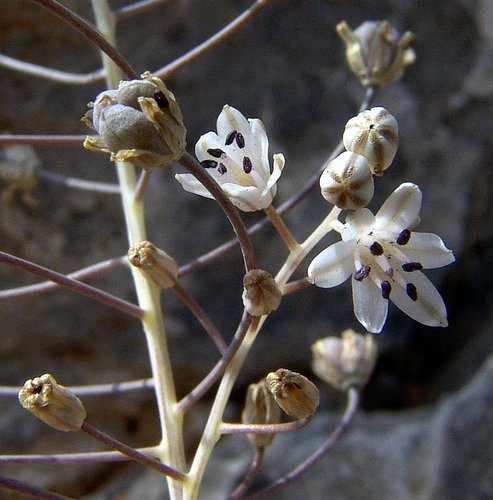
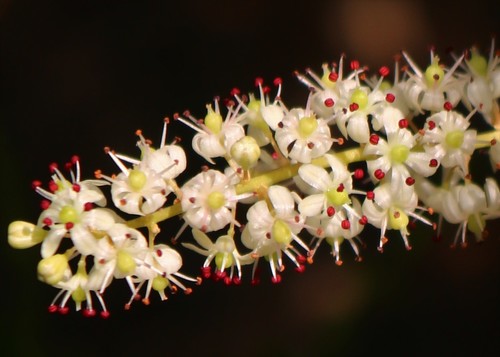
Polianthes tuberosa
L.
Tuberose
iNaturalist· cc-by-nc
(c) SONU KUMAR, some rights reserved (CC BY-NC), uploaded by SONU KUMAR
iNaturalist· cc-by-nc
(c) Murtuza Zabuawala, some rights reserved (CC BY-NC), uploaded by Murtuza Zabuawala
iNaturalist· cc-by-nc-sa
(c) dogtooth77, some rights reserved (CC BY-NC-SA)
Summary
Source: WikipediaPolianthes tuberosa, the tuberose, is a perennial plant in the family Asparagaceae, subfamily Agavoideae, extracts of which are used as a note in perfumery. Now widely grown as an ornamental plant, the species is native to Mexico.
Description
A herb. It grows 120 cm high and spreads 50 cm wide. It forms clumps. The leaves are narrow and strap like. They are grey-green. The flowers are funnel shaped. they are waxy and white. They are 5 cm long with 6 widely flared lobes.
Edible Uses
The flowers are eaten cooked — used in vegetable soups or added to the substrate of kecap, an Indonesian soy sauce. The flowers are also the source of tuberosa-flower water.
Traditional Uses
It has been used as a flavouring for chocolate. The flowers are also added to soup. The fruit are eaten.
This uses section is brief — help expand it
Medicinal Uses
None known.
Distribution
It is a subtropical plant. It suits hardiness zones 9-10. It needs a fertile, well-drained soil. It needs to be kept moist and needs full sun.
Where It Grows
Asia, Australia, Bangladesh, Central America, China, Europe, France, Guam, Hawaii, India, Indonesia, Malaysia, Mexico, Myanmar, North America, Pacific, Philippines, SE Asia, USA,
Cultivation
Requires a warm sheltered position and a well-drained soil. When grown in pots it is best to use a fibrous loam enriched with compost and some silver sand for drainage. Plants require copious amounts of moisture when starting into growth. Not very hardy outdoors in Britain, this species is often grown in the greenhouse where it can be induced to flower at almost any time of the year. It can also be grown outdoors in warm areas of Britain, planting out the bulbs in spring, harvesting them in the autumn and storing them in sand overwinter in a cool but frost-free place. This species is sometimes cultivated for its edible flowers. They are very strongly scented. The flowers are perhaps the most powerfully scented of all flowers. The perfume is almost intoxicating, especially when the plant is grown in gentle heat when it is heavy and sickly almost to the point of unpleasantness. A double-flowered cultivar, 'The Pearl' has an even more pronounced fragrance. The plant is cultivated for its essential oil in China.
Propagation
Seed should be sown in spring in a sunny position in a greenhouse. Once seedlings are large enough to handle, prick them out into individual pots and grow on in the greenhouse through at least their first winter. Plant out into permanent positions in late spring or early summer, after the last expected frosts. The plant can also be propagated by dividing offsets after flowering has finished in late summer.
Other Uses
An essential oil extracted from the flowers is used in high-grade perfumery. Approximately 1,150kg of flowers are required to yield 1kg of absolute essential oil.
Notes
There are 13-14 Polianthes species. Also put in the family Agavaceae.
Also Known As
Azucena, Amiga-de-noche, Evening fragrant Jade, Gulcheri, Gulshabbo, Hnin-pan, Kerak nasi, Kupaloke, Nelasampangi, Nelasampinge, Nilasampangi, Padda, Rajani-gandha, Rajnigandha, Sandarmalam, Sandharaga, Sedap malam, Siku dengan, Sugandha-raja, Sukandaraji, Sundal malam, Sundel malem, Wanxiangyu
References (14)
- Ambasta, S.P. (Ed.), 2000, The Useful Plants of India. CSIR India. p 475
- Bodkin, F., 1991, Encyclopedia Botanica. Cornstalk publishing, p 817
- Bodner, C. C. and Gereau, R. E., 1988, A Contribution to Bontoc Ethnobotany. Economic Botany, 43(2): 307-369
- Brickell, C. (Ed.), 1999, The Royal Horticultural Society A-Z Encyclopedia of Garden Plants. Convent Garden Books. p 815
- Burkill, I.H., 1966, A Dictionary of the Economic Products of the Malay Peninsula. Ministry of Agriculture and Cooperatives, Kuala Lumpur, Malaysia. Vol 2 (I-Z) p 1815
Show all 14 references Hide references
- Cundall, P., (ed.), 2004, Gardening Australia: flora: the gardener's bible. ABC Books. p 1066
- Facciola, S., 1998, Cornucopia 2: a Source Book of Edible Plants. Kampong Publications. p 3
- Harter, J.(Ed.), 1988, Plants. 2400 copyright free illustrations. Dover p 11.6, 11.7
- Hellmuth, N. M., 2011, Maya Ethnobotany. Complete Inventory of plants. Associacion FLAAR Mesoamerica. Tenth edition.
- Hibbert, M., 2002, The Aussie Plant Finder 2002, Florilegium. p 237
- Kermath, B. M., et al, 2014, Food Plants in the Americas: A survey of the domesticated, cultivated and wild plants used for Human food in North, Central and South America and the Caribbean. On line draft. p 674
- Sp. pl. 1:316. 1753
- Staples, G.W. and Herbst, D.R., 2005, A tropical Garden Flora. Bishop Museum Press, Honolulu, Hawaii. p 587 (Drawing)
- Valder, P., 1999, The Garden Plants of China. Florilegium. p 379