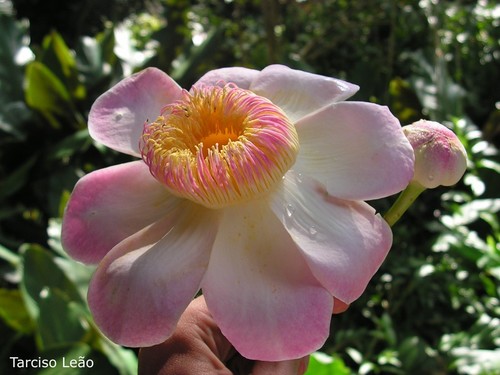
Planchonia careya
(F. Muell.) R Kunth
Cocky Apple, Wild Quince, Billygoat Plum
iNaturalist· cc-by-sa
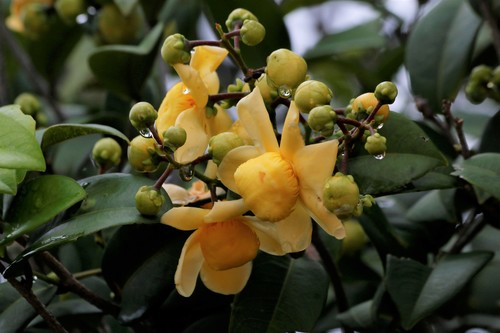
(c) Tony Eales, some rights reserved (CC BY-SA), uploaded by Tony Eales
iNaturalist· cc-by-nc
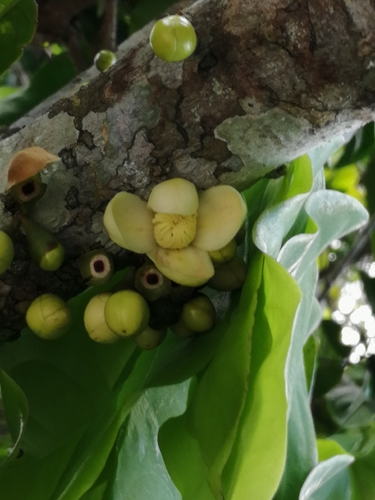
(c) Darren Fielder, some rights reserved (CC BY-NC), uploaded by Darren Fielder
iNaturalist· cc-by-nc-sa
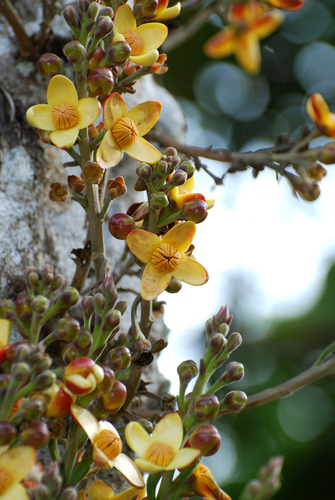
(c) Nick Lambert, some rights reserved (CC BY-NC-SA), uploaded by Nick Lambert
Summary
Source: WikipediaPlanchonia careya is a tree species in the family Lecythidaceae. Common names include cocky apple, cockatoo apple and billygoat plum. The species should not be confused with Terminalia ferdinandiana, with which it shares some common names. The 1889 book 'The Useful Native Plants of Australia' records that Indigenous Australians of the Mitchell River area referred to this plant as "Ootcho" while those of the Cloncurry River area referred to it as "Go-onje" and "Gunthamarrah".
Description
A tree which loses its leaves during the year. It grows 4-15 m high and spreads 2-5 m wide. The bark is grey and corky. The leaves are simple and 2-10 cm long by 3-6 cm wide. The leaves are broadly oval or spoon shaped. They are smooth and shiny above but dull underneath. The leaves turn red colour before they fall. The flowers are 8 cm across. They are pink and white and showy. The fruit is 50 mm long by 35 mm wide. They can be larger. They occur singly or in bunches. The fruit are produced in the axils of leaves or at the ends of branches. They contain several seeds. The seeds are 10-11 mm long by 7 mm wide. The flesh is edible.
Edible Uses
The fruit flesh is edible and eaten when the juice inside turns yellow; the skin and pulp fibres are discarded. The seeds are also edible.
Traditional Uses
The fruit is eaten. They are eaten when the juice in them is yellow. The skin and pulp fibres are discarded.
This uses section is brief — help expand it
Medicinal Uses
Indigenous Australians consumed the raw ripe fruit of this species. The taste is stated to be similar to quince. Indigenous Australians pulverized the inner bark of this species and added it to small water bodies to act as a fish toxin, allowing fish to be easily collected from the surface of the water. This is known to have been a practice used by Indigenous Australians at Cleveland Bay. The roots of the species were also used as a fish toxin by Indigenous Australians. Indigenous Australians boiled the inner bark of this species in water and the resulting liquid was used as an antiseptic wash for open cuts and sores. Indigenous Australians placed the heated leaves of this species over mosquito and sandfly bites to relieve irritation. Indigenous Australians used the flowers of this species as decorations.
Distribution
A tropical plant. It grows in rainforest and open forest in tropical regions. It can also grow in seasonally dry regions and in subtropical places. It needs very good drainage. It does best in a sunny location. It also grows in sand plains behind beaches.
Where It Grows
Australia*, Pacific, Papua New Guinea, PNG,
Cultivation
Plants can be grown from fresh seed. The seed need to be treated to break the hard seed coat before planting. They can be grown by cuttings.
Notes
There are about 14 Plachonia species. They grow in the Asian tropics.
Synonyms
Also Known As
Banggiya, Coolay, Gugani mundtha, Dhanggi, Gulayi, Kanuli, Mangaloo, Melberre, Mi palathi, Mukuwara, Peletji, Wartuluj, Yundu
References (46)
- Barret, R. L., 2006, A review of Planchonia (Lecythidaceae) In Australia. Australian Systematic Botany 19, 147-153
- Bindon, P., 1996, Useful Bush Plants. Western Australian Museum. p 201
- Bircher, A. G. & Bircher, W. H., 2000, Encyclopedia of Fruit Trees and Edible Flowering Plants in Egypt and the Subtropics. AUC Press. p 54 (As Barringtonia careya)
- Bodkin, F., 1991, Encyclopedia Botanica. Cornstalk publishing, p 808
- Brock, J., 1993, Native Plants of Northern Australia, Reed. p 283
Show all 46 references Hide references
- Calvert, G., 2010, The Burdekin Delta Tree Guide. Lower Burdekin Landcare Association., Inc., Ayr p 141
- Crawford, I. M., 1982, Traditional Aboriginal Plant Resources in the Kalumburu Area: Aspects in Ethno-economics. Records of the Western Australian Museum. Supplement No. 15 (As Planchonia australis)
- Cherikoff V. & Isaacs, J., The Bush Food Handbook. How to gather, grow, process and cook Australian Wild Foods. Ti Tree Press, Australia p 201
- Cooper W & Cooper W T, 1994, Fruits of the Rain Forest. RD Press p 226
- Cooper, W. and Cooper, W., 2004, Fruits of the Australian Tropical Rainforest. Nokomis Editions, Victoria, Australia. p 266
- Crawford, I. M., 1982, Traditional Aboriginal Plant Resources in the Kalumburu Area: Aspects in Ethno-economics. Records of the Western Australian Museum Supplement No. 15 (As Planchonia australis)
- Cribb, A.B. & J.W., 1976, Wild Food in Australia, Fontana. p 50
- Cronin, L., 1989, The Concise Australian Flora. Reed. p 156
- Elliot, W.R., & Jones, D.L., 1997, Encyclopedia of Australian Plants suitable for cultivation. Vol 7. Lothian. p 359 (Photo)
- H. G. A. Engler, Pflanzenr. IV. 219a(Heft 105):56. 1939
- Flora of Australia, Volume 8, Lecythidales to Batales, Australian Government Publishing Service, Canberra (1982) p 2
- Hardwick, G., 2001, Economically Useful Plants for Northern Australia: Master Species List. Crusader eBooks.
- Hearne, D.A., & Rance, S.J., 1975, Trees for Darwin and Northern Australia. AGPS, Canberra p 97, Pl. 29
- Hiddins, L., 1999, Explore Wild Australia with the Bush Tucker Man. Penguin Books/ABC Books. p 135
- Isaacs, J., 1987, Bush Food, Aboriginal Food and Herbal Medicine. Weldons. p 62
- Jackes, B.R., 2001, Plants of the Tropics. Rainforest to Heath. An Identification Guide. James Cook University. p 60
- Kenneally, K.E., Edinger, D. C., and Willing T., 1996, Broome and Beyond, Plants and People of the Dampier Peninsula, Kimberley, Western Australia. Department of Conservation and Land Management. p 114
- Lavelle, M., 2008, Wild Flowers of Australia and Oceania. Southwater. p 71
- Lazarides, M. & Hince, B., 1993, Handbook of Economic Plants of Australia, CSIRO. p 192
- Levitt, D., 1981, Plants and people. Aboriginal uses of plants on Groote Eylandt. Australian Institute of Aboriginal Studies, Canberra. p 84
- Low, T., 1991, Wild Food Plants of Australia. Australian Nature FieldGuide, Angus & Robertson. p 149
- Melzer, R. & Plumb, J., 2011, Plants of Capricornia. Belgamba, Rockhampton. p 167
- Menninger, E.A., 1977, Edible Nuts of the World. Horticultural Books. Florida p 38 (As Barringtonia careya)
- Morley, B.D., & Toelken, H.R., (Eds), 1983, Flowering Plants in Australia. Rigby. p 172
- Paczkowska, G. & Chapman, A.R., 2000, The Western Australian Flora. A Descriptive Catalogue. Western Australian Herbarium. p 278
- Pearson, S. & A., 1992, Rainforest Plants of Eastern Australia. Kangaroo Press p 166
- Petheram, R.J. and Kok, B., 2003, Plants of the Kimberley Region of Western Australia. UWA Press p 517
- Scarth-Johnson, V., 2000, National Treasures. Flowering Plants of Cooktown and Northern Australia. Vera Scarth-Johnson Gallery Association. Cooktown, Australia. p 100
- Smith, M & Kalotas, A. C., 1985, Bardi Plants: An Annotated List of Plants and Their Use by the Bardi Aborigines of Dampierland, in North-western Australia. Rec. West Aust. Mus. 1985, 12(3): 317-359
- Smith, N and Wightman, G.M., 1990, Ethnobotanical Notes from Belyuen Northern Territory Australia. Northern Territory Botanical Bulletin No 10. Parks and Wildlife Commission of the Northern Territory. p 21, 22.
- Smith, N. M., 1991, Ethnobotanical Field Notes from the Northern Territory, Australia, J. Adelaide Bot. Gard. 14(1): 1-65
- Stanley, T. D. & Ross, E. M., 1986, Flora of south-eastern Queensland Volume 2. Queensland Government p 219
- Tiwi Plants and Animals. 2001, Aboriginal flora and fauna knowledge from Bathurst and Melville Islands, northern Australia. Northern Territory Botanical Bulletin; No. 24 p 72
- Townsend, K., 1994, Across the Top. Gardening with Australian Plants in the tropics. Society for Growing Australian Plants, Townsville Branch Inc. p 317
- Townsend, K., 1999, Field Guide to Plants of the Dry Tropics. Society for Growing Australian Plants, Townsville Branch Inc. p 78
- Vigilante, T., et al, 2013, Island country: Aboriginal connections, values and knowledge of the Western Kimberley islands in the context of an island biological survey. Records of the Western Australian Museum Supplement 81: 145-182
- Wheeler, J.R.(ed.), 1992, Flora of the Kimberley Region. CALM, Western Australian Herbarium, p 236
- Wickens, G.E., 1995, Edible Nuts. FAO Non-wood forest products. FAO, Rome. p 141
- Wightman, Glenn et al. 1991.Alawa Ethnobotany: Aboriginal Plant Use from Minyerri, Northern Australia. Northern Territory Botanical Bulletin No 11. Parks and Wildlife Commission of the Northern Territory. p 24, 23
- Wightman, G. & Andrews, M., 1991, Bush Tucker Identikit. Common Native Food Plants of Australia’s top end. Conservation Commission Northern Territory. p 22
- Yunupinu Banjgul, Laklak Yunupinu-Marika, et al. 1995, Rirratjinu Ethnobotany: Aboriginal Plant Use from Yirrkala, Arnhem Land, Australia. Northern Territory Botanical Bulletin No 21. Parks and Wildlife Commission of the Northern Territory. p 64