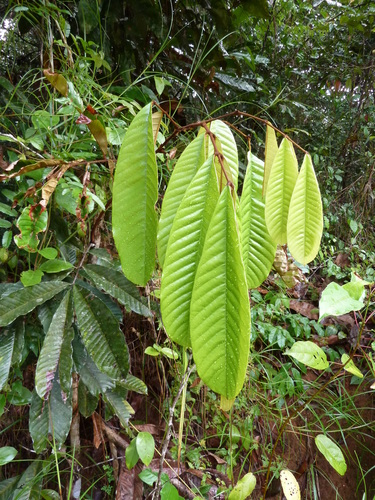
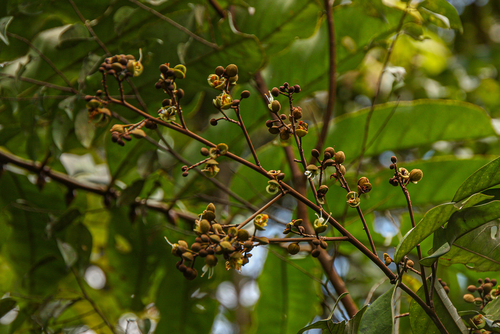
Archidendron kunstleri
(Prain) I. C. Nielsem
gbif· cc0
President and Fellows of Harvard College
gbif· cc0
President and Fellows of Harvard College
gbif· cc0
President and Fellows of Harvard College
Description
A shrub or small tree in the Fabaceae family that grows 2-15 m tall with a trunk 10-80 cm across. It is found in tropical swampy woods, typically below 20 m elevation and along rivers.
Edible Uses
The young shoots and leaves are eaten.
Traditional Uses
The young shoots are eaten.
This uses section is brief — help expand it
Medicinal Uses
The leaves are used as soap.
Known Hazards
Although we have no specific information for this species, the seeds of several other members of this genus contain the amino acid derivative djenkolic acid. Ingestion of seed containing this substance can cause the formation of sharp needle-like crystals of djenkolic acid in the kidney or urinary tract. In severe cases, crystals of djenkolic acid have been found in urine. Indeed, people who are suffering from djenkolism show similar symptoms to those suffering from kidney or urinary stones, a condition for which it has been frequently mistaken.
Distribution
A tropical plant. It often grows in swampy woods. It grows below 20 m above sea level and along rivers.
Where It Grows
Asia, Indonesia, Malaysia, SE Asia,
Cultivation
A plant of the moist lowland tropics, where it is found near sea level. The tree can flower and fruit all year round. This species has a symbiotic relationship with certain soil bacteria, these bacteria form nodules on the roots and fix atmospheric nitrogen. Some of this nitrogen is utilized by the growing plant but some can also be used by other plants growing nearby.
Other Uses
The leaves are used as a soap.
Notes
Also as Mimosaceae. The leaves are used as soap.
Synonyms
References (7)
- Burkill, I.H., 1966, A Dictionary of the Economic Products of the Malay Peninsula. Ministry of Agriculture and Cooperatives, Kuala Lumpur, Malaysia. Vol 2 (I-Z) p 1793 (As Pithecellobium kunstleri)
- Ferns, Useful Tropical Plants
- Heyne, K., 1927, p 701 (As Pithecellobium kunstleri)
- G. King, J. Asiat. Soc. Bengal, Pt. 2, Nat. Hist. 66:271, 517. 1897 (As Pithecellobium kunstleri)
- Martin, F.W. & Ruberte, R.M., 1979, Edible Leaves of the Tropics. Antillian College Press, Mayaguez, Puerto Rico. p 200 (As Pithecellobium kunstleri)
Show all 7 references Hide references
- Terra, G.J.A., 1973, Tropical Vegetables. Communication 54e Royal Tropical Institute, Amsterdam, p 67 (As Pithecellobium kunstleri)
- World Checklist of Useful Plant Species 2020. Royal Botanic Gardens, Kew