Piper betle
L.
Betel pepper
iNaturalist· cc0
no rights reserved, uploaded by 葉子
iNaturalist· cc-by-nc
(c) Han-Ting Liu, some rights reserved (CC BY-NC), uploaded by Han-Ting Liu
Summary
Source: WikipediaFast-growing evergreen perennial climber reaching 5m by 0.5m. Hardy to UK zone 10. Insect-pollinated, not self-fertile. Adapts to light sandy, medium loamy, and heavy clay soils with good drainage preference. Grows in mildly acid, neutral, and basic alkaline soils. Tolerates full shade to semi-shade conditions and prefers moist soil.
Description
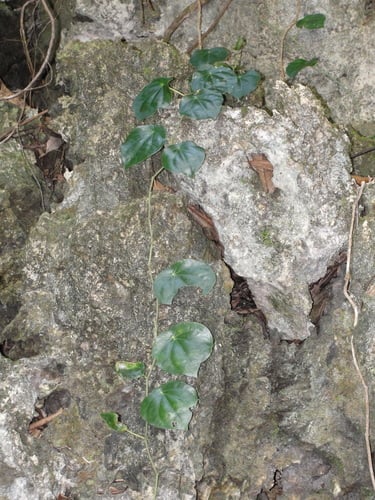
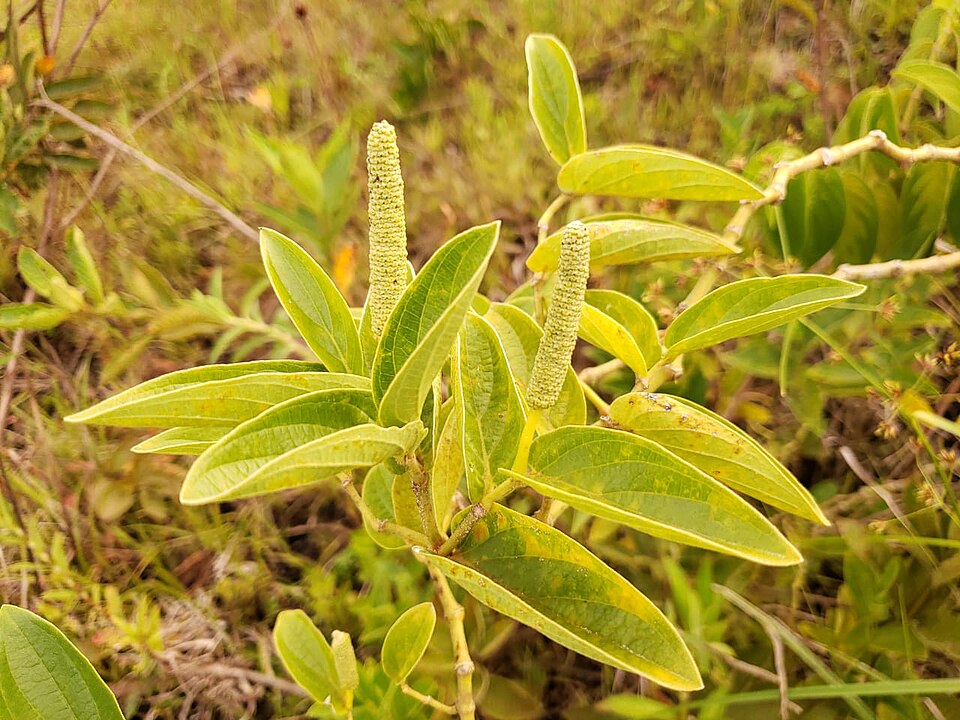
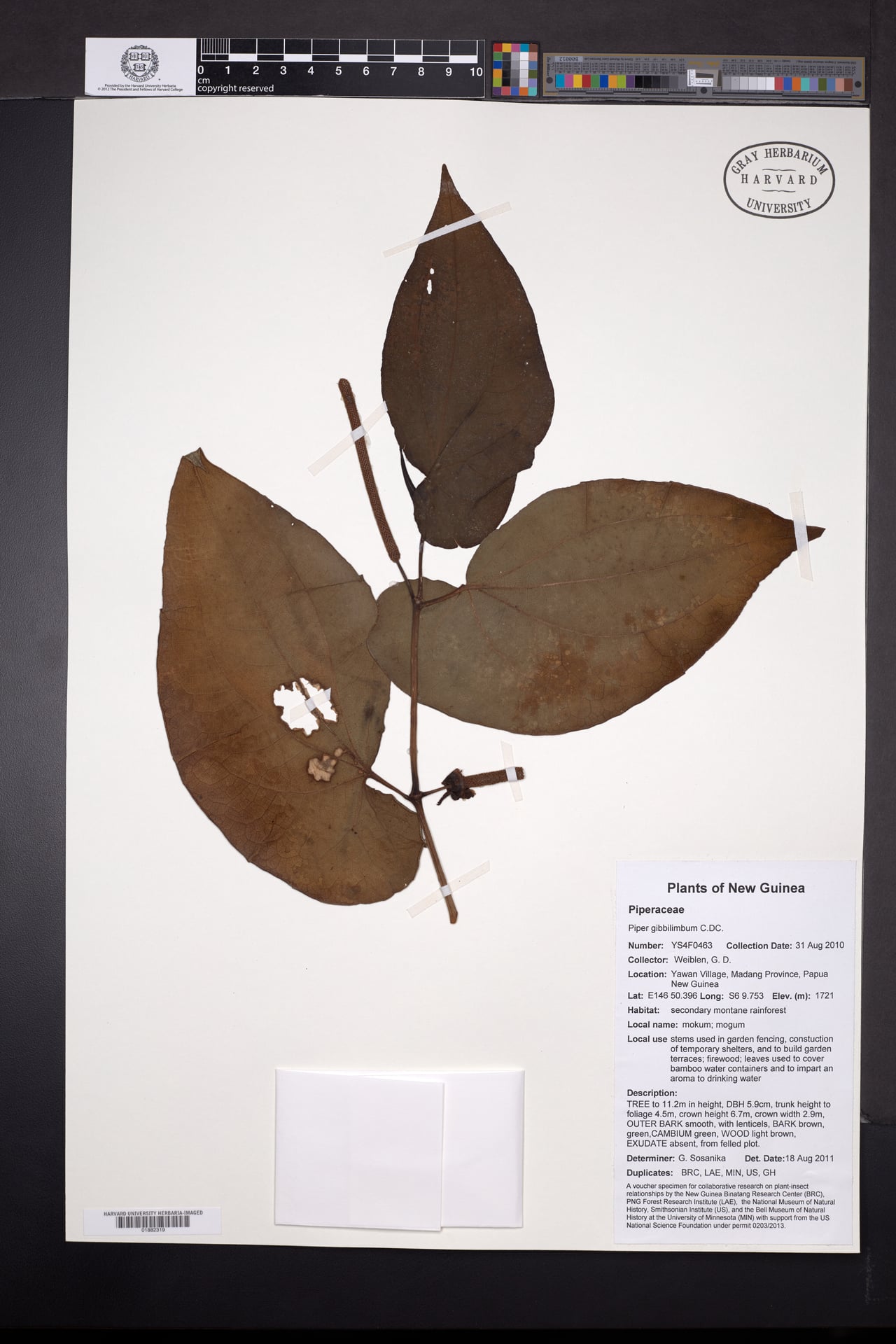
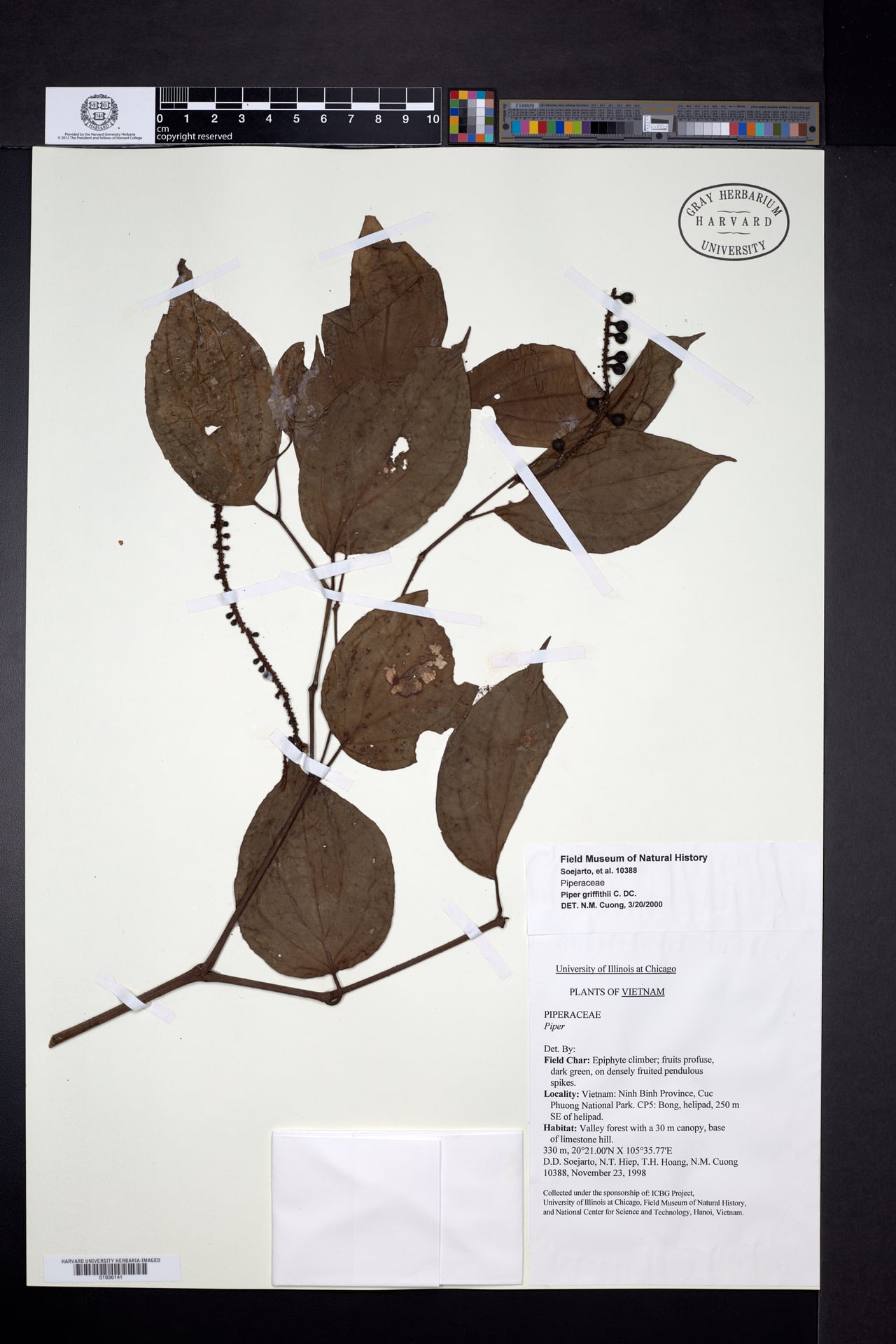
A woody vine which attaches to trees by roots at the nodes on the main vine. The vegetative branches form roots at the nodes but the fruiting branches do not. The stems are 2.5-5 mm thick. The leaf stalk is 2-5 cm long. It has a fine powdery covering. The leaves can be 7-15 cm long and 5-11 cm wide. The leaves are papery or slightly leathery. The flowers are separately male and female. Male spikes are thinner and longer than female. The spikes droop. The fruit is composed of fused parts making a compound fruit.
Edible Uses
Betel leaves are the central ingredient in a widely used masticatory chewed after meals as a gentle stimulant and breath freshener. The composition of the betel quid varies considerably by country and region, but the three core ingredients are typically the betel leaf, the seed ('nut') of the areca palm (Areca catechu), and lime produced by burning seashells or limestone slabs. In the Moluccas and parts of Papua New Guinea, the betel leaf is replaced by the inflorescence of Piper siriboa. Additional ingredients may include gambier (Uncaria gambir), tobacco, palm sugar, and spices such as cardamom (Elettaria cardamomum) and clove (Syzygium aromaticum). The different combinations produce a wide range of flavours. Chewing the quid discolours the teeth and stains saliva, mouth, and lips red, and causes copious salivation requiring frequent spitting. Chewing betel quids can lead to cancers of the mouth and tongue.
Traditional Uses
It is used as a masticatory with betel nut. The leaves and /or fruit are used. Lime is added to make the mixture more alkaline so that the chemical constituents are activated. The fresh leaves are used to flavour Chinese dishes and soups.
Medicinal Uses
The leaves, roots, and seeds are all used medicinally across Asia. The leaves are anthelmintic, antibacterial, antifungal, antiseptic, aphrodisiac, astringent, carminative, expectorant, galactofuge, laxative, sialagogue, stimulant, stomachic, and tonic. Leaf preparations and leaf sap are applied to wounds, ulcers, boils, and bruises. Heated leaves are used as a poultice on the chest to treat coughs and asthma, on the breasts to stop milk secretion, and on the abdomen to relieve constipation. The leaves treat nosebleeds and ulceration of the nose, gums, and mucous membranes; leaf extract is applied to ear wounds; and a leaf infusion is used as an eyewash. A decoction of the leaves is used in postnatal bathing or drunk to reduce unpleasant body odour. The essential oil from the leaves is antibacterial and antifungal, has shown anthelmintic activity against tapeworms and hookworms, and has been used to treat conditions of the mucous membranes of the nose, throat, and respiratory organs.
Known Hazards
Chewing betel quids can lead to cancers in the mouth and on the tongue.
Distribution
A tropical plant. It occurs in the lowlands and up to about 700 m altitude. It needs a reasonably good rainfall. In the Cairns Botanical Gardens. It suits hardiness zones 10-12. At MARDI.
Where It Grows
Africa, Andamans, Asia, Australia, Bangladesh, Bougainville, Cambodia, China, Cuba, East Africa, East Timor, Fiji, Guam, Hawaii, Himalayas, India, Indochina, Indonesia, Laos, Madagascar, Malawi, Malaysia*, Maldives, Mariana Islands, Micronesia, Myanmar, Northeastern India, Pacific, Pakistan, Palau, Papua New Guinea, PNG, Philippines, SE Asia, Solomon Islands, Sri Lanka, Thailand, Timor-Leste, USA, Vietnam, West Africa, West Indies, West Timor, Yap,
Cultivation
Betel pepper is a plant of lowland tropical areas, usually at elevations below 900 metres. It prefers growing in areas where the mean annual temperature falls within 22 - 27°c but can tolerate 17 - 31°c. It thrives under per-humid forest conditions with high relative humidity and an ample supply of soil moisture. It flourishes in areas with a mean annual rainfall of 2,250 - 4,750mm. It prefers a position in the shade and also needs protection from the wind. It prefers a deep, well-drained, friable loamy and clayey soil, rich in organic matter and with a pH of about 7 - 7.5. It prefers a pH in the range 5 - 5.6 but tolerates 4.3 - 6.8. Waterlogged, saline and alkali soils ( clay soils with high pH (> 8.5), a poor soil structure and a low infiltration capacity.) are unsuitable for its cultivation. Young plants grow quickly and, under favourable conditions, can commence being harvested when only 18 months old. Grown under suitable conditions, they usually have larger and less pungent leaves. Each vine is picked 3 - 4 (occasionally 5) times a year. Leaves are traditionally plucked early in the morning by cutting the petiole with a sharpened steel thumbnail. They should be kept out of the sun to preserve their aroma. Other factors determining chewing quality are cultivar, leaf position and plant age. The best leaves are large, yellow and grow on the upper lateral branches. In Malaysia, leaves on the lower lateral branches are regarded as medicinal and are used in preparations applied on ulcers and wounds. Annual yields are estimated at 6 - 10 tonnes per hectare; each vine yields 40 - 50 leaves per year. When a vine becomes 2 metres long, it produces smaller and poorer quality leaves, so it must be rejuvenated by cutting back. Regular rejuvenation is achieved by taking the vines off their supports and burying the lower part of the soil. New roots form and the vigorous new sprouts are trained along supports. The life of a plantation may vary considerably: from 3 - 4 years in temporary gardens to 30 - 50 years in permanent ones. Although only known from cultivation, betel pepper is a very variable species. Numerous cultivars exist with leaves differing in size, shape and colour, softness, pungency, aroma and bleaching response. In Indonesia and Malaysia, some cultivars have a clove-like flavour. In India, five cultivars are known, differing in morphology and essential-oil composition. Closely related species, which are also only known from cultivation, are Piper siriboa and Piper chuvya. Betel pepper needs support for its growth, which may be provided by trees, bamboo, wooden poles or concrete pillars. A dioecious species - both male and female forms need to be grown if fruit and seed are required.
Propagation
Propagate by seed or by cuttings 30–45cm long taken from the tips of vertical shoots. Cuttings typically have 3–5 nodes and are planted with the lowest two nodes buried in the soil. They can be started in nurseries or planted directly in the field, placed close together in pits or along long mounds. Once cuttings begin to sprout and creep, they are tied to a support.
Other Uses
The plant is intercropped with coconut palm and areca palm. The primary use of the leaf beyond food is as a wrapper for chewing areca nut or tobacco, where it mainly contributes flavour. A yellowish-brown essential oil obtained from the leaves has an aromatic odour resembling creosote and tea, with a burning, sharp flavour. Key constituents include the phenols eugenol, chavicol, methyl chavicol (estragol), and chavibetol (betelphenol, an isomer of eugenol), though the oil's composition varies considerably between cultivars. Leaves from the upper parts of the plant contain more essential oil than those from the lower parts. In India and Sri Lanka, a bundle of betel leaves is traditionally offered as a mark of respect and to signify auspicious occasions, including greeting elders at weddings, celebrating the New Year, and making payment to physicians and astrologers.
Production
Plants can last for 10-12 years.
Other Information
A common and important condiment in the lowlands on Papua New Guinea and the SE Asian region. Leaves are sold in local markets. It is cultivated.
Notes
There are between 1000-2000 Piper species. They are mostly in the tropics. It has 7.6 mg per 100 g dry weight and 4.3 mg fresh weight of alpha-tocopherol (Vitamin E).
Nutrition
| Part | Moisture | kJ | kcal | Protein | Vit A | Vit C | Iron | Zinc |
|---|---|---|---|---|---|---|---|---|
| Leaves | 81.9 | 203 | 49 | 6.4 | 59 | — | — | — |
Synonyms
Also Known As
Akabui, Amasi katu, Fa qie wei niu, Gabuuy, Hirata, Igisi, Kata, Kebui, Kubaha, Kun, Kun-ywet-pin, Kura, Lou ye, Loupita, Manavasa, Mithi, Nagavalli, Nagurvel, Nup, Ofa, Ofa, Paan, Pan, Pan pata, Panpatta, Pathi, Pita, Plobo, Pupulu, Sanga, Sarapa, Sirih, Sla-tympew, Tamalapaku, Tambula, Tambuli, Trau khong, Vettila, Vettilai, Videchapana, Vilayadele, Vuvulu
References (44)
- Ambasta, S.P. (Ed.), 2000, The Useful Plants of India. CSIR India. p 459
- Arora, K., Indigenous Forest Management in the Andaman and Nicobar Islands, India.
- Bodkin, F., 1991, Encyclopedia Botanica. Cornstalk publishing, p 803
- Bodner, C. C. and Gereau, R. E., 1988, A Contribution to Bontoc Ethnobotany. Economic Botany, 43(2): 307-369
- Borrell, O.W., 1989, An Annotated Checklist of the Flora of Kairiru Island, New Guinea. Marcellin College, Victoria Australia. p 118
Show all 44 references Hide references
- Bremness, L., 1994, Herbs. Collins Eyewitness Handbooks. Harper Collins. p 283
- Burkill, H. M., 1985, The useful plants of west tropical Africa, Vol. 4. Kew.
- Burkill, I.H., 1966, A Dictionary of the Economic Products of the Malay Peninsula. Ministry of Agriculture and Cooperatives, Kuala Lumpur, Malaysia. Vol 2 (I-Z) p 1767
- Ching, L. S. & Mohamed, S., 2001, Alpha-Tocopherol Content in 62 Edible Tropical Plants. J. Agric. Food Chem. 2001, 49, 3101−3105
- Cowie, I, 2006, A Survey of Flora and vegetation of the proposed Jaco-Tutuala-Lore National Park. Timor-Lests (East Timor) www.territorystories.nt/gov.au p 52
- Cundall, P., (ed.), 2004, Gardening Australia: flora: the gardener's bible. ABC Books. p 1052
- Facciola, S., 1998, Cornucopia 2: a Source Book of Edible Plants. Kampong Publications, p 171
- French, B.R., 1986, Food Plants of Papua New Guinea, A Compendium. Asia Pacific Science Foundation p 373
- French, B.R., 2010, Food Plants of Solomon Islands. A Compendium. Food Plants International Inc. p 364
- Ghosh, A, 2014, Survey of Ethno-medicinal Climbing plants in Andaman and Nicobar Islands, India. Int. J. of Pharm. Life Sci. 5(7): July, 2014:3671-3677
- Hedrick, U.P., 1919, (Ed.), Sturtevant's edible plants of the world. p 499
- Henderson, C.P. and I.R.Hancock, 1988, A Guide to the Useful Plants of the Solomon Islands. Res. Dept. Min of Ag. & Lands. Honiara, Solomon Islands. p 146
- Heywood, V.H., Brummitt, R.K., Culham, A., and Seberg, O., 2007, Flowering Plant Families of the World. Royal Botanical Gardens, Kew. p 256
- Hibbert, M., 2002, The Aussie Plant Finder 2002, Florilegium. p 235
- Hu, Shiu-ying, 2005, Food Plants of China. The Chinese University Press. p 333
- Jacquat, C., 1990, Plants from the Markets of Thailand. D.K. Book House p 62
- Luo, B., et al, 2019, Wild edible plants collected by Hani from terraced rice paddy agroecosystem in Honghe Prefecture, Yunnan, China. Journal of Ethnobiology and Ethnomedicine 15:56
- Martin, F.W. & Ruberte, R.M., 1979, Edible Leaves of the Tropics. Antillian College Press, Mayaguez, Puerto Rico. p 212
- Medhi, P. & Borthakur, S. K., 2012, Phytoresources from North Cachur Hills of Assam -3: Edible plants sold at Hflong market. Indian Journal or Natural Products and Resources. 3(1) pp 84-109
- Murtem, G. & Chaudhrey, P., 2016, An ethnobotanical note on wild edible plants of Upper Eastern Himalaya, India. Brazilian Journal of Biological Sciences, 2016, v. 3, no. 5, p. 63-81
- Partha, P., 2014, Ethnobotany of the Laleng (Patra) Community in Bangladesh. Journal of Pharmacognosy and Phytochemistry. 2(6):173-184
- Peekel, P.G., 1984, (Translation E.E.Henty), Flora of the Bismarck Archipelago for Naturalists, Division of Botany, Lae, PNG. p 124, 126
- Peter, K. V. (Ed.), 2004, Handbook of Herbs and Spices Vol. 2 Woodhead Publishing and CRC Press.
- Pham-Hoang Ho, 1999, An Illustrated Flora of Vietnam. Nha Xuat Ban Tre. p 291
- Phawa, G. M., Dkhar, E. K. & Marbaniang, D., 2019, Indigenous Wild Edible Plants of Bataw Village, East Jaintia Hills District, Meghalaya. International Journal of Arts, Science and Humanities. 7(2)
- Phon, P., 2000, Plants used in Cambodia. © Pauline Dy Phon, Phnom Penh, Cambodia. p 501
- Purseglove, J.W., 1968, Tropical Crops Dicotyledons, Longmans. p 437
- Rashid, H. E., 1977, Geography of Bangladesh. Westview. p 306
- Recher, P, 2001, Fruit Spirit Botanical Gardens Plant Index. www.nrg.com.au/~recher/ seedlist.html p 3
- Sawian, J. T., et al, 2007, Wild edible plants of Meghalaya, North-east India. Natural Product Radiance Vol. 6(5): p 420
- Smith, A.C., 1981, Flora Vitiensis Nova, Lawaii, Kuai, Hawaii, Volume 2 p 60
- Solomon, C., 2001, Encyclopedia of Asian Food. New Holland. p 38
- Sp. pl. 1:28. 1753
- Sukarya, D. G., (Ed.) 2013, 3,500 Plant Species of the Botanic Gardens of Indonesia. LIPI p 954
- Tseng Yung-chien, Xia Nianhe, Gilbert, M.G., Piperaceae. Flora of China.
- Williams, C.N., Chew, W.Y., and Rajartnam, J.A., 1989, Tree and Field Crops of the Wetter Regions of the Tropics. Longman, p 77
- Williamson, J., 2005, Useful Plants of Malawi. 3rd. Edition. Mdadzi Book Trust. p 201
- World Checklist of Useful Plant Species 2020. Royal Botanic Gardens, Kew
- Zeven, A. C. & de West, J. M. J., 1982, Dictionary of cultivated plants and their regions of diversity. Wageningen. p 62