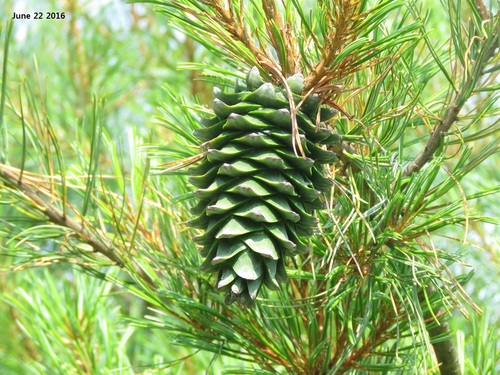
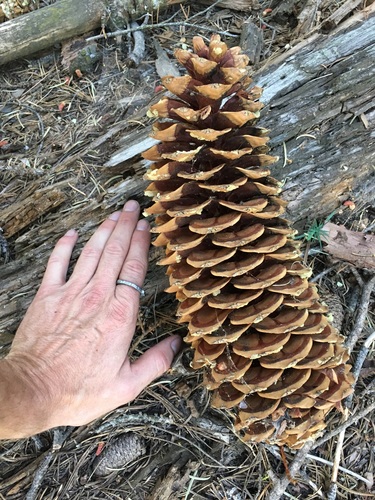
Pinus nelsonii
G. R. Shaw
Nelson pinyon pine
iNaturalist· cc-by-nc
(c) CARLOS VELAZCO, some rights reserved (CC BY-NC), uploaded by CARLOS VELAZCO
iNaturalist· cc-by-nc
(c) CARLOS VELAZCO, some rights reserved (CC BY-NC)
iNaturalist· cc-by-sa
(c) Juan Cruzado Cortés, some rights reserved (CC BY-SA), uploaded by Juan Cruzado Cortés
Summary
Source: WikipediaPinus nelsonii, Nelson's pinyon, is a species of pine native to the mountains of northeastern Mexico, in Nuevo León, San Luis Potosí and Tamaulipas at 1,800–3,200 m altitude.
Description
Evergreen tree growing to 9m tall. Monoecious, wind-pollinated, not self-fertile. Evergreen foliage; seeds ripen in October. Tolerates light sandy and medium loamy well-drained soils, nutritionally poor conditions, mildly acidic, neutral, and very acidic soils. Requires full sun and grows in dry or moist conditions with drought tolerance.
Edible Uses
The seeds can be eaten raw or cooked. They are oil-rich with a lightly resinous flavour, and are fairly large at around 10mm x 8mm. A vanillin flavouring is also obtained as a by-product of resins released from the pulpwood.
Medicinal Uses
Turpentine from pine resin is antiseptic, diuretic, rubefacient, and vermifuge. Taken internally, it treats kidney and bladder complaints, and is used both internally and as a rub or steam bath for rheumatic conditions. It supports the respiratory system and is useful for mucous membrane diseases, coughs, colds, influenza, and TB. Externally it treats skin complaints, wounds, sores, burns, and boils, applied as liniment plasters, poultices, herbal steam baths, and inhalers.
Known Hazards
The wood, sawdust and resins from various species of pine can cause dermatitis in sensitive people.
Distribution
It is a subtropical plant.
Where It Grows
Central America, Mexico, North America, USA,
Cultivation
Thrives in a light well-drained sandy or gravelly loam. Dislikes poorly drained moorland soils. Established plants tolerate drought and are very resistant to maritime exposure. This species is not hardy in the colder areas of the country, it tolerates temperatures down to between -5 and -10°c. Only one specimen of this genus is known to be growing in Britain. Planted at Kew in 1910, it was 10 metres tall in 1969. The plants often develop as multi-stemmed shrubs. The cones open and shed their seed whilst still attached to the tree. Plants are strongly outbreeding, self-fertilized seed usually grows poorly. They hybridize freely with other members of this genus. Leaf secretions inhibit the germination of seeds, thereby reducing the amount of plants that can grow beneath the tree. Plants in this genus are notably susceptible to honey fungus.
Propagation
Sow seed in individual pots in a cold frame as soon as it is ripe, or in late winter if not. Stored seed benefits from 6 weeks of cold stratification at 4°c to improve germination. Move seedlings to their permanent positions as soon as possible and protect them for the first winter or two. The root system is very sparse, so early planting is essential for good establishment. Plant trees when small — between 30 and 90cm, ideally around 5–10cm tall — with a thorough weed-excluding mulch. Larger transplants check badly, barely growing for several years, and develop poor root systems and wind resistance. Cuttings are only viable from trees under 10 years old, using single leaf fascicles with the base of the short shoot. Disbudding a few weeks before taking cuttings can help, though cuttings are typically slow to establish.
Other Uses
A tan or green dye comes from the needles. The needles release terpene when rained on, which negatively affects germination of some plants including wheat. Oleo-resins are extracted by tapping the trunk or by destructive distillation of the wood; warmer-region trees tend to yield more. Turpentine makes up around 20% of the oleo-resin and is separated by distillation, used as a solvent for waxes, in varnish-making, and medicinally. Rosin, the residue after turpentine removal, is used on violin bows and in sealing wax and varnish. Pitch from the resin is used for waterproofing and as a wood preservative.
Other Information
The seeds are sold in local markets.
Notes
There are over 100 species of Pinus.
Also Known As
Nelson pine, Pino pinonero, Pinon duro
References (11)
- Ciesla, W.M., 1998, Non-wood forest products from conifers. Non-wood forest products 12, FAO, Rome, p 73
- Farjon, A., and Styles, B. T., 1997, Pinus (Pinaceae): Flora Neotropica, Vol. 75, pp. 1-291
- Glowinski, L., 1999, The Complete Book of Fruit Growing in Australia. Lothian. p 134
- Grandtner, M. M., 2008, World Dictionary of Trees. Wood and Forest Science Department. Laval University, Quebec, Qc Canada. (Internet database http://www.wdt.qc.ca)
- Kermath, B. M., et al, 2014, Food Plants in the Americas: A survey of the domesticated, cultivated and wild plants used for Human food in North, Central and South America and the Caribbean. On line draft. p 661
Show all 11 references Hide references
- Mapes, C. & Basurto, F., 2016, Biodiversity and Edible Plants of Mexico. Chapter 5 in R. Lira, et al. (eds.), Ethnobotany of Mexico, Ethnobiology, Springer. p 91
- Piedra-Malagón, E. M., et al, 2022, Edible native plants of the Gulf of Mexico Province. Biodiversity Data Journal 10: e80565 p 27
- Plants for a Future database, The Field, Penpol, Lostwithiel, Cornwall, PL22 0NG, UK. http://www.scs.leeds.ac.uk/pfaf/
- Segura, S., et al, 2018, The edible fruit species in Mexico. Genet Resour Crop Evol (2018) 65:1767–1793
- Wickens, G.E., 1995, Edible Nuts. FAO Non-wood forest products. FAO, Rome. p176
- World Checklist of Useful Plant Species 2020. Royal Botanic Gardens, Kew