Pinus kesiya
Royle ex Gordon
Khasi pine, Three-needled pine
iNaturalist· cc-by-nc
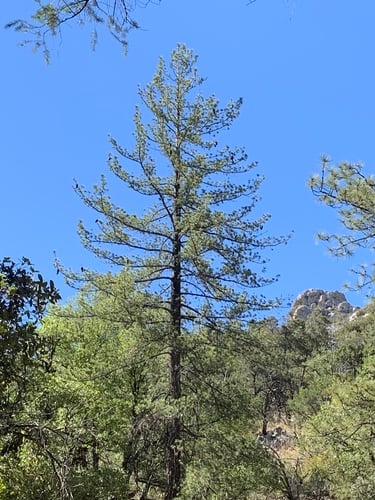
(c) canyonkid91, some rights reserved (CC BY-NC), uploaded by canyonkid91
iNaturalist· cc-by-nc
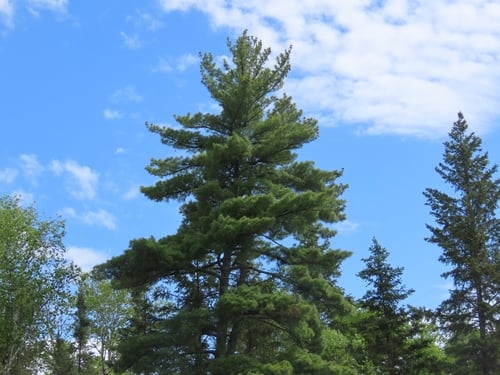
(c) Liselle Santos, some rights reserved (CC BY-NC), uploaded by Liselle Santos
iNaturalist· cc-by-nc
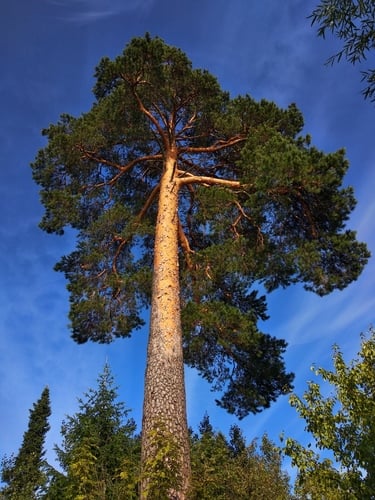
(c) José Ignacio Márquez Corro, some rights reserved (CC BY-NC), uploaded by José Ignacio Márquez Corro
Summary
Source: WikipediaPinus kesiya (Khasi pine or Benguet pine) is one of the most widely distributed pines in southeast Asia. Its range extends south and east from the Khasi Hills in the northeast Indian state of Meghalaya, to Burma, northern Thailand, Cambodia, Laos, southernmost China, Vietnam, and the Philippines. It is an important plantation species elsewhere in the world, including in southern Africa and South America. The common name "Khasi pine" is from the Khasi hills in India, and "Benguet pine" is from the landlocked province of Benguet in Luzon, Philippines, where it is the dominant species of the Luzon tropical pine forests (known as saleng in Ilocano). The Benguet pine is sometimes treated as a separate species, Pinus insularis; however, the current opinion is to treat this as conspecific with P. kesiya var. langbianensis. The city of Baguio is nicknamed "The City of Pines", as it is noted for large stands of this tree.
Description
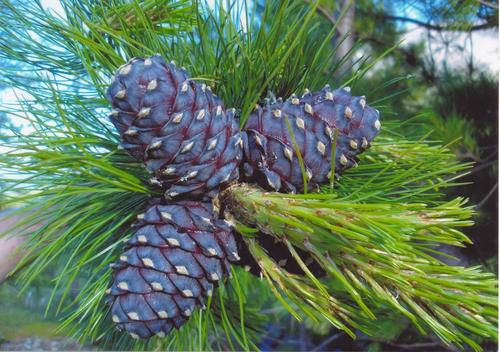
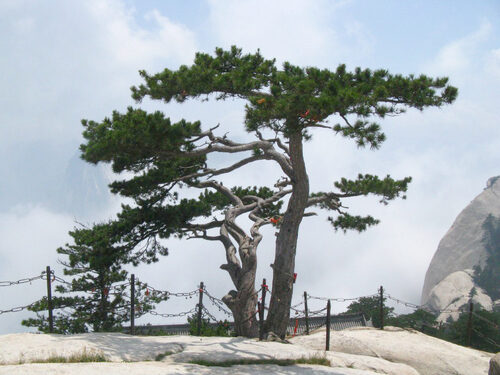
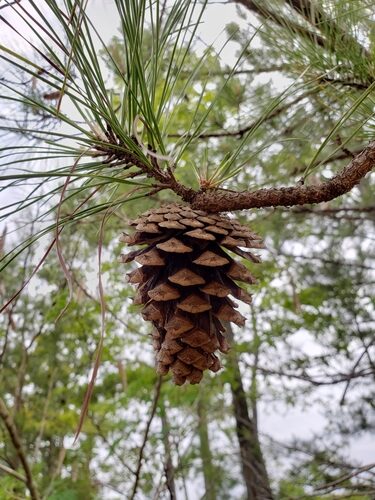
A tree. It grows 30-35 m tall. The trunk is straight. It can be 1 m across. The bark is thick and brown. The branches are horizontal or drooping. The leaves are needle-like are dark green with 3 in a group. They are 15-20 cm long. The cones are oval and 5-9 cm long. The seeds are 6-7 mm long. Cones mature after 18-20 months.
Edible Uses
The seeds of all Pinus species are more or less edible, and some are of good size and make very tasty and nutritious foods, often eaten in quantitiy. Others can be less desireable, either having a strongly resinous flavour, being bitter or, more commonly, rather too small and fiddly to make it very worthwhle even trying to eat them, We have no specific information of the desireability of this species, though they are rather small (the size given includes the shell). A vanillin flavouring is obtained as a by-product of other resins that are released from the pulpwood.
Traditional Uses
An extract from the resin has a vanilla flavouring.
This uses section is brief — help expand it
Medicinal Uses
Oil of turpentine, obtained from the oleo-resin of all pine trees, is antiseptic, antispasmodic, astringent, diuretic, rubefacient, stimulant and vermifuge. It is a valuable remedy used internally in the treatment of kidney and bladder complaints and is used both internally and as a rub and steam bath in the treatment of rheumatic affections. It is also very beneficial to the respiratory system and so is useful in treating diseases of the mucous membranes and respiratory complaints such as coughs, colds, influenza and TB. Applied externally in the form of liniment plasters, poultices, herbal steam baths and inhalers, it is a very beneficial treatment for a variety of skin complaints, wounds, sores, burns, boils etc.
Known Hazards
The wood, sawdust and resins from various species of pine can cause dermatitis in sensitive people.
Distribution
It is a subtropical plant. It grows between 300-2,700 m above sea level. In Yunnan.
Where It Grows
Africa, Asia*, Cambodia, China, Colombia, India, Indonesia, Laos, Madagascar, Myanmar, Philippines, SE Asia, South America, Thailand, Tibet, Vietnam,
Cultivation
A plant of the moist tropics and subtropics, where it is found at elevations from 300 - 2,700 metres. Very adaptable to different ecological conditions, though it does not grow well in tropical lowlands. It is found naturally in areas where the mean annual rainfall is in the range 700 - 1,800mm, with a pronounced dry season, and the mean annual temperature is 17 - 22°c, with a mean maximum temperature of the hottest month of 26 - 30°c and a mean minimum temperature of the coldest month of 10 - 18°c. Most provenances can tolerate some frost. A strongly light-demanding plant. Occurs on a variety of soil types from sandy to clay, but seemingly with preference for poor well-drained soil. In the Philippines it is also found on limestone soil. Prefers a pH in the range 4.5 - 5.5, tolerating 3.5 - 6.5. Established plants are fairly drought tolerant. Since it rapidly colonizes degraded areas, khasi pine may become invasive when introduced. Although trees are quite slow-growing for their first 5 years, they then become a fairly fast-growing species. 38-year-old trees in Madagascar were 46 metres tall. Tapping the trees for resin can commence 15 years after the trees have been planted out. Seedling trees begin producing male strobili when aged 9 - 11 years, whilst females are often produced 1 - 2 years later. Cone bearing age begins at 13 - 15 years. In Sumatra, ripe seeds are produced most abundantly between July and November, but viable seeds are produced throughout the year. Field planting is carried out at a spacing of 4 x 4 metres (for resin production) or 3 x 1 - 2 metres (for timber production). Weeding is necessary for about 3 years until the canopy has completely overtopped the grasses. This species requires more weeding than Pinus caribaea and Pinus oocarpa. In Thailand weeding in Pinus kesiya plantations is carried out 4 times a year. Plants are quite fire resistant. Plants in this genus are notably susceptible to honey fungus.
Propagation
Seed - some highland provenances have a slight temperature dormancy, and it is recommended to cool down imbibed seed for 2 - 3 weeks in a refrigerator before sowing. Pre-soaking the seed in warm water at 40 - 50°c, then cooling it down for a night enhances germination. Sowing in sand in a seedbed and transplanting into polythene tubes is most common. Germination is quite fast for pre-treated seed - usually 5 - 20 days. Time in the nursery is 6 months to 1 year, planting out when the plants are 14 - 20 cm tall. Seedlings may already be suitable for transplanting after 4 - 6 months. Successful natural regeneration is only possible where a relatively large amount of sunlight reaches the ground. The seeds can be stored for several years, provided they are kept dry, cold and in an airtight container. Air-layering. Top cleft grafting. Mass propagation by rooting cuttings from hedged orchards is technically possible but not yet operational on a large scale.
Other Uses
A tan or green dye is obtained from the needles. An oleoresin of good quality is obtained from the trees, though yields are often low. The resin is obtained by tapping the trunk, or by destructive distillation of the wood. The oleoresin is distilled to give turpentine and rosin. Oil of Turpentine consists of an average of 20% of the oleo-resin. It has a wide range of uses including as a solvent for waxes etc, for thinning and dissolving varnish and paints, a shoe polish, medicinal etc. Rosin is used in paper glue and soap manufacturing, as a constituent of varnishes and paints, and for coating the bows of stringed musical instruments such as violins. Pitch can also be obtained from the resin and is used for waterproofing, as a wood preservative etc. Old and slow growing trees often develop a red heartwood. This can be chipped and used as torches. The heartwood is red-yellow to red-brown, darkening upon exposure; it is usually clearly demarcated from the 35 - 50mm wide band of pale yellow sapwood. The wood contains numerous resin canals, often visible as straight brown scratches on longitudinal surfaces. The texture is medium to fairly coarse and uneven; the grain straight; growth rings are distinct. The wood is light to moderately heavy; soft; not very durble. It seasons quickly with very little risk of checking or distortion; once dry it is moderately stable in service. It saws easily and can be worked to a smooth surface with all tools, but the high resin content may cause dulling of tool edges; nailing and screwing properties are good; gluing is correct; the wood takes paints and varnishes well. It is easy to cut into smooth, tight veneer. The wood is used as a general purpose, softwood timber for construction, furniture, boxes, flooring, joinery, poles, mine props etc. It is also suitable for ship and boat building, agricultural implements, turnery, veneer, plywood and railway sleepers. The wood is used for the manufacture of particle board and pulp, but its usefulness depends on the quality of the wood. The wood is used as fuel wood, for the production of charcoal and for torches. A pioneer species, its natural range is extended by colonization following disturbances such as fire. It grows, for instance, scattered in fire-prone grassland and woodland. The trees are increasing in number in recently disturbed areas. This species is the preferred species for reforestation on highland sites in Thailand. The tree is recommended as a shade tree for coffee plantations. It is planted at a spacing of 3 x 3 metres and, after 5 - 7 years when the pines have reached a height of at least 4 metres, young coffee is planted. The needles contain a substance called terpene, this is released when rain washes over the needles and it has a negative effect on the germination of some plants, including wheat.
Production
It is fast growing. Plants can be tapped for resin after 15 years.
Synonyms
References (5)
- Encyclopedia of Life.
- Roa, J. A. G. & Boada, D. S. G., 2018, Fundación para el Fortalecimiento de la Fruticultura y Plantas Alimenticias no Convencionales en Colombia.
- Useful Tropical Plants.
- Wikipedia
- World Checklist of Useful Plant Species 2020. Royal Botanic Gardens, Kew