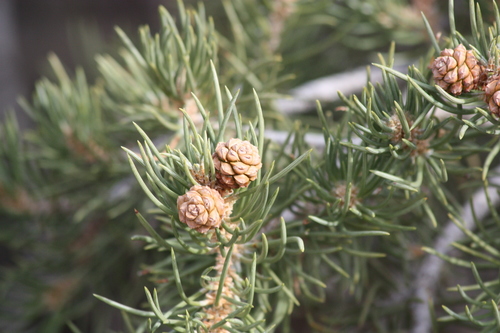
Pinus monticola
Douglas ex D. Don
Western Mountain Pine, Mountain white pine
iNaturalist· cc-by-nc
(c) Milli Vedder, some rights reserved (CC BY-NC), uploaded by Milli Vedder
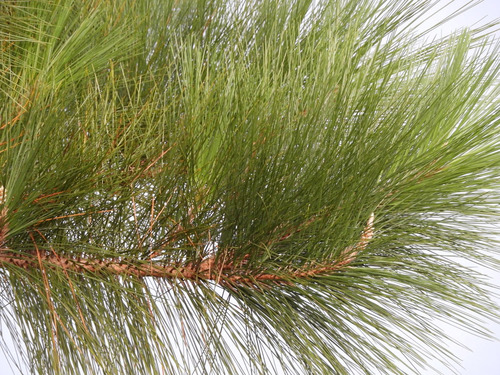
iNaturalist· cc-by-nc
(c) Chauncey, some rights reserved (CC BY-NC)
Summary
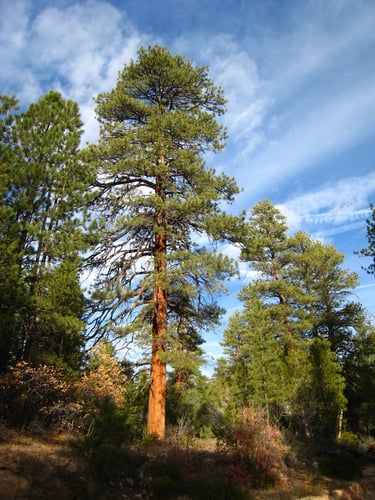
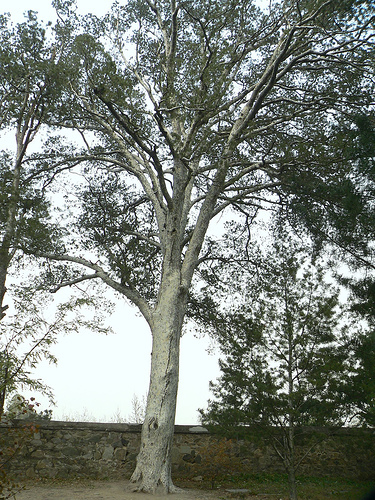
Source: WikipediaA tall evergreen tree reaching 60m, growing at a fast rate. Hardy to UK zone 4. Wind-pollinated; monoecious but not self-fertile. Seeds ripen in October. Prefers light sandy or medium loamy, well-drained soils with mildly acidic to neutral pH. Tolerates poor soils, full sun requirement, and drought. Withstands strong winds but not maritime exposure.
Description
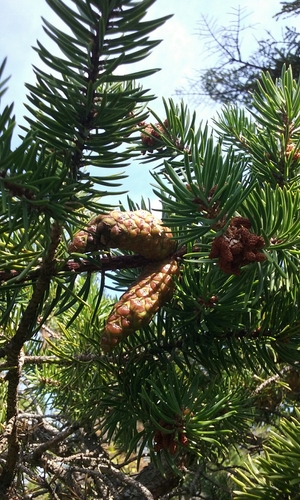
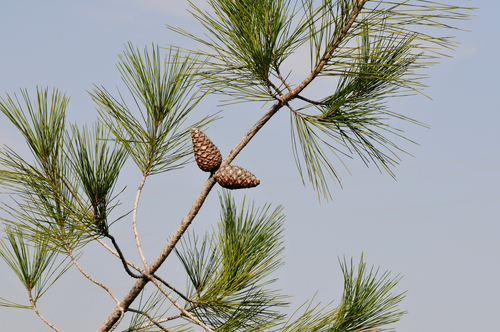
A soft pine. It can grow to a very large tree. It can be 50 m high and with a trunk 150 cm across. The leaves are needle like and evergreen. They stay on the tree fro 3-4 years. They are in bundles of 5 and are 5-10 cm long. They are slender and straight and triangular in cross section. They are soft and flexible and bluish green with lines of white dots. The edges are finely toothed. The seed cones are cylindrical and 10-30 cm long. They are slightly curved and hang down. There are 90-160 scales. These curve back when dry and do not have prickles. Soon after the cones mature, seeds are shed. Seed are brown and mottled. They are 5-7 mm long and with wings 18-26 mm long.
Edible Uses
The oil-rich seeds can be eaten raw or cooked, carrying a resinous flavour. They are small — around 5mm long, though some reach up to 9mm. A gummy exudation from the stem is chewable as a gum. The inner bark is edible raw or cooked; dried and ground into a powder, it works as a thickener in soups or can be mixed into flour when baking bread. Roasted young cones are also edible. A vanillin flavouring is obtained as a by-product of resins released from the pulpwood.
Traditional Uses
Occasionally slices of green cones are chewed. The seeds from partially roasted cones are eaten. The inner soft layer (cambium) between the wood and bark is eaten. A tea drink can be made by steeping the leaves in water. Caution: The tea should not be drunk in large amounts. It should not be drunk by pregnant women.
Medicinal Uses
Turpentine from the resin is antiseptic, diuretic, rubefacient, and vermifuge. Taken internally, it treats kidney and bladder complaints, and is used both internally and as a rub or steam bath for rheumatic conditions. It benefits the respiratory system and helps with mucous membrane diseases, coughs, colds, influenza, and TB. Externally it treats skin complaints, wounds, sores, burns, and boils, applied as liniment plasters, poultices, herbal steam baths, and inhalers. A bark infusion has been used as a blood purifier and for stomach disorders and tuberculosis. A bark decoction serves as a wash for cuts and sores. A decoction of young shoots can be used as a soak for rheumatism.
Known Hazards
The wood, sawdust and resins from various species of pine can cause dermatitis in sensitive people.
Distribution
It is a temperate plant. They will grow on a variety of sites from peat bogs to dry sandy soils. They do best in moist valleys and on gentle slopes. The can tolerate some shade. It will grow at low elevations in Canada. It suits hardiness zones 4-9.
Where It Grows
Australia, Canada, North America, USA,
Cultivation
Thrives in a light well-drained sandy or gravelly loam in a sunny position. Dislikes poorly drained moorland soils. Established plants tolerate drought. A fast growing tree, capable of sustaining growth of 75cm per year over a long period of time even when in an unfavourable site. This species establishes very well on severely altered sites such as after a forest fire. Trees on a site 300m above sea level in N. Wales have grown exceptionally well. Girth increases of up to 4cm a year have been recorded. Trees take 30 - 40 years before they produce reliable crops of seeds. Good crops are produced every 2 - 4 years in the wild, with little seed in the intervening years. The cones are 12 - 27cm long and take 2 years to mature, they open and shed their seed in late summer and early autumn whilst still attached to the tree. Very susceptible to 'white pine blister rust' this tree should not be planted near Ribes species (currants and gooseberries) because they can transmit the rust(1, 11, 120). Most of the older trees in this country have been killed by the rust. However, it seems that infection only occurs when the trees are young in this country and new plantings in areas isolated from species of Ribes are being made. Plants are also subject to damage by aphis. Trees have a thin bark, which makes them susceptible to forest fires. Plants are strongly outbreeding, self-fertilized seed usually grows poorly. They hybridize freely with other members of this genus. Leaf secretions inhibit the germination of seeds, thereby reducing the amount of plants that can grow beneath the tree. Plants in this genus are notably susceptible to honey fungus.
Propagation
Sow seed in individual pots in a cold frame as soon as it is ripe, or in late winter if not. Stored seed benefits from 6 weeks of cold stratification at 4°c to improve germination. Seedlings should be moved to their permanent positions as soon as possible and protected for the first winter or two. Because the root system is very sparse, early planting is important for good establishment. Plant trees when small — between 30 and 90cm, ideally around 5–10cm tall — with a thorough weed-excluding mulch. Larger transplants check badly, barely growing for several years, and suffer poor root development and wind resistance. Cuttings are only viable from trees under 10 years old, using single leaf fascicles with the base of the short shoot. Disbudding shoots a few weeks before taking cuttings can help, though cuttings are typically slow to establish.
Other Uses
A tan or green dye comes from the needles. The needles release terpene when rained on, which inhibits germination of some plants including wheat. Oleo-resins are extracted by tapping the trunk or by destructive distillation of the wood; warmer-region trees tend to yield more. Turpentine makes up around 20% of the oleo-resin and is separated by distillation, used as a solvent for waxes, in varnish-making, and medicinally. The remaining rosin is used by violinists on bows and in sealing wax and varnish. Pitch from the resin is used for waterproofing and as a wood preservative. The wood is straight and close-grained, soft, light, not strong, but very durable and resistant to shrinking and warping. It is an important timber used in doors, shelving, flooring, and construction; dark knots make it attractive for panelling.
Production
Trees can live for 400 years.
Notes
There are over 100 species of Pinus.
References (14)
- Beckstrom-Sternberg, Stephen M., and James A. Duke. "The Foodplant Database." http://probe.nalusda.gov:8300/cgi-bin/browse/foodplantdb.(ACEDB version 4.0 - data version July 1994)
- Brickell, C. (Ed.), 1999, The Royal Horticultural Society A-Z Encyclopedia of Garden Plants. Convent Garden Books. p 802
- Ciesla, W.M., 1998, Non-wood forest products from conifers. Non-wood forest products 12, FAO, Rome, p 72
- Cundall, P., (ed.), 2004, Gardening Australia: flora: the gardener's bible. ABC Books. p 1049
- Farrar, J.L., 1995, Trees of the Northern United States and Canada. Iowa State University press/Ames p 46
Show all 14 references Hide references
- Kuhnlein, H. V. and Turner, N. J., 1991, Traditional Plant Foods of Canadian Indigenous Peoples. Food and Nutrition in History and Anthropology Volume 8. Gordon and Breach. p 41
- A. B. Lambert, Descr. Pinus ed. 3, 2: unnumbered page between 144 & 145. 1832
- MacKinnon, A., et al, 2009, Edible & Medicinal Plants of Canada. Lone Pine. p 33
- Moerman, D. F., 2010, Native American Ethnobotany. Timber Press. p 410
- Plants for a Future database, The Field, Penpol, Lostwithiel, Cornwall, PL22 0NG, UK. http://www.scs.leeds.ac.uk/pfaf/
- Stubbs, R. D., 1966, An investigation of the Edible and Medicinal Plants used by the Flathead Indians. MA thesis University of Montana. p 57
- Turner, N. J., 1988, Ethnobotany of Coniferous Tress in Thompson and Lillooet Interior Salish of British Colombia. Economic Botany 42(2) :177-194
- Turner, N., 1997, Food Plants of Interior First Peoples. Royal BC Museum Handbook p 165
- Wickens, G.E., 1995, Edible Nuts. FAO Non-wood forest products. FAO, Rome. p176