Pinus caribaea
Morelet
Caribbean pitch pine, Cuban pine
iNaturalist· cc-by-nc
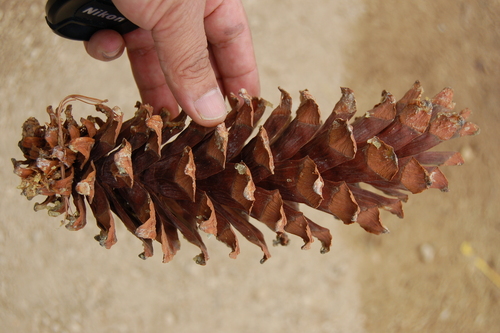
(c) Mike Plagens, some rights reserved (CC BY-NC), uploaded by Mike Plagens
iNaturalist· cc-by-nc
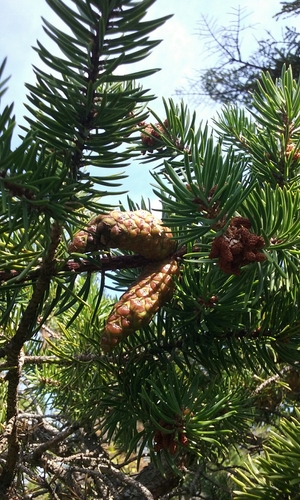
(c) eliudescamps, some rights reserved (CC BY-NC)
Summary
Fast-growing evergreen tree reaching 30m tall and 20m wide. Hardy to UK zone 10. Wind and bird-pollinated, not self-fertile. Attracts wildlife. Tolerates light sandy and medium loamy well-drained soils; grows in mildly acid to neutral soils and very acid to saline soils. Requires full sun. Adapts to drought and maritime exposure.
Description
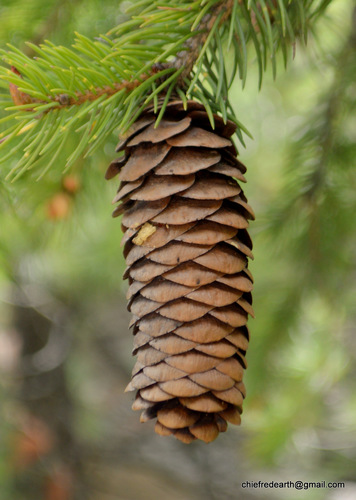
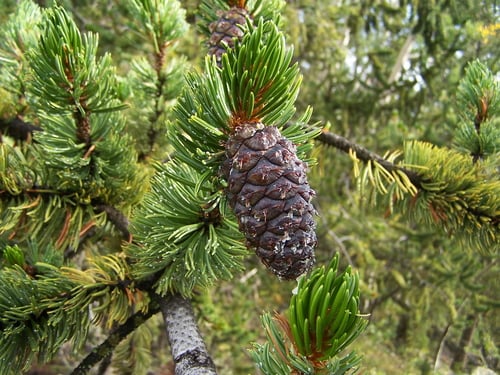
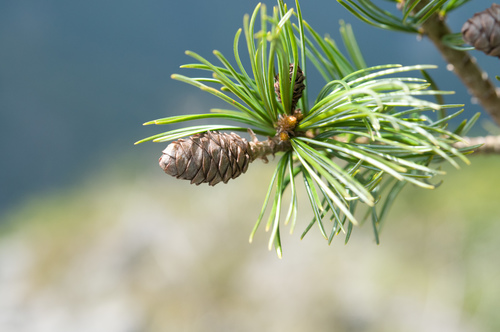
A tree. It grows 20-45 m tall. The trunk is round and slender and 50-100 cm across. The bark is rough, red brown and scaly. It cracks into irregular square plates. The leaves are needle-like and 15-26 cm long by 14-18 mm wide. They are slightly twisted and saw-toothed. The male cones are 5-6 cm cm across. The female are oval and 5-12 cm long by 4-6 cm wide when open. The seeds are light brown and 5-7 mm long by 3-4 cm wide. They are winged.
Edible Uses
The seeds are narrowly ovoid, up to 6mm long and 3mm wide, and can be eaten raw or cooked. A vanillin flavouring is also obtained as a by-product of resins released during pulpwood processing.
Medicinal Uses
The leaf oil is sometimes used in medicinal baths. Turpentine from pine resin is antiseptic, diuretic, rubefacient, and vermifuge, and is a valuable internal remedy for kidney and bladder complaints. It is used both internally and as a rub or steam bath for rheumatic conditions, and benefits the respiratory system in treating mucous membrane diseases, coughs, colds, influenza, and TB. Externally it is applied via liniment plasters, poultices, steam baths, and inhalers for skin complaints, wounds, sores, burns, and boils. Hexane extracts of the bark have demonstrated strong antifungal and antibacterial activity.
Known Hazards
The wood, sawdust and resins from various species of pine can cause dermatitis in sensitive people.
Distribution
It is a tropical plant. It grows in woodland between sea level and 800 m above sea level.
Where It Grows
Africa, Asia, Australia, Bahamas, Belize, Caribbean, Central America*, China, Colombia, Cuba, East Africa, Fiji, Guatemala, Indonesia, Jamaica, Mozambique, New Zealand, Pacific, Papua New Guinea, PNG, Rotuma, SE Asia, South Africa, South America, St Lucia, Sudan, Turks & Caicos, Venezuela, Vietnam, West Africa, West Indies, Zambia, Zimbabwe,
Cultivation
It grows in areas where the mean annual temperature is in the range 22 - 37°c, and the mean annual rainfall is 1,000 - 3,000mm. It grows best in frost-free areas at elevations up to about 700 metres in more fertile sites with good subsoil drainage and an annual rainfall of 2,000 - 3,000mm. Grows best in a sunny position. Soils are usually loams or sandy loams, sometimes with high amounts of gravel and generally well drained. It can tolerate seasonal waterlogging. The tree prefers a pH in the range 5.0 - 5.5, but can tolerate a range from 4.3 - 6.5. It tolerates salt winds and hence may be planted near the coast. The tree has been widely planted throughout the tropics, and has often escaped from cultivation. It is considered to be an invasive weed in some areas. A fast growing tree, generally averaging more than 1 metre increase in height per year when young. Bole straightness generally improves from the subtropics towards the tropics. Young plantations usually start bearing female cones when they are 3 - 4 years old but these do not produce fertile seed owing to the inadequate supply of pollen at this age, unless older plantations adjoin the site. Initial spacing when growing in plantations depends on the markets for which the pine is being grown and the technique used in tending the plantation. Mechanical cultivation requires a spacing of at least 3 metres between rows, but close spacing is possible within rows. When it is grown for pulpwood, a spacing of 2 x 2 metres is used to give maximum stem production of suitable sizes in the shortest time possible without thinning. Pruning is recommended to reduce fire danger, improve form, improve access within the crop, and reduce the size and frequency of knots, especially in saw logs. In plantations grown for pulpwood on a short rotation of 10 - 15 years, there may be one early cleaning thinning at 3 - 4 years old to remove malformed trees, or no thinning at all. Where both saw logs and pulpwood are being produced, a heavy thinning at 10 years for pulpwood may leave an open crop for logs saw harvested during the second thinning at 17 years. The tree can be effectively tapped for oleoresins from when it is 10 years old and has a bole diameter of at least 20 cm. An average of 25 g per tree per day of oleoresins can be tapped. The tree is rated as moderately fire resistant. Can be attacked by termites. Pine species are generally not self-fertile; they require cross-pollination between different trees to produce seeds effectively. Pine seeds are typically harvested in late summer to early autumn, usually from August to October (Northern Hemisphere), when cones begin to open and release seeds. Pine trees usually flower in spring, typically from March to June (Northern Hemisphere), depending on the species and climatic conditions.
Propagation
Seeds germinate in 8–21 days without pre-treatment, though soaking in cold water overnight followed by 2–3 days of cold storage at 4–5°c is often practised. Mechanically sifting out hollow or defective seed before sowing can substantially improve germination rates and allows single seeds to be sown directly into containers rather than germination beds first. Collect cones once they begin turning from green to brown on the tree — collecting earlier may yield seed with reduced viability. Seeds can be extracted from cones opened in the sun by raking them as they lie on a tarpaulin. Seed storage behaviour is orthodox: viability is lost within 1 year in hermetic storage at room temperature with 13±2% moisture content; no viability loss occurs over 2 years of hermetic storage at room temperature; no viability loss after 5 years at 0–5°c with over 8% moisture content. Hermetic storage at 4.5% moisture content is recommended; roughly 16% viability is lost after 2.7 years of hermetic storage at 8°c.
Other Uses
In areas where this tree grows naturally, the needle mat on the ground is valued for protecting the soil surface from erosion. In Sri Lanka, large-scale reforestation using this species successfully established tree cover on heavily eroded, otherwise unplantable land. The trees are also grown as windbreaks. Needles release terpene when washed by rain, which inhibits germination in some plants including wheat. The sapwood in particular can be tapped for oleoresin — a pale yellow, clear, sticky substance that becomes brittle on evaporation. It is soluble in non-polar organic solvents such as dry ethyl ether and hexane. Distillation yields 75% gum rosin and 25% turpentine. Turpentine, a liquid mixture of terpene hydrocarbons, is used in paint and batik industries. Gum rosin — a brittle solid soluble in many organic solvents and composed mainly of abietic and pimaric-type acids — is used in paper, soap, and glue production. Bark tannin content is around 10%, which can be extracted and dried to a water-soluble reddish powder. The heartwood is yellowish to reddish-brown, set apart from a 5–10cm band of white or yellowish sapwood. The grain is straight with a medium to coarse texture, distinct growth rings, and visible resin canals appearing as brown streaks on longitudinal surfaces. Wood properties vary considerably between sites and trees. The timber ranges from moderately light to moderately heavy; slower-grown trees from natural stands have higher density and lower resin content than plantation-grown trees. It is soft to moderately hard, moderately durable, susceptible to marine borer and termite attack but resistant to powder-post beetles and fungi — resistance to insect attack increases with resin content. The wood air-dries well, though end splits can occur. It works and finishes well with hand and machine tools, though resin may clog tool surfaces. It takes nails and screws well and glues satisfactorily. Resin exudation makes it less suitable for joinery or flooring, but resin-soaked wood is valued for boat decking due to its durability. Low density limits its use in structural work or furniture, though it suits shuttering, temporary applications, packaging, turnery, toys, moulding, interior trim, veneer, plywood, piles, vats, particle board, and fibreboard. Transmission poles made from this wood are used in Tanzania and Malaysia. Its long tracheids make it a good pulpwood source; 15-year-old plantations are considered ideal. The wood is also used for fuel and occasionally charcoal, with an energy value of 20,300 kJ/kg, though it throws sparks when burning.
Synonyms
Also Known As
Pinus karibia
References (7)
- Franklin, J., Keppel, G., & Whistler, W., 2008, The vegetation and flora of Lakeba, Nayau and Aiwa Islands, Central Lau Group, Fiji. Micronesica 40(1/2): 169–225, 2008
- Kew Plants of the World onLine
- McClatchey, W., Thaman, R., & Vodonaivalu, S., 2000, A Preliminary Checklist of the Flora of Rotuma with Rotuman Names. Pacific Science (2000) Vol. 54, No. 4: 345-363
- PROTA
- Roa, J. A. G. & Boada, D. S. G., 2018, Fundación para el Fortalecimiento de la Fruticultura y Plantas Alimenticias no Convencionales en Colombia.
Show all 7 references Hide references
- Sukarya, D. G., (Ed.) 2013, 3,500 Plant Species of the Botanic Gardens of Indonesia. LIPI p 448
- World Checklist of Useful Plant Species 2020. Royal Botanic Gardens, Kew