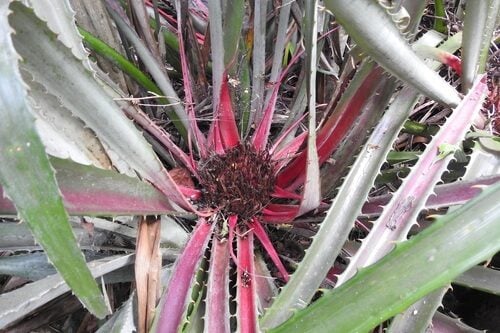
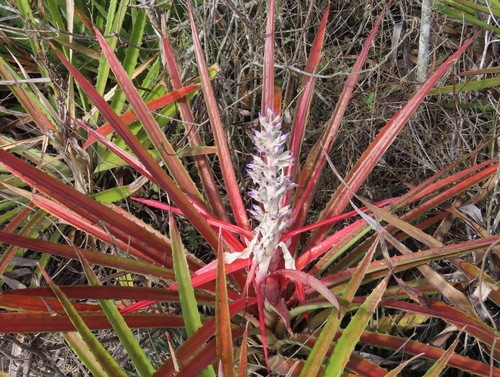
Ananas comosus
(L.) Merrill
Pineapple
iNaturalist· cc-by
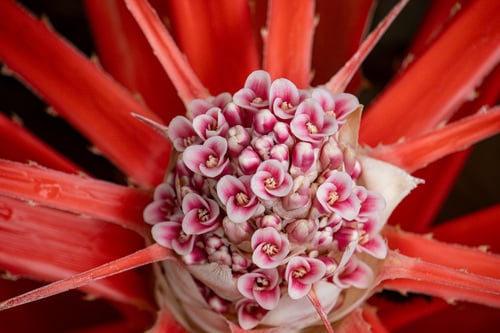
(c) Diogo Luiz, some rights reserved (CC BY), uploaded by Diogo Luiz
iNaturalist· cc-by-sa
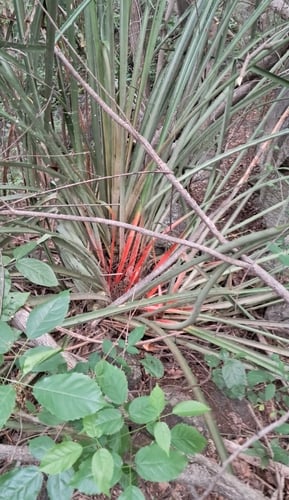
(c) David Monniaux, some rights reserved (CC BY-SA)
iNaturalist· cc-by-nc
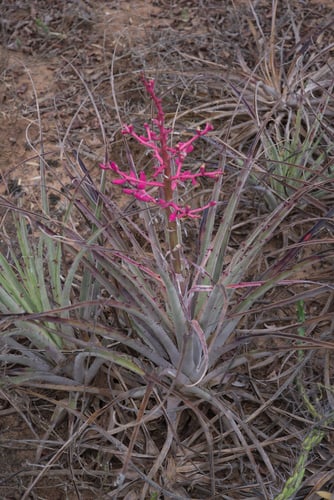
(c) karim_herrera_ico_3c, some rights reserved (CC BY-NC)
Summary
Source: WikipediaAnanas comosus is an evergreen perennial reaching 1 m (3 ft 3 inches) in height and spread, growing at a fast rate. Hardy to UK zone 10, it requires well-drained soil and tolerates light sandy, medium loamy, and heavy clay soils with mildly acid to neutral pH. The plant grows in semi-shade to full sun, prefers moist soil, and tolerates drought once established. It is not self-fertile.
Description
A perennial herb with a rosette of long, thick, spiky leaves up to 1 m high & spreading 1-1.5 m. The leaves are arranged in spirals. Some kinds have thorns along the edges of the leaves. The plant produces suckers both near the base of the stem and also higher up the stem near the fruit. These are called slips and these, and the suckers, are broken off and used for planting. The main plant dies after producing a fruit but the suckers keep growing. The plant produces a flower and fruit at the end. The fruit is made up of about 150 berry-like fruitlets that are almost fused together. There is a small crown of leaves on top of the fruit. The fruit can be 25 cm long and weigh 0.5-4 kg. The two main kinds of pineapples are the rough leafed variety which has spines on the leaves and produces a smaller but sweeter fruit. The other kind is the smooth leaf kind with spineless leaves and larger fruit. There are several cultivated varieties.
Edible Uses
The fruit is eaten raw, cooked, or preserved, offering a succulent, aromatic, sweet, and acidic pulp used fresh, canned, juiced, or cooked in dishes. The core is made into candies. The fruit is a good source of vitamins A and C. It is a multiple fruit formed by the near-complete fusion of 100–200 berry-like fruitlets, weighing between 0.5 and 2.5 kilos and measuring roughly 30–60 cm long. Pressed juice yields a sugar syrup. Terminal buds can be eaten raw or cooked as a vegetable or added to soups. The flowering stem, peeled and sliced, is used as a cooked vegetable or added to stews. Young shoots are eaten in salads or curries.
Traditional Uses
The fruit is eaten fresh or used for juice. The fruit can also be sliced and cooked with ham. The fruit is used in ice cream, jams and juices. The young heart leaves can be eaten. They are cooked in curry dishes. Unripe fruit are also cooked and eaten. The flower spikes are peeled and sliced and steamed as a vegetable or added to stews. The rind of the fruit is used for drinks.
Medicinal Uses
Pineapple fruit contains bromelain, a protein-splitting enzyme that aids digestion. The sour, unripe fruit stimulates appetite, improves digestion, and relieves dyspepsia; in Indian herbal medicine it is also considered a uterine tonic and is used to ease sore throats. In some regions it is eaten alone or cooked with Citrus aurantiifolia to induce abortion. The ripe fruit has a cooling, soothing effect — it settles wind and reduces excessive gastric acid, and its significant fibre content makes it a useful laxative for constipation. Juice of the ripe fruit is both diuretic and a digestive tonic. The leaves are anthelmintic and purgative, used to encourage menstruation, ease painful periods, and treat fractures. The plant's juice is applied externally to burns, itches, and boils.
Distribution
It is a tropical plant. They grow from sea level up to 1800 m altitude near the equator. It can survive brief periods down to freezing but cold retards growth, delays fruiting and causes fruit to be more acid. A friable well drained soil with high organic matter is best. Plants cannot stand water-logging. It can survive drought but adequate soil moisture is necessary for good fruit production. Pineapples need an annual average temperature between 17.2°C and 26.9°C. Growth ceases below 20°C. In the equatorial tropics this is mostly between sea level and 1800 metres altitude. Pineapples need well drained and fertile soil. They suit an acid soil and can develop rots in soils where lime has been added. The soil acidity can be between pH 3.3 and 6.0. The best range is pH 4.5 to 5.5. Soils which are not sufficiently acid can be treated with sulphur. It suits hardiness zones 9-10. In Yunnan.
Where It Grows
Africa, Amazon, American Samoa, Antigua and Barbuda, Argentina, Asia, Australia, Bangladesh, Barbados, Benin, Bolivia, Bougainville, Brazil*, Burkina Faso, Cambodia, Cameroon, Cape Verde, Central Africa, Central America, China, Chuuk, Colombia, Congo DR, Congo R, Cook Islands, Costa Rica, Côte d'Ivoire, Cuba, Dominican Republic, East Africa, East Timor, Easter Island, Ecuador, Eswatini, Ethiopia, Fiji, FSM, French Guiana, Ghana, Grenada, Guam, Guatemala, Guianas, Guinea, Guinée, Guyana, Haiti, Hawaii, Himalayas, India, Indochina, Indonesia, Ivory Coast, Jamaica, Kenya, Kiribati, Laos, Lesser Antilles, Madagascar, Malawi, Malaysia, Maldives, Marquesas, Marshall Islands, Mexico, Micronesia, Middle East, Mozambique, Myanmar, Nauru, Nepal, New Caledonia, Nicaragua, Niger, Nigeria, Niue, North America, Northeastern India, Pacific, Pakistan, Palau, Papua New Guinea, PNG, Paraguay, Peru, Philippines, Pohnpei, Puerto Rico, Rotuma, Sahel, Samoa, Sao Tome and Principe, Saudi Arabia, SE Asia, Sierra Leone, Sikkim, Slovenia, Solomon Islands, South Africa, Southern Africa, South America*, South Sudan, Sri Lanka, St Lucia, St. Vincent and Grenadines, Suriname, Swaziland, Taiwan, Tanzania, Thailand, Timor-Leste, Tonga, Turks & Caicos, Tuvalu, Uganda, Uruguay, USA, Vanuatu, Venezuela, Vietnam, Wallis & Futuna, West Africa, West Indies, West Timor, Yap, Zambia, Zimbabwe,
Cultivation
The suckers and slips can be used for planting as well as the top of the fruit. The time to maturity is the fastest for the suckers near the bottom of the plant and slowest when the top of the fruit is planted. Therefore use suckers that grow from the stem near the ground, for earliest yield. Other suckers or the top of the fruit can be used. Pineapples can grow well under shade. Pineapple flowering hormone can be used for fruit production with thorny varieties and calcium carbide for smooth kinds. Fruiting is less seasonal in the highlands than in the lowlands. Pineapples can be planted with 35,000 to 43,000 plants per hectare or 3 or 4 plants per square metre. If plants are spaced more widely they produce more suckers. Fruits become more acid where plants are closely spaced. If too many suckers are left growing from the main plant then smaller fruit will be produced. They can grow in partial shade and in this situation the plants are normally more green. The red colouring of pineapple leaves is due to a deficiency of the nutrient nitrogen. This shows up more quickly in plants in full sunlight. When the plant is sufficiently large it responds to changes such as less nutrients available or less water available, and starts to produce a flower, then a fruit. The number of hours of sunlight as well as reducing temperature and reduced sunlight also help the flowers start to form. The result of this is that flowering and fruiting is often seasonal. This can easily be changed by using a fruiting hormone which allows fruit to be produced at times to suit the grower. Pineapples can grow in semi-arid conditions and this is because the leaves can store some water. They also tend to lose only small amounts of water evaporating through their leaves. But with plenty of water they can grow well. The roots are very sensitive to water logging. Therefore the soil must be well drained. Pineapples do not cover the soil well so it is good to use a mulch of plant material to help weed control, provide some nutrients and to stop soil erosion.
Propagation
Cultivars do not breed true from seed, so seed production is generally reserved for developing new cultivars. Crowns — the leafy clumps atop mature fruits — can be removed by twisting or cutting, cleared of any remaining fruit tissue, dried for one to two days, then placed in moist potting mix or water until roots form. Stem cuttings taken after fruiting can have their leaves removed and be cut into pieces or laid intact in trays and covered with 2 cm of rooting medium; apply bottom heat at 20–27°C until roots form. Lateral shoots can also be used for propagation.
Other Uses
Plants can be grouped as a groundcover in mass plantings. A strong, silky fibre obtained from the leaves surpasses flax in strength, fineness, and lustre. It is white, soft, flexible, long in staple, remarkably durable, and unaffected by immersion in water. It can substitute for silk, mix with wool or cotton, and be used for cordage, textile fabrics, sewing thread, lace, and stringing necklaces. It produces the celebrated piña cloth of the Philippine Islands. The plant is also grown as an indoor houseplant.
Production
Plants usually produce for about 4 years. Fruiting is less seasonal in the highlands than in the lowlands in the tropics. The growth rate for pineapples gets slower as the temperature gets less. So plants grown in the highlands or at higher latitudes take longer to get ready for harvest. It takes 60 days from when the flower starts to form until it appears. Then there are 5 months until the fruit is ready for harvest. The time from planting to harvesting ranges from 11 months up to 32 months depending on temperature. The fruit are smaller, poorer shape and more acid where the temperatures are lower or there is less sunlight.
Other Information
Pineapples are a common and popular fruit. About 16 million tons are produced each year worldwide. It is cultivated.
Notes
There are 7 Ananas species. It contains a chemical called Bromelain which breaks down protein and is also antibacterial. It has antioxidant and antitumoral properties and is cardioprotective.
Nutrition
| Part | Moisture | kJ | kcal | Protein | Vit A | Vit C | Iron | Zinc |
|---|---|---|---|---|---|---|---|---|
| Fruit | 84.3 | 194 | 46 | 0.5 | 60 | 25 | 0.4 | 0.1 |
| Shoots | — | — | — | — | — | — | — | — |
Synonyms
Also Known As
Abacaxi, Abarba, Anana, Ananas, Anaras, Anarash, Anarosa, Anarosh, Andras, Aneh, Annasi, Apangdang, Bhuin kathar, Bonat, Danas, Ekunhun ahun, Enanasi, Ennanansi, Kanas, Kifubu, Kikakasi, Laimuri, Mananasi, Maneas, Mazhudhachakka, Mnanasi mwitu, Moneah, Moyusi, Mua, Nanas pager, Nanas, Nanasi, Nanat, Naneh, Nat, Nenas mudo, Painapiu, Pina, Po lo, Ponapa, Pweinaper, Pwainiper, Sapparat, Sapparot, Simbita, Sola, Supparot, Te bainaboro, Thom, Vadra, Vainapiu, Yaanat, Zanana
References (127)
- AAK, 1980, Bertanam Pohon Buah-buahan. Penerbitan Yayasan Kanisius, Jogyakarta. p 10
- Abbiw, D.K., 1990, Useful Plants of Ghana. West African uses of wild and cultivated plants. Intermediate Technology Publications and the Royal Botanic Gardens, Kew. p 42
- Anderson, E. F., 1993, Plants and people of the Golden Triangle. Dioscorides Press. p 202
- Baidu-Forson, J.J., et al ,2014,. Assessment of agrobiodiversity resources in the Borotse flood plain, Zambia. CGIAR Research Program on Aquatic Agricultural Systems. Penang, Malaysia. Working Paper: AAS-2014-12.
- Balkrishna, A., et al, 2022, Indigenous Uses of Plants among Forest-dependent Communities of Seijosa, Arunachal Pradesh. International Journal of Economic Plants 2022, 9(1):064-080
Show all 127 references Hide references
- Bandyopadhyay, S. et al, 2009, Wild edible plants of Koch Bihar district, West Bengal. Natural Products Radiance 8(1) 64-72
- Bennett, B. C., 1990, Useful Plants of Amazonian Ecuador. US Agency for International Development. Fifth Progress Report. New York Botanical Gardens. p 40
- Bernholt, H. et al, 2009, Plant species richness and diversity in urban and peri-urban gardens of Niamey, Niger. Agroforestry Systems 77:159-179
- Bianchini, F., Corbetta, F., and Pistoia, M., 1975, Fruits of the Earth. Cassell. p 170
- Bircher, A. G. & Bircher, W. H., 2000, Encyclopedia of Fruit Trees and Edible Flowering Plants in Egypt and the Subtropics. AUC Press. p 26 (Also as Ananas debilis)
- Blench, R., 2004, Fruits and Arboriculture in the Indo-Pacific Region. Indo-Pacific Prehistory Association Bulletin 24. (Taipei Papers Volume 2) p 34
- Bodkin, F., 1991, Encyclopedia Botanica. Cornstalk publishing, p 79
- Bodner, C. C. and Gereau, R. E., 1988, A Contribution to Bontoc Ethnobotany. Economic Botany, 43(2): 307-369
- Bremness, L., 1994, Herbs. Collins Eyewitness Handbooks. Harper Collins. p 146
- Brickell, C. (Ed.), 1999, The Royal Horticultural Society A-Z Encyclopedia of Garden Plants. Convent Garden Books. p 111
- Brown, D., 2002, The Royal Horticultural Society encyclopedia of Herbs and their uses. DK Books. p 120
- Brown, W.H., 1920, Wild Food Plants of the Philippines. Bureau of Forestry Bulletin No. 21 Manila. p 34
- Burkill, H. M., 1985, The useful plants of west tropical Africa, Vol. 1. Kew.
- Burkill, I.H., 1966, A Dictionary of the Economic Products of the Malay Peninsula. Ministry of Agriculture and Cooperatives, Kuala Lumpur, Malaysia. Vol 1 (A-H) p 149
- Chatterjee, A. S., 1997, Fruit Trees in Cambodian Home Gardens. Trainers' training manual. Home garden series No.3 p 29
- Chin, H.F., & Yong, H.S., 1996, Malaysian Fruits in Colour. Tropical press, Kuala Lumpur p 22
- Chowdery, T., et al, 2014, Wild edible plants of Uttar Dinajpur District, West Bengal. Life Science Leaflets. 47:pp 20-36 http://lifesciencesleaflets.ning.com
- Cobley, L.S. (rev. Steele, W.M.) 2nd Ed., 1976, An Introduction to the Botany of Tropical Crops. Longmans. p 178
- Coe, F. G. and Anderson, G. J., 1999, Ethnobotany of the Sumu (Ulwa) of Southeastern Nicaragua and Comparisons with Miskitu Plant Lore. Economic Botany Vol. 53. No. 4. pp. 363-386
- Coronel, R.E., 1982, Fruit Collections in the Philippines. IBPGR Newsletter p 6
- Cull, B.W., 1995, Fruit Growing in Warm Climates. Reed. p 175
- Cundall, P., (ed.), 2004, Gardening Australia: flora: the gardener's bible. ABC Books. p 149
- D'Ambrosio, U., & Puri, R. K., 2016, Foodways in transition: food plants, diet and local perceptions of change in a Costa Rican Ngäbe community. Journal of Ethnobiology and Ethnomedicine (2016) 12:3 p 22
- Darley, J.J., 1993, Know and Enjoy Tropical Fruit. P & S Publishers. p 100
- Duarte, M. C., et al, 2022, Diversity of Useful Plants in Cabo Verde Islands: A Biogeographic and Conservation Perspective. Plants 2022, 11, 1313 p 10
- Facciola, S., 1998, Cornucopia 2: a Source Book of Edible Plants. Kampong Publications, p 61
- Flowerdew, B., 2000, Complete Fruit Book. Kyle Cathie Ltd., London. p 144
- Fowler, D. G., 2007, Zambian Plants: Their Vernacular Names and Uses. Kew. p 15
- French, B., 1986, Food Plants of Papua New Guinea, Asia Pacific Science Foundation p 205
- French, B.R., 2010, Food Plants of Solomon Islands. A Compendium. Food Plants International Inc. p 204
- Fu, Yongneng, et al, 2003, Relocating Plants from Swidden Fallows to Gardens in Southwestern China. Economic Botany, 57(3): 389-402
- Furusawa, T., et al, 2014, Interaction between forest biodiversity and people's used of forest resources in Roviana, Solomon Islands: implications for biocultural conservation under socioeconomic changes. Journal of Ethnobiology and Ethnomedicine, 10:10
- Goode, P., 1989, Edible Plants of Uganda. FAO p 27
- Hedrick, U.P., 1919, (Ed.), Sturtevant's edible plants of the world. p 53 (As Ananas sativus)
- Hermandez Bermejo, J.E., and Leon, J. (Eds.), 1994, Neglected Crops. 1492 from a different perspective. FAO Plant Production and Protection Series No 26. FAO, Rome. p 14
- Heywood, V.H., Brummitt, R.K., Culham, A., and Seberg, O., 2007, Flowering Plant Families of the World. Royal Botanical Gardens, Kew. p 354
- Hu, Shiu-ying, 2005, Food Plants of China. The Chinese University Press. p 308
- Hunter, D., et al, 2019, The potential of neglected and underutilized species for improving diets and nutrition. Planta (2019) 250:709-729
- Huxley, A. (Ed.), 1977, The Encyclopedia of the Plant Kingdom. Chartweil Books. p 63
- INFOODS:FAO/INFOODS Databases
- Interp. Herb. amboin. 133. 1917
- Jacquat, C., 1990, Plants from the Markets of Thailand. D.K. Book House p 105
- Jahan, S. et al, 2011, Nutritional Profile of Some Tropical Fruits in Bangladesh: Specially Anti-Oxidant Vitamins and Minerals. Bangladesh Journal of Medical Science Vol. 10 No. 2
- Japanese International Research Centre for Agricultural Science www.jircas.affrc.go.jp/project/value_addition/Vegetables
- Jardin, C., 1970, List of Foods Used In Africa, FAO Nutrition Information Document Series No 2.p 119
- John, L., & Stevenson, V., 1979, The Complete Book of Fruit. Angus & Robertson p 230
- Khan, D. & Shaukat, S.S., 2006, The Fruits of Pakistan: Diversity, Distribution, Trends of Production and Use. Int. J. Biol. Biotech., 3(3):463-499
- Kiple, K.F. & Ornelas, K.C., (eds), 2000, The Cambridge World History of Food. CUP p 1834
- Latham, P., 2004, Useful Plants of Bas-Congo province. Latham & DFID p 29
- Latham, P. & Mbuta, A. K., 2014, Useful Plants of Bas-Congo Province, Democratic Republic of Congo. Volume 1. p 46
- Latham, P. & Mbuta, A. K., 2017, Plants of Kongo Central Province, Democratic Republic of Congo. Volume 1. 3rd ed p 50
- Lazarides, M. & Hince, B., 1993, Handbook of Economic Plants of Australia, CSIRO. p 19
- Lembaga Biologi Nasional, 1977, Buah-Buahan, Balai Pustaka, Jakarta. p 96
- Llamas, K.A., 2003, Tropical Flowering Plants. Timber Press. p 155
- Lorenzi, H., Bacher, L., Lacerda, M. & Sartori, S., 2006, Brazilian Fruits & Cultivated Exotics. Sao Paulo, Instituto Plantarum de Estuados da Flora Ltda. p 99
- Lyle, S., 2006, Discovering fruit and nuts. Land Links. p 62
- Macmillan, H.F. (Revised Barlow, H.S., et al) 1991, Tropical Planting and Gardening. Sixth edition. Malayan Nature Society. Kuala Lumpur. p 270
- Majumdar, K. & Datta, B. K., 2009, Traditional wild edible fruits for the forest dwellers of Tripura, India. Pleione 3(2): 167 - 178.
- Manandhar, N.P., 2002, Plants and People of Nepal. Timber Press. Portland, Oregon. p 88
- Martin, F. W., et al, 1987, Perennial Edible Fruits of the Tropics. USDA Handbook 642 p 21
- Medhi, P. & Borthakur, S. K., 2012, Phytoresources from North Cachur Hills of Assam -3: Edible plants sold at Hflong market. Indian Journal of Natural Products and Resources. 3(1) pp 84-109
- Molla, A., Ethiopian Plant Names. http://www.ethiopic.com/aplants.htm
- Morton, J. F., 1987, Fruits of Warm Climates. Wipf & Stock Publishers p 18
- Nascimento, V. T. D., et al, 2013, Knowledge and Use of Wild Food Plants in Areas of Dry Seasonal Forests in Brazil. Ecology of Food and Nutrition, 52:317–343
- Nkeoua, G. & Boundzanga, G. C., 1999, Donnees sur les produits forestieres non ligneux en Republique du Congo. FAO. p 20 (As Ananas sativum)
- Norrington, L., & Campbell, C., 2001, Tropical Food Gardens. Bloomings Books. p 114
- Ochse, J.J. et al, 1931, Vegetables of the Dutch East Indies. Asher reprint. p 84
- Oliviera V. B., et al, 2012, Native foods from Brazilian biodiversity as a source of bioactive compounds. Food Research International 48 (2012) 170-179
- Omawale, 1973, Guyana's edible plants. Guyana University, Georgetown p 36
- Owen, S., 1993, Indonesian Food and Cookery, INDIRA reprints. p 75
- Parham, B. E. V., 1972, Plants of Samoa. New Zealand Department of Scientific and Industrial Research. Information Series. No. 85 p 20
- Pascual-Mendoza, S. et al, 2021, Traditional knowledge of edible plants in an indigenous community in the Sierra Norte of Oaxaca, Mexico. Plant Biosystems - An International Journal Dealing with all Aspects of Plant Biology
- Pawera, L., et al, 2020, Wild Food Plants and Trends in Their Use: From Knowledge and Perceptions to Drivers of Change in West Sumatra, Indonesia, Foods. 2020, 9, 1240
- Paz, F. S., et al, 2021, Edible Fruit Plant Species in the Amazon Forest Rely Mostly on Bees and Beetles as Pollinators. Journal of Economic Entomology, XX(XX), 2021, 1–13
- Peekel, P.G., 1984, (Translation E.E.Henty), Flora of the Bismarck Archipelago for Naturalists, Division of Botany, Lae, PNG. p 76, 74
- Phon, P., 2000, Plants used in Cambodia. © Pauline Dy Phon, Phnom Penh, Cambodia. p 35
- Pickersgill, B., 1979, Pineapple, in Simmonds N.W.,(ed), Crop Plant Evolution. Longmans. London. p 14
- Plants of Haiti Smithsonian Institute http://botany.si.edu
- Priyadi, H., et al, Five hundred plant species in Gunung Halimun Salak National Park West Java. A checklist including Sundanese names, distribution and use. CIFOR, FFPRI, SLU p 38
- PROSEA (Plant Resources of South East Asia) handbook, Volume 2, 1991, Edible fruits and nut. p 66
- Purseglove, J.W., 1972, Tropical Crops. Monocotyledons. Longmans p 76
- Rajapaksha, U., 1998, Traditional Food Plants in Sri Lanka. HARTI, Sri Lanka. p 100
- Rashid, H. E., 1977, Geography of Bangladesh. Westview. p 339 (As Ananas sativa)
- Recher, P, 2001, Fruit Spirit Botanical Gardens Plant Index. www.nrg.com.au/~recher/ seedlist.html p 1
- Roa, J. A. G. & Boada, D. S. G., 2018, Fundación para el Fortalecimiento de la Fruticultura y Plantas Alimenticias no Convencionales en Colombia.
- Ruiters-Welcome, A. K., 2019, Food plants of southern Africa. Ph.D. thesis. Univ. of Johannesburg p 40
- Segnon, A. C. & Achigan-Dako, E. G., 2014, Comparative analysis of diversity and utilization of edible plants in arid and semi-arid areas in Benin. Journal of Ethnobiology and Ethnomedicine 2014, 10:80
- Segura, S. et al, 2018, The edible fruit species in Mexico. Genet Resour Crop Evol (2018) 65:1767–1793
- Sharma, B.B., 2005, Growing fruits and vegetables. Publications Division. Ministry of Information and broadcasting. India. p 123
- Small, E., 2009, Top 100 Food Plants. The world's most important culinary crops. NRC Research Press. p 427
- Smith, A.C., 1979, Flora Vitiensis Nova, Lawaii, Kuai, Hawaii, Volume 1 p 275
- Solomon, C., 2001, Encyclopedia of Asian Food. New Holland. p 281
- Staples, G.W. and Herbst, D.R., 2005, A tropical Garden Flora. Bishop Museum Press, Honolulu, Hawaii. p 635 (Drawing)
- Tate, D., 1999, Tropical Fruit. Archipelago Press. Singapore. p 16
- Termote, C., et al, 2014, Assessing the potential of wild foods to reduce the cost of a nutritionally adequate diet: An example from eastern Baringo District, Kenya. Food and Nutrition Bulletin, vol. 35, no. 4
- Terra, G.J.A., 1973, Tropical Vegetables. Communication 54e Royal Tropical Institute, Amsterdam, p 23
- Thaman, R.R., 1976, The Tongan Agricultural System, University of the South Pacific, Suva, Fiji. p 380
- Thaman, R. R., 1987, Plants of Kiribati: A listing and analysis of vernacular names. Atoll Research Bulletin No. 296
- Thaman, R. R., et al, 1994, The Flora of Nauru. Atoll Research Bulletin No. 392. Smithsonian Institute p 47
- Thaman, R. R, 2016, The flora of Tuvalu. Atoll Research Bulletin No. 611. Smithsonian Institute p 43
- Torre, de la, L., et al, 2008, Enciclopedia de las Plantas Útiles del Ecuador. Herbario QCA. Pontificia Universidad Católica del Ecuador. p 259
- Tugume, P. & Nyakoojo, C., 2020, Traditional use of wild edible plants in the communities adjacent to Mabira Central Forest Reserve, Uganda. Ethnobotany Research & Applications 20:15 (2020)
- USDA, ARS, National Genetic Resources Program. Germplasm Resources Information Network - (GRIN). [Online Database] National Germplasm Resources Laboratory, Beltsville, Maryland. Available: www.ars-grin.gov/cgi-bin/npgs/html/econ.pl (10 April 2000)
- Vael, L., 2015, Ethnobotanical study of the plant use in the natural landscape of two mestizo communities in the Ucayali region of the Peruvian Amazon. Universiteit Gent.
- Vander Velde, N, 2003, The Vascular Plants of Majuro Atoll, Republic of the Marshall Islands. Atoll research Bulletin. No. 503. Smithsonian Institute. p 34
- Van den Eynden, V., et al, 2003, Wild Foods from South Ecuador. Economic Botany 57(4): 576-603
- van Wyk, B., 2005, Food Plants of the World. An illustrated guide. Timber press. p 58
- Vasquez, R. and Gentry, A. H., 1989, Use and Misuse of Forest-harvested Fruits in the Iquitos Area. Conservation Biology 3(4): 350f
- Vasquez, Roberto Ch. & Coimbra, German S., 1996, Frutas Silvestres Comestibles de Santa Cruz. p 247
- Vickery, M.L. and Vickery, B., 1979, Plant Products of Tropical Africa, Macmillan. p 37
- Walsh, M., 2009, The Use of Wild and Cultivated Plants as famine Foods on Pemba Island, Zanzibar. Études océan Indien. 42-43
- Walter, A. & Lebot, V., 2007, Gardens of Oceania. ACIAR Monograph No. 122. p 229
- Welcome, A. K. & Van Wyk, B.-E., 2019, An inventory and analysis of the food plants of southern Africa. South African Journal of Botany 122 (2019) 136–179
- Wiersema, J. H. & Leon, B., 2013, World Economic Plants. A Standard Reference CRC Press. 2nd Ed. p 50
- Williams, C.N., Chew, W.Y., and Rajartnam, J.A., 1989, Tree and Field Crops of the Wetter Regions of the Tropics. Longman, p 110
- Williamson, J., 2005, Useful Plants of Malawi. 3rd. Edition. Mdadzi Book Trust. p 23
- Wiriadinata, H., Ethnobotany of Economic Plants in the Baliem Valley, Jayawijaya, Irian Jaya, Indonesian Institute of Science, Bogor, Indonesia
- World Checklist of Useful Plant Species 2020. Royal Botanic Gardens, Kew
- www.colecionandofrutas.org
- Yuncker, T.G., 1959, Plants of Tonga, Bernice P. Bishop Museum, Hawaii, Bulletin 220. p 76
- Zaldivar, M. E., et al, 2002, Species Diversity of Edible Plants Grown in Homegardens of Chibehan Amerindians from Costa Rica. Human Ecology, Vol. 30, No. 3, pp. 301-316
- Zuchowski W., 2007, Tropical Plants of Costa Rica. A Zona Tropical Publication, Comstock Publishing. p 369