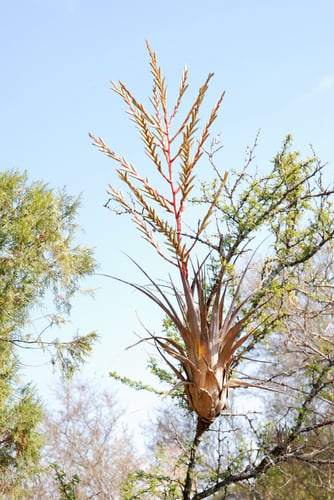
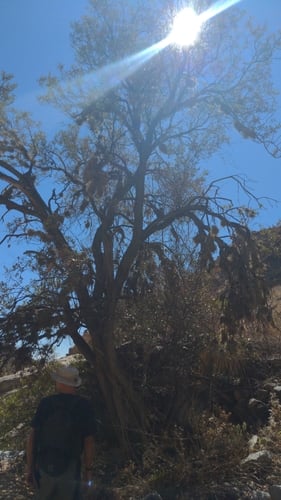
Bromelia balansae
Mez.
Heart of Flame, Dore
iNaturalist· cc-by-nc
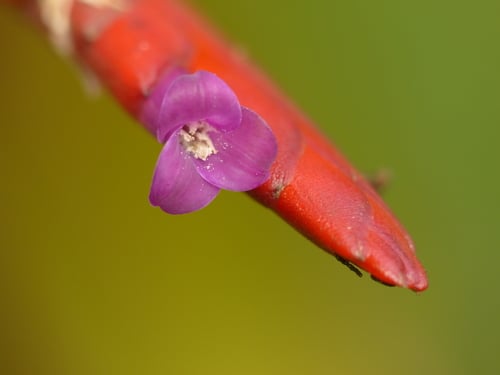
(c) Julio César Schadek Barbosa, some rights reserved (CC BY-NC), uploaded by Julio César Schadek Barbosa
iNaturalist· cc-by-nc
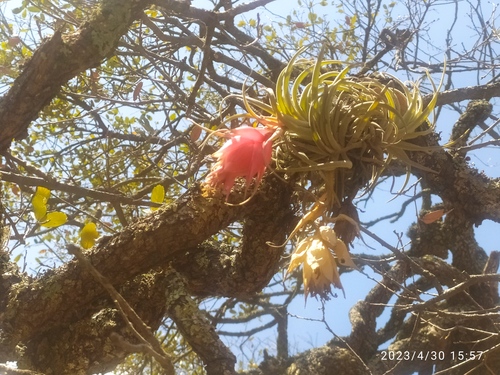
(c) Wagner Teixeira Florentino, some rights reserved (CC BY-NC), uploaded by Wagner Teixeira Florentino
iNaturalist· cc-by-nc
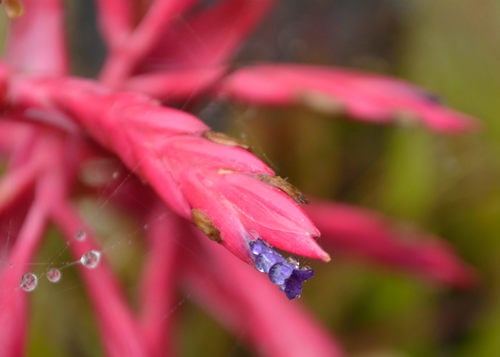
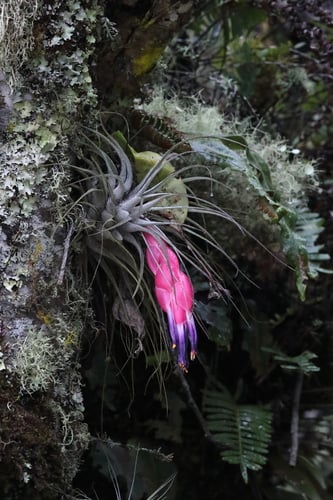
(c) Tito Lahaye, some rights reserved (CC BY-NC), uploaded by Tito Lahaye
Summary
Source: WikipediaBromelia balansae is a plant species in the genus Bromelia. This species is native to Argentina, Brazil, Colombia, Bolivia, and Paraguay where it grows at elevations of 150 to 3,000 feet.
Description
A pineapple like plant. It grows 1 m tall. Plants can spread by underground runners. The leaves are spiny and 0.5-1.5 m long. They are blue-grey. They are coarse and fibrous. The young central leaves turn red-violet during flowers. The flowers are violet and 2 cm across. The flower spike is 20 cm long. The fruit is composed of many fruitlets. They are not as closely fused as pineapple. The flesh is yellow and juicy.
Edible Uses
The fruit is primarily used for juice, though sweetness varies between plants. The leaf bases are traditionally roasted directly in fire and then eaten.
Traditional Uses
It is mostly used for juice. Plants vary in the sweetness of the fruit. The leaves are placed directly in the fire then the base of the leaves is eaten.
Medicinal Uses
None mentioned in data.
Known Hazards
None mentioned in data.
Distribution
A tropical plant. It can be grown in tropical and subtropical places. They are best in a protected site. In Colombia it is recorded in woodland between 60-1,000 m above sea level.
Where It Grows
Argentina*, Australia, Bolivia, Brazil, Colombia, Paraguay, South America,
Cultivation
Plants can be grown by removal of suckers. It can also be grown by seed. Cleaned seed germinate in a few days.
Propagation
Seed - Division of suckers.
Other Uses
A soft and silky fibre is obtained from the leaves. Of medium strength, it resembles pineapple fibre (Ananas comosus) and is obtained in lengths of 120 - 180cm. It is used for rude cordage, sacks, etc.
Notes
There are 51 Bromelia species. They grow in tropical America.
Also Known As
Caraguata, Gravata, Macambira
References (14)
- Bodkin, F., 1991, Encyclopedia Botanica. Cornstalk publishing, p 171
- Bortolotto, I. M., et al, 2018, Lista preliminar das plantas alimenticias nativas de Mato Grosso do Sul, Brasil. Iheringia, Serie Botanica, Porto Alegre, 73 (supl.):101-116
- Brack, P., et al, 2020, Frutas nativas do Rio Grande do Sul, Brasil: riqueza e potencial alimentício. Native fruits of Rio Grande do Sul, Brazil: richness and potential as food. Rodriguésia 71: e03102018.
- Brickell, C. (Ed.), 1999, The Royal Horticultural Society A-Z Encyclopedia of Garden Plants. Convent Garden Books. p 192
- Hibbert, M., 2002, The Aussie Plant Finder 2002, Florilegium. p 46
Show all 14 references Hide references
- Keller, H., et al, 2010, Ethnobotanical resources of multipe-use Guarani Reserve, Misiones (Argentina): their importance to indigenous communities of Caramelito and Taruma Poty-1. Ethnobotany Bol. 22, 2010 pp 38-54
- Kiple, K.F. & Ornelas, K.C., (eds), 2000, The Cambridge World History of Food. CUP p 1835
- Lyle, S., 2006, Discovering fruit and nuts. Land Links. p 64 (As Bromelia balancia)
- Roa, J. A. G. & Boada, D. S. G., 2018, Fundación para el Fortalecimiento de la Fruticultura y Plantas Alimenticias no Convencionales en Colombia.
- Scarpa, G. F., 2009, Wild food plants used by the indigenous peoples of South American Gran Chaco: A general synopsis and intercultural comparison. Journal of Applied Botany and Food Quality 83:90-101
- Schmedia-Hirschmann, G., 1994, Plants resources Used by the Ayoreo of the Paraguayan Chaco. Economic Botany Vol. 48. No. 3. pp. 252-258
- Smith, L. B. & Downs, R. J., 1979, Bromelioideae, Flora Neotropica 14(3), p 1660
- World Checklist of Useful Plant Species 2020. Royal Botanic Gardens, Kew
- www.colecionandofrutas.org