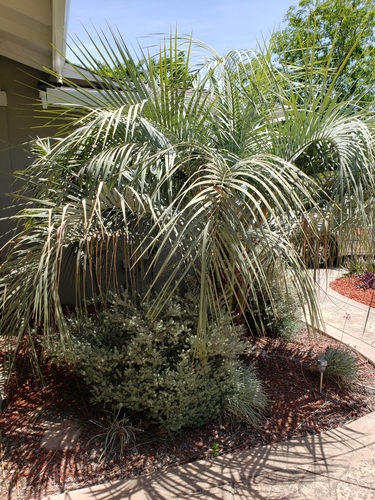
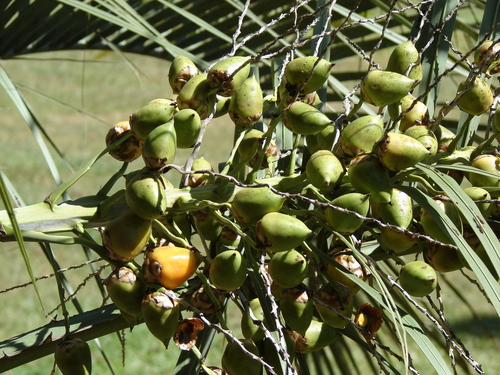
Pinanga speciosa
Becc.
Banisan
iNaturalist· cc-by-nc
(c) Scott Zona, some rights reserved (CC BY-NC)
iNaturalist· cc-by-sa
(c) filibot.web, some rights reserved (CC BY-SA)
iNaturalist· cc-by-nc
(c) I am Forester, some rights reserved (CC BY-NC), uploaded by I am Forester
Description
A small slender palm. It has a solitary ringed trunk. It grows about 10 m tall. The trunk has blackish- green tinges. The crown-shaft is dark coloured. The leaves are dark green with leaflets along the stalk. The leaf segments are equal distance and large and straight. They are 2 to 3 ribbed and of a rather soft texture. The fruiting stalk is branched. The fruit are small. They are 15 mm by 9 mm and oval with the rounded part on top. They occur in 2 opposite rows. The seed is oblong and the embryo at a slight angle.
Edible Uses
The palm bud is eaten cooked. The cabbage (palm heart) is also harvested as an edible portion.
Traditional Uses
The bud is eaten cooked.
This uses section is brief — help expand it
Distribution
A tropical plant. They are found in primary forests at altitudes of 400 to 1200 m. They occur from Agusan, Davao and Zamboanga in the Philippines. It suits tropical locations. It grows in shady situations.
Where It Grows
Asia, Australia, Pacific, Philippines, SE Asia,
References (5)
- Jones, D.L., 1994, Palms throughout the World. Smithtonian Institution, Washington. p 308
- Jones, D.L., 2000, Palms of Australia 3rd edition. Reed/New Holland. p 206
- Monsalud, M.R., Tongacan, A.L., Lopez, F.R., & Lagrimas, M.Q., 1966, Edible Wild Plants in Philippine Forests. Philippine Journal of Science. p 514
- Riffle, R.L. & Craft, P., 2003, An Encyclopedia of Cultivated Palms. Timber Press. p 416
- World Checklist of Useful Plant Species 2020. Royal Botanic Gardens, Kew