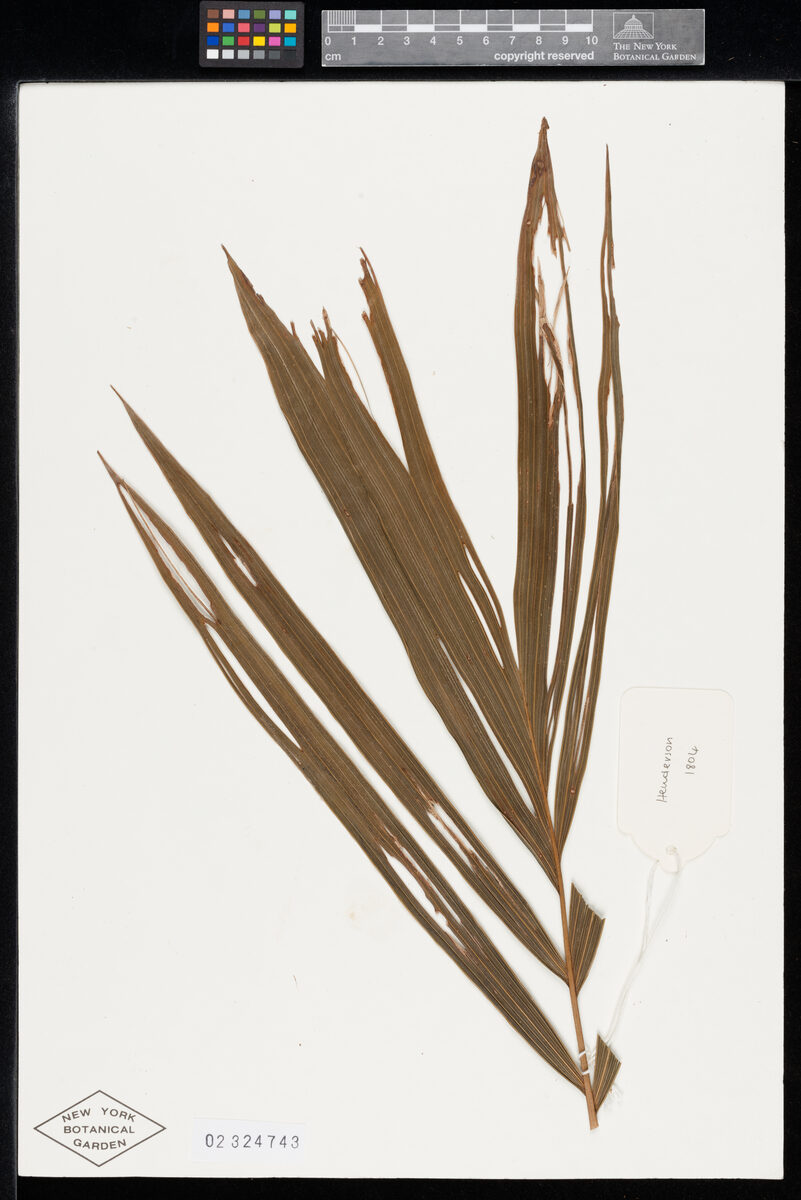
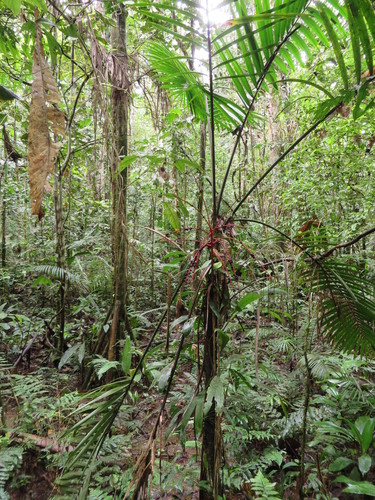
Euterpe precatoria
Mart.
Mountain cabbage palm
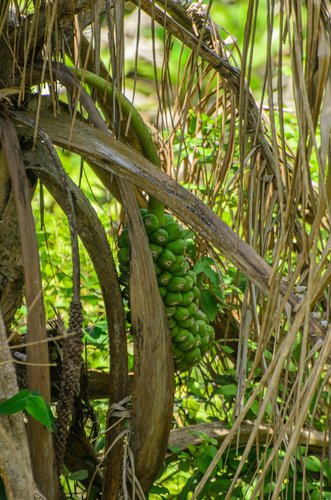
iNaturalist· cc-by-nc
(c) scott.zona, some rights reserved (CC BY-NC)
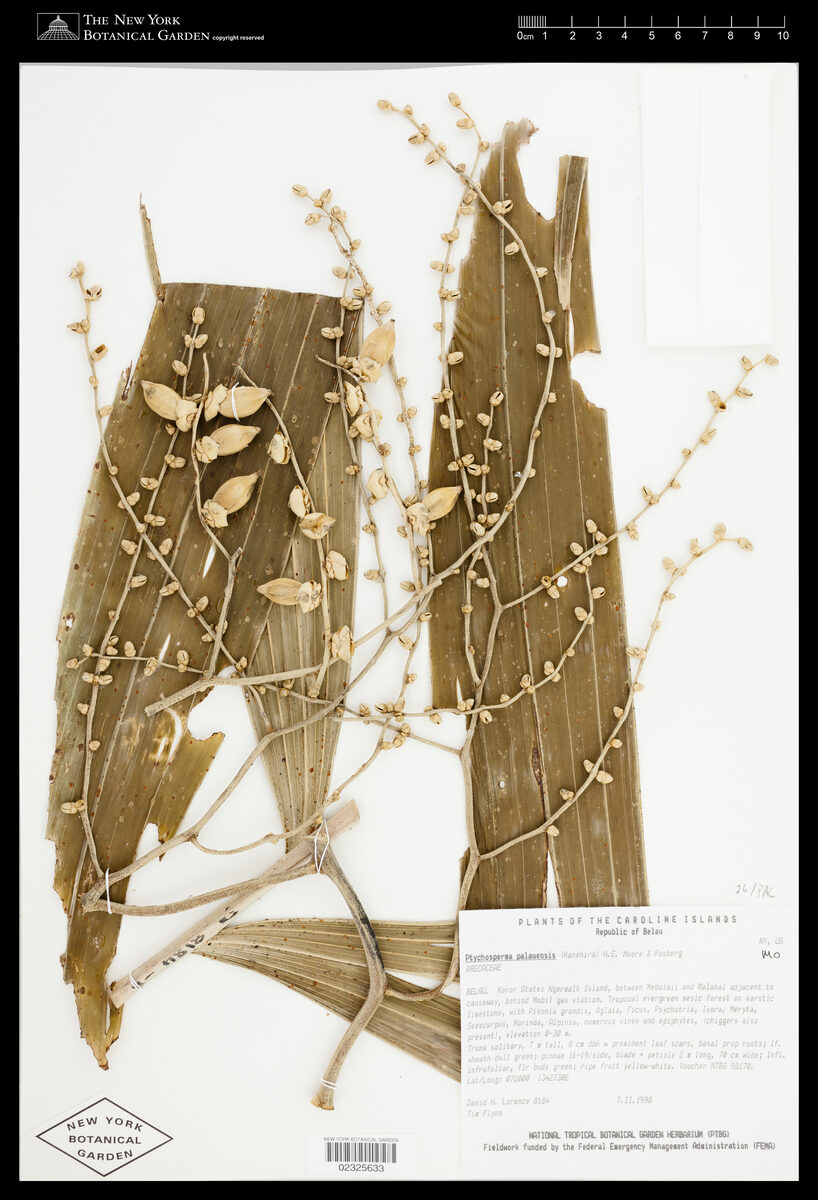
iNaturalist· cc-by-nc
(c) claudiocrespor, some rights reserved (CC BY-NC)
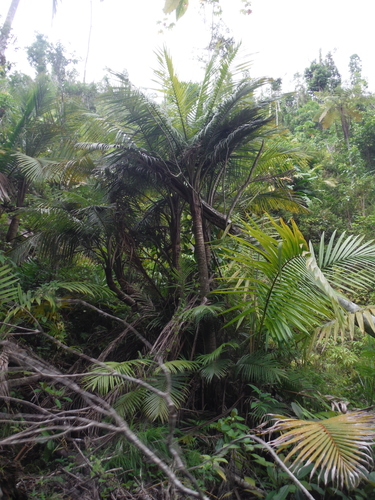
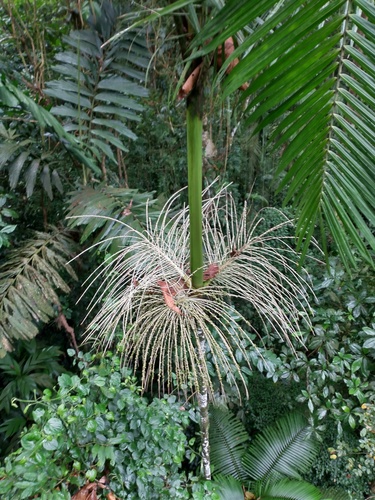
iNaturalist· cc-by-nc
(c) Apipa, some rights reserved (CC BY-NC), uploaded by Apipa
Summary
Source: WikipediaEuterpe precatoria is a tall, slender-stemmed, pinnate-leaved palm native to Central and South America and Trinidad and Tobago. E. precatoria is used commercially to produce fruits, although Euterpe oleracea is more commonly cultivated due to its larger fruits.
Description
A slim solitary palm. The trunk can be 15-20 m tall. The trunk is 20-25 cm across. There are rings on the trunk. There are 8-13 leaves. The leaves hang down. The leaves are 3-3.5 m long. There are leaflets along the stalk. The leaflets hang down. The leaflets are 30-40 cm long and without leaflet stalks. The flowering stalk grows below the crown-shaft. The fruit are produced in large numbers. The fruit are round and 1.3 cm across. They are dark purple when ripe. The seed is 1 cm across. There are at least 2 varieties.
Edible Uses
E. precatoria is a non-timber forest product that produces acai berries. As well as the edible fruits, this palm is a source of prized (though not very nutritious) hearts of palm. Since it is a single-stemmed palm, harvesting palm hearts kills the tree, and has led to a reduction in numbers. During the 1990s, the palm was heavily harvested for palmito in Peru and Bolivia, but production dropped in the early 2000s due to overharvesting. Today, prices in Peru are currently high since it is now uncommon in the wild.
Traditional Uses
The palm heart is edible. The fruit are used for drinks. The seeds yields an edible oil.
This uses section is brief — help expand it
Medicinal Uses
The roots are boiled, and the water drunk as an antimalarial. A decoction of the roots, combined with the roots of Manicaria saccifera and the leaves of bamboo, are used as a remedy for bronchitis.
Distribution
A tropical plant. It grows in north of South America from sea level to 2000 m altitude. It grows in wet forests and along rivers. It can grow in swamps and areas than are occasionally flooded. In Ecuador it grows between 900-1,300 m above sea level.
Where It Grows
Amazon, Belize, Bolivia*, Brazil*, Central America, Colombia*, Costa Rica, Ecuador, Guiana, Guianas, Guyana, Peru, South America, Suriname, Trinidad and Tobago, Venezuela*,
Cultivation
Plants are grown from seed. The seeds are small and should be planted when fresh.
Propagation
Seed - germinates rapidly and grows quickly.
Other Uses
The stems are widely used in construction.
Other Information
The juice as 'assai wine' is popular. The fruit are sold in local markets. Also the palm hearts. It is cultivated.
Notes
There are between 7 and 18 Euterpe species.
Nutrition
| Part | Moisture | kJ | kcal | Protein | Vit A | Vit C | Iron | Zinc |
|---|---|---|---|---|---|---|---|---|
| Fruit | 85.3 | 274 | 67 | 0.8 | — | 33.7 | 0.9 | 0.4 |
Synonyms
Also Known As
Abua, Acaf, Acai, Acai-do-amazonas, Acai solteiro, Asaf, Asahi, Asai, Asai de la selva, Baboen-pina, Big manicole, Chonta, Dudiba, Huasai, Huasi, Imibi ni, Jene, Maimasi, Manaca, Midra, Monkimonki-pina, Murrapo, Palmiche, Palmito, Palmo real, Pana, Panane, Reho, Warunamsebe, Wassai, Winamoro
References (43)
- Altschul, S.V.R., 1973, Drugs and Foods from Little-known Plants. Notes in Harvard University Herbaria. Harvard Univ. Press. Massachusetts. no. 85 (As Euterpe subruminata)
- Balick, M.J. and Beck, H.T., (Ed.), 1990, Useful palms of the World. A Synoptic Bibliography. Colombia p 68, 332, 558, 561,
- Bortolotto, I. M., et al, 2018, Lista preliminar das plantas alimenticias nativas de Mato Grosso do Sul, Brasil. Iheringia, Serie Botanica, Porto Alegre, 73 (supl.):101-116
- Castaneda, H., & Stepp, J. R., 2007, Ecosystems as Sources of Useful Plants for the Guaymi People of Costa Rica. Ethnobotany Journal. 5:249-257
- Chizmar Fernandez, C., et al, 2009, Plantas comestibles de Centroamerica. Instituto de Biodiversidad, Costa Rica. p 100
Show all 43 references Hide references
- Daly, D. C., An Index of Common Names of Plants in Acre, Brazil. New York Botanical Garden Universidade Federal do Acre.
- D'Ambrosio, U., & Puri, R. K., 2016, Foodways in transition: food plants, diet and local perceptions of change in a Costa Rican Ngäbe community. Journal of Ethnobiology and Ethnomedicine (2016) 12:3 p 22
- DeWalt, S. J., et al, 1999, Ethnobotany of the Tacana: Quantitative Inventories of Two Permanent Plots of Northwestern Bolivia. Economic Botany Vol. 53. No. 3. pp. 237-260
- A. D. d'Orbigny, Voy. Amerique mer. 7(3). Palmiers 10, t. 8, fig. 2. 1842; 8: t. 18, fig. A. 1846
- Etkin, N.L. (Ed.), 1994, Eating on the Wild Side, Univ. of Arizona. p 137
- Eynden, Van den, V., & Cueva E., Cebrera, O., 2004, Edible Palms of Southern Ecuador. Palms. Vol 48(3):141-147
- Facciola, S., 1998, Cornucopia 2: a Source Book of Edible Plants. Kampong Publications, p 28
- Gibbons, M., 2003, A pocket guide to Palms. Chartwell Books. p 106
- Gilmore, M. P., et al, 2013, The socio-cultural importance of Mauritia flexuosa palm swamps (aguajales) and implications for multi-use management in two Maijuna communities of the Peruvian Amazon. Journal of Ethnobiology and Ethnomedicine 2013, 9:29
- Grandtner, M. M., 2008, World Dictionary of Trees. Wood and Forest Science Department. Laval University, Quebec, Qc Canada. (Internet database http://www.wdt.qc.ca)
- Grandtner, M. M. & Chevrette, J., 2013, Dictionary of Trees, Volume 2: South America: Nomenclature, Taxonomy and Ecology. Academic Press p 246
- Haynes, J., & McLaughlin, J., 2000, Edible palms and Their Uses. University of Florida Fact sheet MCDE-00-50-1 p 6
- Henderson, A., Galeano, G and Bernal, R., 1995, Field Guide to the Palms of the Americas. Princeton. p 124
- Hunter, D., et al, 2019, The potential of neglected and underutilized species for improving diets and nutrition. Planta (2019) 250:709-729
- Johnson, D.V., 1998, Tropical palms. Non-wood Forest products 10. FAO Rome. p 20, 93
- Langlois, H. C., 2004, Ethnobotanical analysis of different successional stages as sources of wild edible plants for the Guaymi people in Costa Rica. M. Sc. thesis University of Florida.
- Lopez-Diago, D. & Garcia, N., 2021, Wild edible fruits of Colombia. Biota ColomBiana 22 (2) p 31
- Lorenzi, H., Bacher, L., Lacerda, M. & Sartori, S., 2006, Brazilian Fruits & Cultivated Exotics. Sao Paulo, Instituto Plantarum de Estuados da Flora Ltda. p 81
- Maas, P.J. M., Non-Timber Forest Products of the North-West District of Guyana Part 2. The 85 most important NTFP species. p 90
- Marcia, M. J., et al, 2011, Palm Uses in Northwestern South America: A Quantitative Review. Bot. Rev. (2011) 77:462-570
- Melnyk, M., Indigenous enterprise for the domestication of trees and the commercialization of their fruits. FAO
- Paz, F. S., et al, 2021, Edible Fruit Plant Species in the Amazon Forest Rely Mostly on Bees and Beetles as Pollinators. Journal of Economic Entomology, XX(XX), 2021, 1–13
- Philips, O., 1992, The potential for harvesting fruits in tropical rainforests: new data from Amazonian Peru. Biodiversity and Conservation 2, 18-38
- Riffle, R.L. & Craft, P., 2003, An Encyclopedia of Cultivated Palms. Timber Press. p 337
- Roa, J. A. G. & Boada, D. S. G., 2018, Fundación para el Fortalecimiento de la Fruticultura y Plantas Alimenticias no Convencionales en Colombia.
- Smith, N., et al, 2007, Amazon River Fruits. Flavors for Conservation. Missouri Botanical Gardens Press. p 68
- Torre, de la L., et al, 2008, Enciclopedia de las Plantas Útiles del Ecuador. Herbario QCA. Pontificia Universidad Católica del Ecuador. p 201
- Tomchinsky, B., et al, 2021, Food Composition Data: Edible Plants from the Amazon. in M. C. M. Jacob, U. P. Albuquerque (eds.), Local Food Plants of Brazil, Ethnobiology, Springer p 275
- Vael, L., 2015, Ethnobotanical study of the plant use in the natural landscape of two mestizo communities in the Ucayali region of the Peruvian Amazon. Universiteit Gent.
- Van den Eynden, V., et al, 2003, Wild Foods from South Ecuador. Economic Botany 57(4): 576-603
- Van den Eynden, V. et al, 2004, Edible Palms of Southern Ecuador. Palms Volume 48(3):142-148
- van Roosmalen, M.G.M., 1985, Fruits of the Guianan Flora. Utrecht Univ. & Wageningen Univ. p 349
- Vasquez, R. and Gentry, A. H., 1989, Use and Misuse of Forest-harvested Fruits in the Iquitos Area. Conservation Biology 3(4): 350f
- Vasquez, Roberto Ch. & Coimbra, German S., 1996, Frutas Silvestres Comestibles de Santa Cruz. p 164
- Wiersema, J. H. & Leon, B., 2013, World Economic Plants. A Standard Reference CRC Press. 2nd Ed. p 297
- World Checklist of Useful Plant Species 2020. Royal Botanic Gardens, Kew
- www.proyanomami.org
- Zambrana, P, et al, 2017, Traditional knowledge hiding in plain sight – twenty-first century ethnobotany of the Chácobo in Beni, Bolivia. Journal of Ethnobiology and Ethnomedicine (2017) 13:57