Pinanga rigida
Becc.
Hiliuasiu
wikimedia· cc0
Wikimedia Commons - National Museum of Natural History
gbif· cc0
President and Fellows of Harvard College
gbif· cc0
President and Fellows of Harvard College
Description
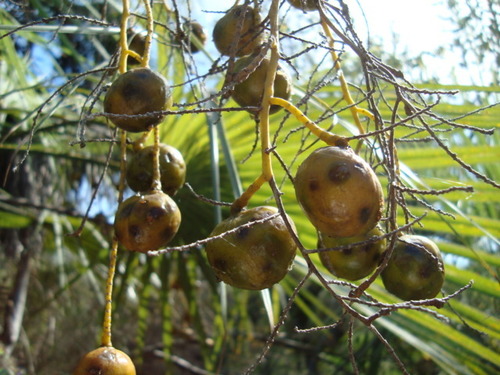
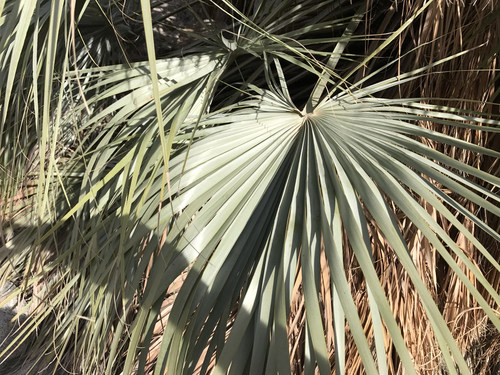
A small slender palm. The trunk is brown and ringed. It grows 5 m tall. The leaves have numerous segments which are inserted at a very sharp angle. They are 1-ribbed, sword shaped, and straight. There is a single vein in the leaflets. The flower arrangement is a spike of flowers along a central stalk with several branches in a spiral. The fruit are oval and 13 to 15 mm by 6 to 7 mm. They are dark red and velvety when mature. The seed is oval and the embryo at an angle.
Edible Uses
The unopened leaf bud is cooked and eaten as a vegetable, and palm heart is consumed as food.
Traditional Uses
The bud is cooked and eaten as a vegetable.
This uses section is brief — help expand it
Distribution
A tropical plant. They occur in mossy forests at altitudes of 1200 to 1800 m throughout the Philippines.
Where It Grows
Asia, Pacific, Philippines, SE Asia,
References (3)
- Jones, D.L., 1994, Palms throughout the World. Smithtonian Institution, Washington. p 306
- Monsalud, M.R., Tongacan, A.L., Lopez, F.R., & Lagrimas, M.Q., 1966, Edible Wild Plants in Philippine Forests. Philippine Journal of Science. p 519
- World Checklist of Useful Plant Species 2020. Royal Botanic Gardens, Kew