Amyema miraculosa
(Miq.) Tieghem
Box Mistletoe
iNaturalist· cc-by-nc
(c) Euan Moore, some rights reserved (CC BY-NC), uploaded by Euan Moore
iNaturalist· cc-by-nc
(c) Pete Woodall, some rights reserved (CC BY-NC), uploaded by Pete Woodall
iNaturalist· cc-by-nc
(c) Aaron Oehms, some rights reserved (CC BY-NC), uploaded by Aaron Oehms
Summary
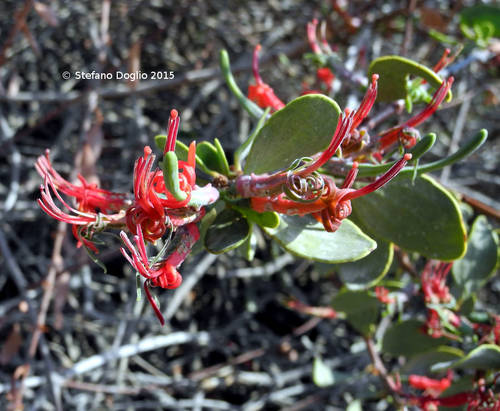
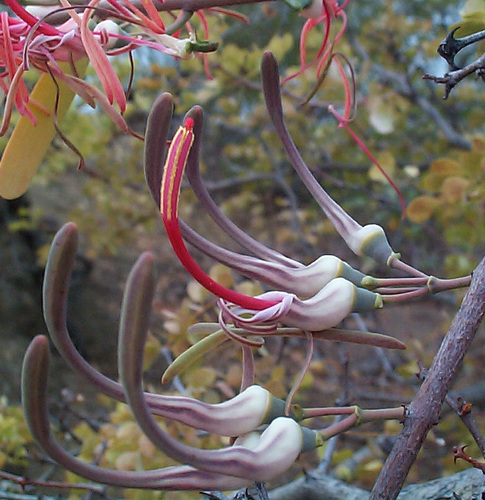
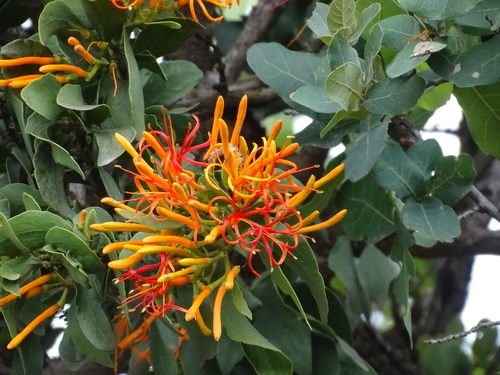
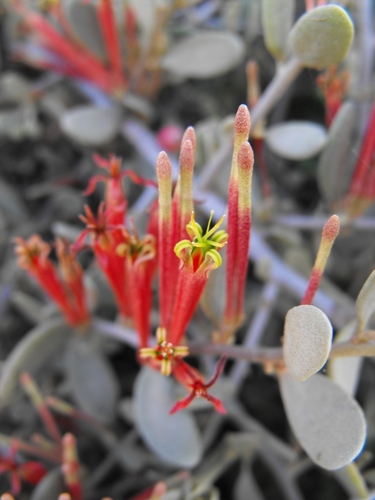
Source: WikipediaAmyema miraculosa, also known as the fleshy mistletoe and the round-leaf mistletoe, is an Australian native mistletoe found in all states except Tasmania. It is a woody, hemiparasitic plant, in the Loranthaceae family. Being hemiparasitic, it draws water and minerals from its host, however it photosynthesises to manufacture its own supply of carbohydrates. The plant has thick, fleshy leaves with rounded tips. It has dark red flowers which are carried in groups of three and the fruit is a narrow shaped yellow berry. It forms dense, upright clumps and is often found parasitising other parasitic plants, making it an epiparasite. It has been recorded utilising a total of 41 different species as hosts, however its preferred hosts are from the Santalum family and other Loranthaceae species. There are two subspecies within Australia. A. miraculosa subsp. boormanii which is predominantly in the eastern half of the continent while A. miraculosa subsp. miraculosa is present mainly in Western Australia.
Description
A shrub which grows in the branches of other plants. It partly lives off these plants. The stems are smooth. The leaves are 2.5-10 cm long by 1-2.5 cm wide. Their shape varies. The flowering stalk is in the axils of leaves. The stalk can be 30 cm long. The flowers are in groups of 3. There are 2-3 of these groups in a cluster. They are bright red.
Edible Uses
The fruit is eaten.
Distribution
It grows on Acacia species, Casuarina species and Santalum species. It grows in subtropical and warm temperate places.
Where It Grows
Australia*,
Notes
There are about 90-100 Amyema species.
Synonyms
References (5)
- Elliot, W.R., & Jones, D.L., 1982, Encyclopedia of Australian Plants suitable for cultivation. Vol 2. Lothian. p 189
- Lazarides, M. & Hince, B., 1993, Handbook of Economic Plants of Australia, CSIRO. p 19
- Paczkowska, G. & Chapman, A.R., 2000, The Western Australian Flora. A Descriptive Catalogue. Western Australian Herbarium. p 284
- World Checklist of Useful Plant Species 2020. Royal Botanic Gardens, Kew
- Zola, N., & Gott, B., 1992, Koorie Plants Koorie People. Koorie Heritage Trust. p 30