Cryptocarya densiflora
Blume
Cinnamon laurel
iNaturalist· cc-by-nc
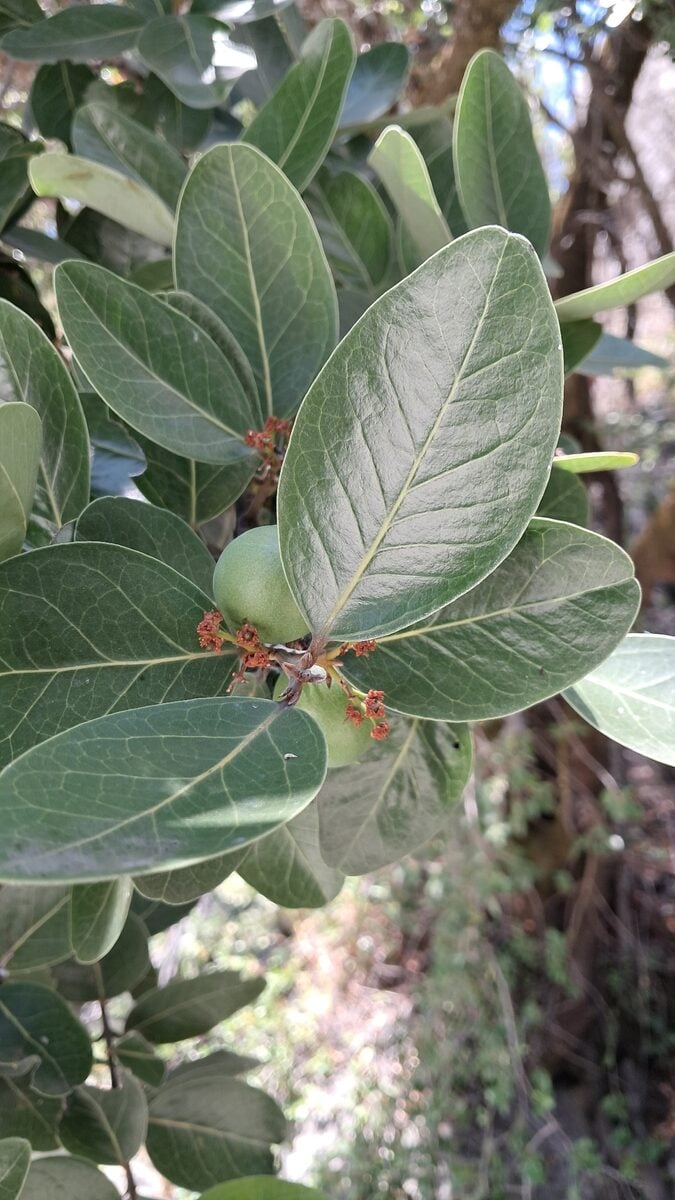
(c) Geoffrey Sinclair, some rights reserved (CC BY-NC), uploaded by Geoffrey Sinclair
iNaturalist· cc-by-nc
(c) Russell Cumming, some rights reserved (CC BY-NC)
Summary
Source: WikipediaCryptocarya densiflora, commonly known as cinnamon laurel or white laurel, is a tree in the laurel family and is native to north Queensland and parts of Indonesia. Its leaves are lance-shaped to elliptic, the flowers yellowish-green and brown, tube-shaped but not perfumed, and the fruit is a flattened spherical, reddish maroon drupe that turns black when ripe.
Description
A tree. It grows 7-20 m tall. The trunk is 12-40 cm across. The small branches have a rusty coating. The leaves are alternate and 10-15 cm long by 5-8.5 cm wide. The flowers are white. The fruit is brown to yellow but turns black when ripe.
Distribution
It is a tropical plant.
Where It Grows
Asia, Australia, Cambodia, China, Indonesia, Malaysia, Papua New Guinea, PNG, Philippines, SE Asia, Thailand, Vietnam,
Other Uses
The wood is finely grained, more or less heavy and durable. It is used for house construction and making furniture. Many Cryptocarya species that grow large enough are utilized for their timber, very often with several species being lumped together indiscriminately. Most species do not have very detailed individual descriptions of their timber - the following is a general description for the species. The heartwood is pinkish brown, grayish brown, reddish brown, or chocolate brown; it is not clearly differentiated from the somewhat lighter-coloured sapwood. The texture is rather fine to medium; the grain usually straight; lustre low; sometimes with an aromatic odour when freshly cut but without any distinctive odour or taste when dry. A silica content of up to 0:82% has been reported for some species. Some species are reported to be easy to season, whilst others have a tendency to warp and split. The wood is generally reported to be not difficult to work with hand and machine tools. Durability is variable with species; most species being not very durable when exposed to the elements. The sapwood is prone to powder-post beetle attack. The wood is often attractive and can be used for purposes such as cabinetwork, flooring, decorative veneers, panelling; whilst it is also often used for joinery, construction etc.
Synonyms
References (1)
- World Checklist of Useful Plant Species 2020. Royal Botanic Gardens, Kew