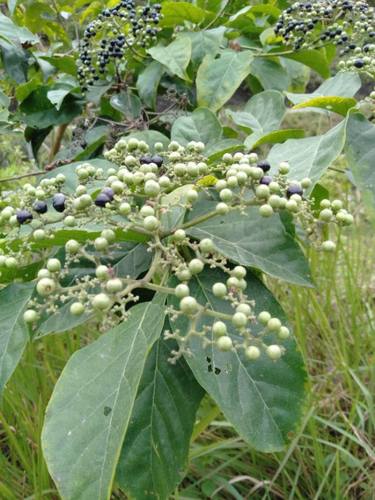
Perilla frutescens
(L.) Britton
Perilla, Beefsteak plant
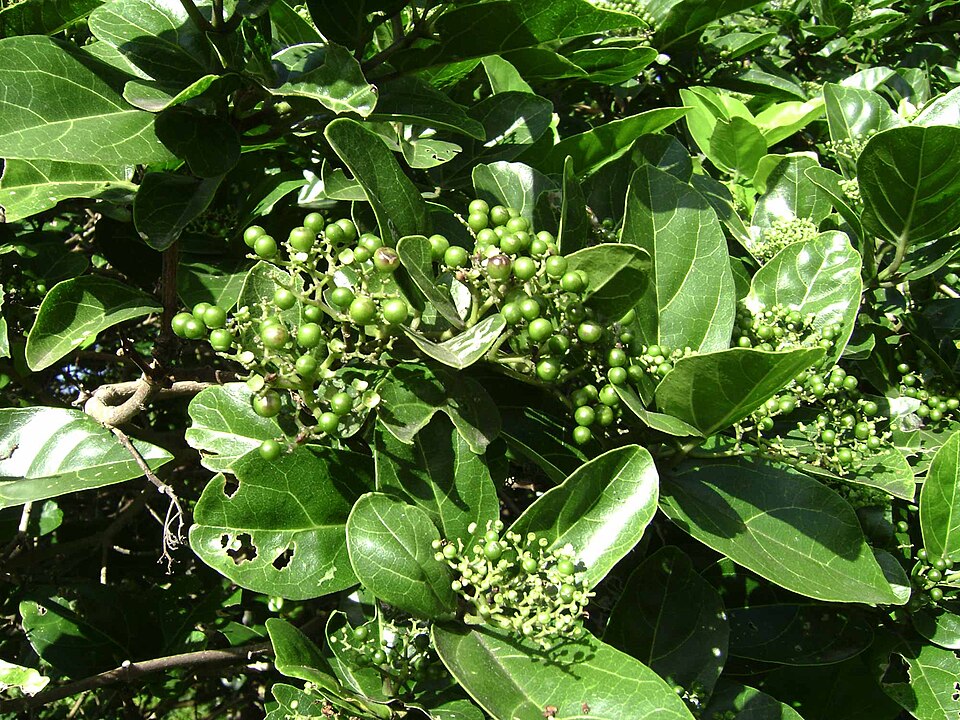
iNaturalist· cc-by-nc
(c) H. Wilson Montgomery, Jr., some rights reserved (CC BY-NC), uploaded by H. Wilson Montgomery, Jr.
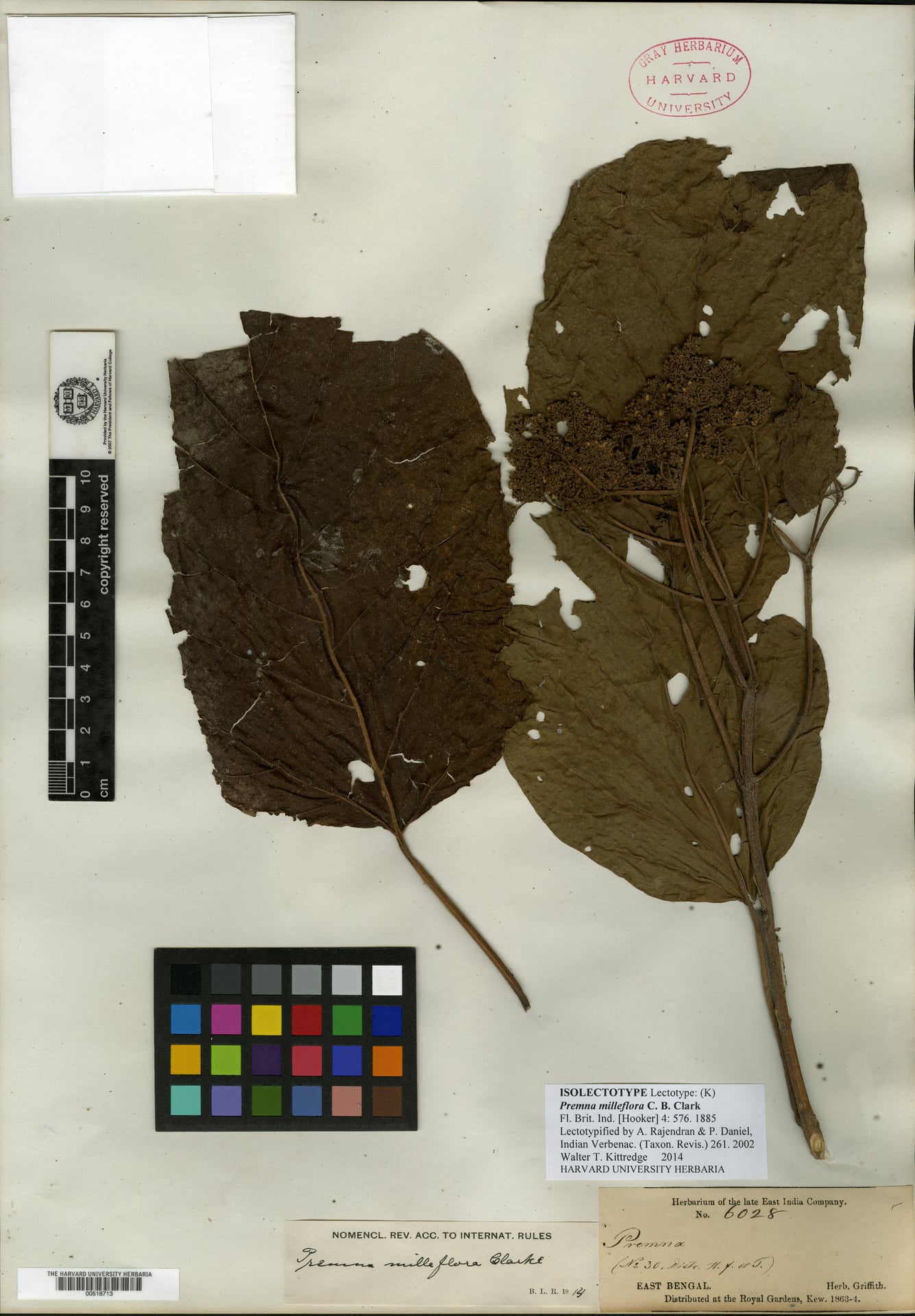
iNaturalist· cc-by-nc
(c) Cat, some rights reserved (CC BY-NC)
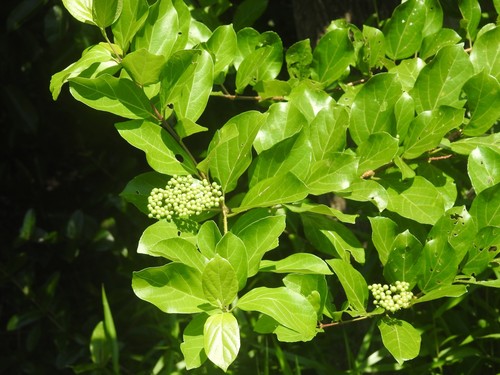
iNaturalist· cc-by-nc
(c) savernon, some rights reserved (CC BY-NC)
Summary
Source: WikipediaPerilla frutescens, known as deulkkae (Korean: 들깨) or Korean perilla in Korea, as egoma (Japanese: エゴマ) in Japan, and as zisu (Chinese: 紫苏) in China, is a species of Perilla in the mint family Lamiaceae. It is an annual plant native to Southeast Asia and Indian highlands, and is traditionally grown in the Korean peninsula, southern China, Japan and India as a crop. A variety of this plant, P. frutescens var. crispa known as "shiso", is widely grown in Japan. An edible plant, perilla is grown in gardens and attracts butterflies. It has a strong mint-like smell. The major volatile compound responsible for this characteristic aroma is perilla ketone, which is present in particularly high amounts in the leaves of Perilla frutescens described in this article. In the United States, Perilla frutescens is a weed pest, toxic to cattle after ingestion.
Description
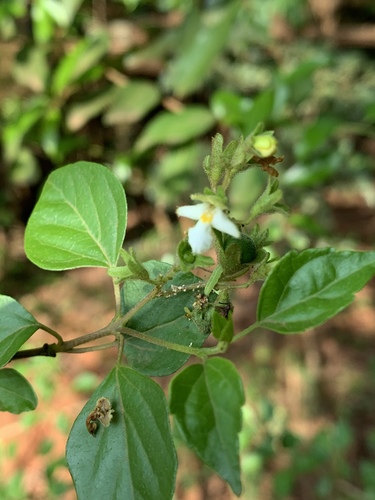
An erect herb. It re-grows each year. It grows from 30 cm to 2 m tall. The stems are square. Plants can be green or purple. The leaf stalk is 3-5 cm long. The leaves are oval and 4.5-10 cm long by 2.8-10 cm wide. They are toothed along the edge. Leaves are hairy on both surfaces. The flowers are white. They are in equal stalked flower clusters either in the axils of leaves or at the ends of branches. The fruit is a 1-seeded nutlet. There are a range of cultivated varieties.
Edible Uses
Young leaves and seedlings can be eaten raw or cooked. The flavour is unusual to western palates, with some people detecting cinnamon, others coriander or citrus. Seedlings are good added to salads, while older leaves work well as a garnish or flavouring. Older leaves are also salted and used as a condiment for tofu or as a garnish for tempura. Leaves from purple cultivars are used to colour preserved fruits, and leaves can be dried for later use. The leaves contain approximately 3.1% protein, 0.8% fat, 4.1% carbohydrate, and 1.1% ash. Immature flower clusters make a garnish for soups and chilled tofu, while older flower clusters are fried and eaten. The seeds are preserved in salt or used as a spice in pickles, tempura, and miso, and are one of the ingredients in the seven-spice mixture known as shichimi. Seeds can also be eaten cooked, with those from purple-leafed forms preferred for culinary use. Seeds contain approximately 21.5% protein, 43.4% fat, 11.3% carbohydrate, and 4.4% ash. An edible drying oil rich in linolenic acid is obtained from the seed. The plant also yields an essential oil used as a food flavouring in candies and sauces.
Traditional Uses
The young leaves, flowers and seeds are eaten cooked. They can be dried and used later. They are also used for flavouring. They are used in chutney. The young cotyledons are sprouted and eaten. The roasted seeds are pickled. The seed oil is used as an ingredient in cooking. They are used to improve the taste of curry. Caution: Wild forms are poisonous due to ketones. These are toxins to the liver.
Medicinal Uses
The leaves, stems, and seeds are widely used in Oriental medicine. The herb is pungent, aromatic, and warming, with antibacterial, antidote, antipyretic, antiseptic, antispasmodic, antitussive, aromatic, carminative, diaphoretic, emollient, expectorant, pectoral, stomachic, and tonic properties. Leaves are used to treat colds, chest stuffiness, vomiting, and abdominal pain, and the leaf juice is applied to cuts and wounds. The seed is antiasthmatic, antitussive, emollient, and expectorant, used internally for asthma, colds and chills, nausea, abdominal pain, food poisoning, allergic reactions (especially to seafood), bronchitis, and constipation. The stems are a traditional Chinese remedy for morning sickness. This herb should be avoided by pregnant women.
Known Hazards
Although perilla is widely cultivated as an edible plant for humans, it is toxic to cattle and other ruminants, as well as horses. In grazing cattle, plant ketones cause acute respiratory distress syndrome, also called "panting disease". Contact dermatitis may occur in people handling the leaves or oil. Consumption of large amounts of seeds has resulted in anaphylaxis.
Distribution
A tropical plant. Plants are frost tender. In Nepal they grow between 600-2400 m altitude. It needs rich, well-drained soil and full sun. It suits hardiness zone 8-11. In XTBG Yunnan. In Sichuan.
Where It Grows
Asia*, Australia, Bhutan, Cambodia, China, SE Asia, Europe, Hawaii, Himalayas*, India, Indochina, Indonesia, Japan, Korea, Laos, Malaysia, Myanmar, Nepal, North America, Northeastern India, Pacific, Pakistan, Papua New Guinea, PNG, Russia, SE Asia, Sikkim, Taiwan, Tasmania, Tibet, USA, Vietnam,
Cultivation
Plants are grown from seed. The seed need to be cooled to 5°C for 3 days before planting. Seed need light to germinate. Plants should be spaced about 30 cm apart.
Propagation
Surface-sow or only lightly cover the seed in mid spring in a greenhouse. Seeds germinate best at 20°C but will also succeed at slightly lower temperatures. Germination is usually quick; prick out seedlings into trays or individual pots when large enough to handle and plant out into permanent positions in early summer. Provide some protection such as a cloche until plants are growing well. Seed has a short viability and should be used when less than a year old.
Other Uses
A drying oil from the seed is used in making paints, varnishes, and waterproofing materials. The plant yields 0.3–1.3% essential oil containing 20% citral, used as a food flavouring and in dental products.
Other Information
It is a commercially cultivated vegetable. It is sold in local markets in China.
Notes
There is only one (6) Perilla species.
Nutrition
| Part | Moisture | kJ | kcal | Protein | Vit A | Vit C | Iron | Zinc |
|---|---|---|---|---|---|---|---|---|
| Leaves | 86 | 176 | 42 | 3.4 | — | — | 6.7 | — |
| Seeds | 88.2 | 176 | 42 | 2.6 | — | — | 1.3 | — |
Synonyms
Also Known As
Angami, Arim, Bai-su-zi, Ban tulsi, Bhangiro, Bhanjira, Che-so, Chiso, Deulkkae, Egoma, Gee so, Jen, Jhutela, Kenia, Kkaennip, Naga machala, Namdung, Ngaa khee mon, Perille verte cultivee, Ri ben bai su, Seelam, Shan-hnan, Shiso, Silam, Silame, Si leng, Sipui, Snem, Sookloti, Tanam, Thi, Tia To, Zhou bai su, Zi su
References (68)
- Perilla references Perilla frutescens
- Agarwal, R. & Chandra, V., 2019, Diversity of wild edible plants in the Mandal-Chopta forest, Uttarakhand. Journal of Medicinal Plants Studies 2019; 7(1): 89-92
- Altschul, S.V.R., 1973, Drugs and Foods from Little-known Plants. Notes in Harvard University Herbaria. Harvard Univ. Press. Massachusetts. no. 3921
- Ambasta, S.P. (Ed.), 2000, The Useful Plants of India. CSIR India. p 440
- Arora, R. K., 2014, Diversity in Underutilized Plant Species - An Asia-Pacific Perspective. Bioversity International. p 43, 107 (Also as Perilla arguta)
Show all 68 references Hide references
- Aryal, K. P., et al, 2018, Diversity and use of wild and non-cultivated edible plants in the Western Himalaya. Journal of Ethnobiology and Ethnomedicine (2018) 14:10
- Barua, U., et al, 2007, Wild edible plants of Majuli island and Darrang districts of Assam. Indian Journal of Traditional Knowledge 6(1) pp 191-194
- Brickell, C. (Ed.), 1999, The Royal Horticultural Society A-Z Encyclopedia of Garden Plants. Convent Garden Books. p 772
- Burkill, I.H., 1966, A Dictionary of the Economic Products of the Malay Peninsula. Ministry of Agriculture and Cooperatives, Kuala Lumpur, Malaysia. Vol 2 (I-Z) p 1723 (As Perilla nankinensis and also Perilla ocimoides Linn.)
- Cheifetz, A., (ed), 1999, 500 popular vegetables, herbs, fruits and nuts for Australian Gardeners. Random House p 146
- Cheng, Z., et al, 2022, Ethnobotanical study on wild edible plants used by Dulong people in northwestern Yunnan, China. Journal of Ethnobiology and Ethnomedicine (2022) 18:3
- Creasy, R., 2000, The Edible Asian Garden. Periplus p 52
- Cundall, P., (ed.), 2004, Gardening Australia: flora: the gardener's bible. ABC Books. p 1011
- Dangol, D. R. et al, 2017, Wild Edible Plants in Nepal. Proceedings of 2nd National Workshop on CUAOGR, 2017.
- Dobriyal, M. J. R. & Dobriyal, R., 2014, Non Wood Forest Produce an Option for Ethnic Food and Nutritional Security in India. Int. J. of Usuf. Mngt. 15(1):17-37
- Duke, J.A., 1992, Handbook of Edible Weeds. CRC Press. p 142
- Facciola, S., 1998, Cornucopia 2: a Source Book of Edible Plants. Kampong Publications, p 132
- Flora of Pakistan. www.eFloras.org
- Food Composition Tables for use in East Asia FAO http://www.fao.org/infoods/directory No. 332 (As Peria frutescens)
- Gautam, R. S., et al, 2020, Wild Edible Fruits of Nepal. Int. J. Appl. Sci. Biotechnol. Vol 8(3): 289-304
- Gouldstone, S., 1983, Growing your own Food-bearing Plants in Australia. Macmillan p 193
- Hibbert, M., 2002, The Aussie Plant Finder 2002, Florilegium. p 229
- Illustrated Flora of Central Texas p 768
- Kays, S. J., and Dias, J. C. S., 1995, Common Names of Commercially Cultivated Vegetables of the World in 15 languages. Economic Botany, Vol. 49, No. 2, pp. 115-152
- Khanal, R., et al, 2014, Documenting abundance and use of underutilized plant species in the mid hill region of Nepal. ECOPRINT 21: 63-71, 2014
- Kiple, K.F. & Ornelas, K.C., (eds), 2000, The Cambridge World History of Food. CUP p 1730, 1833
- Larkcom, J., 1991, Oriental Vegetables, John Murray, London, p 108, 137
- Lawton, B.P., 2002, Mints. A Family of Herbs and Ornamentals. Timber Press, Portland, Oregon. p 168
- Li, D. et al, 2017, Ethnobotanical survey of herbal tea plants from the traditional markets in Chaoshan, China. Journal of Ethnopharmacology. 205 (2017) 195-206
- Li Hai-wen, Hedge, I.C., Lamiaceae. Flora of China. p 319
- Liu, Yi-tao, & Long, Chun-Lin, 2002, Studies on Edible Flowers Consumed by Ethnic Groups in Yunnan. Acta Botanica Yunnanica. 24(1):41-56
- Manandhar, N.P., 2002, Plants and People of Nepal. Timber Press. Portland, Oregon. p 351
- Martin, F.W. & Ruberte, R.M., 1979, Edible Leaves of the Tropics. Antillian College Press, Mayaguez, Puerto Rico. p 196
- Medhi, P. & Borthakur, S. K., 2012, Phytoresources from North Cachur Hills of Assam -3: Edible plants sold at Hflong market. Indian Journal of Natural Products and Resources. 3(1) pp 84-109
- Mem. Torrey Bot. Club 5:277. 1894
- Miya, M. S. & Gautum, D., 2021, Checklist of floral species at the Institute of Forestry, Pokhara Campus, Pokhara, Nepal. Journal of Institute of Forestry, Nepal 18 (2021) 133-177
- Murtem, G. & Chaudhrey, P., 2016, An ethnobotanical note on wild edible plants of Upper Eastern Himalaya, India. Brazilian Journal of Biological Sciences, 2016, v. 3, no. 5, p. 63-81
- Myuki, N., Lee, J. K., and Ohnishi, O., 2003, Asian Perilla Crops and Their Weedy Forms: Their Cultivation, Utilization and Genetic Relationships. Economic Botany 57(2): 245-253
- Nabeta, K., and H.Sugisawa, 1983, Volatile components produced by callus tissues from the Perilla plants. Pages 65-84 in G.Charalambous and G. Inglett, eds., Instrumental analysis of foods. Vol.1 Academic Press, New York.
- Okazaki, N., M.Matsunaka, M.Kondo, and K.Okamoto, 1982, Contact dermatitis due to beefsteak plant. (Perilla frutescens Britton var. acuta Kudoa). Skin Res. 24:250-256.
- Patiri, B. & Borah, A., 2007, Wild Edible Plants of Assam. Geethaki Publishers. p 104
- Plants for a Future database, The Field, Penpol, Lostwithiel, Cornwall, PL22 0NG, UK. http://www.scs.leeds.ac.uk/pfaf/
- Raghavan, S., 2007, Handbook of Spices, Seasonings, and Flavourings. Second Edition. CRC Press p 70
- Saikia, M., 2015, Wild edible vegetables consumed by Assamese people of Dhemaji District of Assam, NE India and their medicinal values. Archives of Applied Science Research, 2015, 7 (5):102-109 (As Perilla ocymoides)
- Sarma, H., et al, 2010, Updated Estimates of Wild Edible and Threatened Plants of Assam: A Meta-analysis. International Journal of Botany 6(4): 414-423
- Savita, et al, 2006, Studies on wild edible plants of ethnic people in east Sikkim. Asian J. of Bio Sci. (2006) Vol. 1 No. 2 : 117-125 (As Perilla ocymoides)
- Schneider, E., 2001, Vegetables from Amaranth to Zucchini: The essential reference. HarperCollins. p 486
- Self, M., 199, Phoenix Seeds catalogue. p 7
- Singh, H.B., Arora R.K.,1978, Wild edible Plants of India. Indian Council of Agricultural Research, New Delhi. p 32
- Smith, K., 1998. Growing Uncommon Fruits and Vegetables. New Holland. p 53
- Solomon, C., 2001, Encyclopedia of Asian Food. New Holland. p 279
- Song, M., et al, 2013, Traditional knowledge of wild edible plants in Jeju Island, Korea. Indian Journal of Traditional Knowledge. 12(2) pp 177-194 (As var. japonica)
- Srivastava, R. C., 2009, Traditional knowledge of Adi tribe of Arunachal Pradesh on plants. Indian Journal of Traditional Knowledge. 8(2): 146-153 (As Perilla ocymoides)
- Staples, G.W. and Herbst, D.R., 2005, A tropical Garden Flora. Bishop Museum Press, Honolulu, Hawaii. p 360
- Taram, M., et al, 2018, Wild Food Plant Resources of Komkar Adi Tribe of Upper Siang District in Arunachal Pradesh, India. Bulletin of Arunachal Forest Research, Vol. 33(2), 27-35
- Terra, G.J.A., 1973, Tropical Vegetables. Communication 54e Royal Tropical Institute, Amsterdam, p 65
- Thomson, G. & Morgan, W., (Ed.) 2000, Access to Asian Foods Newsletter, Vic Govt., Australia Issue 30; 2001, Issue 38
- Ulian, T., et al, 2020, Unlocking plant resources to support food security and promote sustainable agriculture. Plants, People, Planet. 2020;2:421–445.
- Uprety, Y., et al, 2012, Diversity of use and local knowledge of wild edible plant resources in Nepal. Journal of Ethnobotany and Ethnomedicine 8:16
- Van Sam, H. et al, 2008, Uses and Conservation of Plant Species in a National Park. A case study of Ben En, Vietnam. Economic Botany 62:574-593
- van Wyk, B., 2005, Food Plants of the World. An illustrated guide. Timber press. p 284
- Wang, J. et al, 2013, A Study on the Utilization of Wild Plants for Food in Liangshan Yi Autonomous Prefecture. Plant Diversity and Resources. 35(4): 416-471
- Wang, J., et al, 2020, An ethnobotanical survey of wild edible plants used by the Yi people of Liangshan Prefecture, Sichuan Province, China. Journal of Ethnobiology and Ethnomedicine 16:10 p 7
- Wiersema, J. H. & Leon, B., 2013, World Economic Plants. A Standard Reference CRC Press. 2nd Ed. p 508
- Wilson, B.J., J.E. Garst , R.D. Linnabary, and R.B. Channell. 1977. Perilla ketone: a potent lung toxin from the mint plant, Perilla frutescens Britton. Science 197:573-574
- Woodward, P., 2000, Asian Herbs and Vegetables. Hyland House. p 108
- World Checklist of Useful Plant Species 2020. Royal Botanic Gardens, Kew
- Zeven, A. C. & de West, J. M. J., 1982, Dictionary of cultivated plants and their regions of diversity. Wageningen. p 39