Tournefortia argentea
Linn. f.
Silver leaf, Tree heliotrope
iNaturalist· cc-by-nc
(c) Lijin Huang (紫楝), some rights reserved (CC BY-NC)
iNaturalist· cc-by-nc
(c) Lijin Huang (紫楝), some rights reserved (CC BY-NC)
iNaturalist· cc-by-nc
(c) Lijin Huang (紫楝), some rights reserved (CC BY-NC)
Description
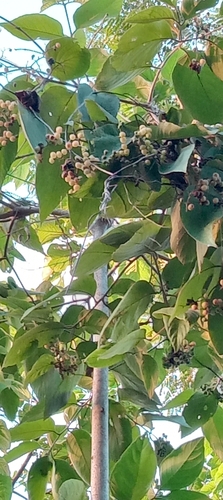
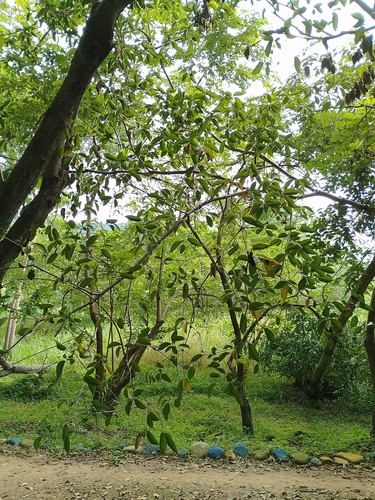
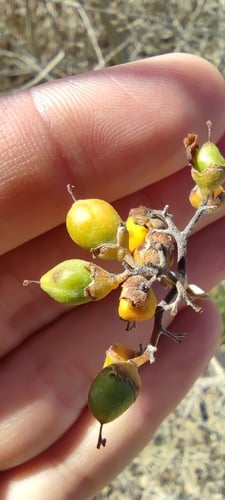
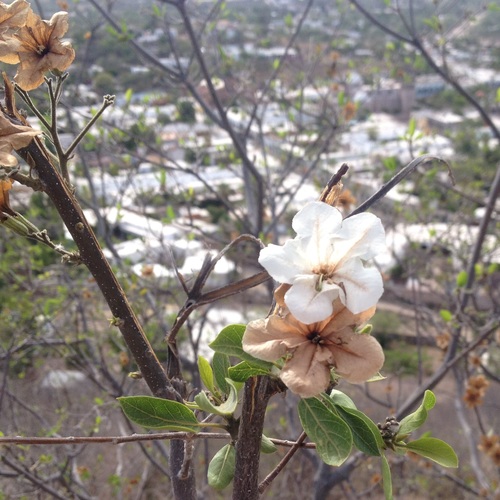
A shrub or small crooked tree. It grows 1-6 m high. The bark is light grey and deeply cracked. The leaves are light green and with silky hairs. The leaves are simple and alternate. They are broadly oval and in rings at the tips of the branches. The leaves are 10-30 cm long and 3-12 cm wide. The flowers are small, white and hairy. They occur in groups and have no stalks. The fruit are smooth and green. They are round and 5-8 mm long. There are 2-4 small nutlets that are light brown when dry.
Edible Uses
The leaves are eaten raw with a parsley-like taste, and are used for stuffing when cooking pigs. The fruit is also edible.
Traditional Uses
The leaves are eaten raw. They have the taste of parsley. They are also used for stuffing when cooking pigs.
This uses section is brief — help expand it
Medicinal Uses
The fruits are said to have antihistamine properties. The meristem and root inner bark are pounded to prepare a medicine that is used to treat children's rashes, diarrhoea and fish poisoning. Combined with the flesh of a coconut, it is used to treat haemorrrhoids. Combined with the juice of a young green coconut, it is drunk daily as a treatment for asthma. An infusion of the leaves is taken to treat poisoning caused by eating tainted fish. The leaves are used in a steam bath to treat bleeding and bruises; as a restorative for a woman after giving birth. The leaf juice is applied to infected cuts and stings from certain poison fish.. The heated leaves are placed on the eyes to treat blindness caused probably by gonococci. An infusion of the leaves is used to bathe red, sore or infected eyes, and also as a mouthwash for painful and loose teeth.
Distribution
A tropical and subtropical plant. It grows along sandy beaches in China. It grows in coastal regions up to 15 m altitude. It is usually in areas with rainfall or 300-5000 mm per year. It can grow in shallow, salty and infertile soils. It grows in areas with an average temperature of 20-32°C. It can be on rocky limestone banks. It needs good drainage. It can grow with soil pH of 6.1-7.4. It can tolerate windy coastal conditions.
Where It Grows
Africa, American Samoa, Asia, Australia, British Indian Ocean Terr., BIOT, Caroline Islands, China, Chuuk, Cook Islands, East Africa, East Timor, Fiji, Guam, Hawaii, India, Indian Ocean, Indochina, Indonesia, Japan, Kiribati, Madagascar, Malaysia, Maldives, Mariana Islands, Marshall islands, Micronesia, Mozambique, Nauru, New Caledonia, Pacific, Philippines, Polynesia, Russia, Samoa, SE Asia, SW Asia, Europe, Singapore, Solomon Islands, Sri Lanka, Taiwan, Timor-Leste, Tokelau, Tonga, Tuvalu, USA, Vietnam, Wallis & Futuna, Yap,
Cultivation
Plants can be grown from seed. Seeds are collected from ripe fruit. The flesh is rubbed off and the seeds planted, preferably fresh. Seeds germinate in 2-4 weeks. Seedlings can be planted in the field after 12 months. It can be grown from cuttings or by layering.
Propagation
Seed - best sown as soon as it is ripe, either in a nursery seedbed or in individual containers, in either a sunny or a lightly shaded position. Germination takes 2- 4 weeks. Seedlings take 12 months or more to become large enough to plant out, the preferred size is around 35cm tall with a woody stem around 10mm wide at the base. The seed is likely to have a viability of at least a few weeks if kept cool. Cuttings root easily. Hardwood cuttings are more successful than greenwood - they should be around 15 - 30cm long and generally form roots in 3 - 6 weeks. Air layering.
Other Uses
Children use the dried fruits as 'peas' in peashooters. The leaves contain tannins and are used in making a red dye. The leaves are used as a female deodorant. The wood is used in traditional house construction, for making certain parts of canoes, handicrafts, knife handles etc. The wood is frequently used as a fuel, and is also used for making fire by friction. The plant grows well on exposed coasts and can be used to form an important barrier that provides protection from salt-laden winds whilst also helping to stabilize the soil. The plant does not tolerate extensive pruning or shearing, but can be used as an untrimmed hedge or barrier plant. A natural colonizing species of hot, salty, windswept coastal areas, it can be used as a pioneer to help establish woodland gardens in costal areas. The leaves are considered to be an important mulch for the soil.
Production
It is slow growing.
Other Information
It is cultivated.
Notes
There are about 150 Tournefortia species. It can be invasive on some tropical islands.
Synonyms
Also Known As
Amoloset, Amonoset, Babakoan, Boshi, Chen, Ebu, Evu, Hunek, Hunig, Hunik, Irin, Ki bako, Kiden, Lorovahu asa hila-hila, N'vimbaleia, Rirs, Roronibebe, Sesen, Sisin, Sruhsruh, Tausuni, Tahinu, Tai'inu, Taihuni, Tau'unu, Tauhunu, Tausuni, Tausunu, Tchel, Te re, Te ren, Titin, Touhuni, Yamolehat
References (22)
- Ambasta, S.P. (Ed.), 2000, The Useful Plants of India. CSIR India. p 368 (As Messerschmidia argentea)
- Burkill, I.H., 1966, A Dictionary of the Economic Products of the Malay Peninsula. Ministry of Agriculture and Cooperatives, Kuala Lumpur, Malaysia. Vol 2 (I-Z) p 2209
- Cowie, I, 2006, A Survey of Flora and vegetation of the proposed Jaco-Tutuala-Lore National Park. Timor-Lests (East Timor) www.territorystories.nt/gov.au p 45
- Cribb, A.B. & J.W., 1976, Wild Food in Australia, Fontana. p 112
- Elevitch, C.R.(ed.), 2006, Traditional Trees of the Pacific Islands: Their Culture, Environment and Use. Permanent Agriculture Resources, Holualoa, Hawaii. p 775
Show all 22 references Hide references
- Flora of Solomon Islands
- Franklin, J., Keppel, G., & Whistler, W., 2008, The vegetation and flora of Lakeba, Nayau and Aiwa Islands, Central Lau Group, Fiji. Micronesica 40(1/2): 169–225, 2008
- Grubben, G. J. H. and Denton, O. A. (eds), 2004, Plant Resources of Tropical Africa 2. Vegetables. PROTA, Wageningen, Netherlands. p 565
- Heyne, K., 1927, p 1309
- Marinelli, J. (Ed), 2004, Plant. DK. p 470
- Martin, F.W. & Ruberte, R.M., 1979, Edible Leaves of the Tropics. Antillian College Press, Mayaguez, Puerto Rico. p 180
- Parham, B. E. V., 1972, Plants of Samoa. New Zealand Department of Scientific and Industrial Research. Information Series. No. 85 p 124 (As Messerschmidia argentea)
- Riedl, 1997, Boragniaceae, Flora Malesiana Ser. 1 Vol 13 p 117
- Schatz, G.E., 2001, Generic Tree Flora of Madagascar. Royal Botanical Gardens, Kew and Missouri Botanical Garden. p 86
- Selvam, V., 2007, Trees and shrubs of the Maldives. RAP Publication No. 2007/12 p 168
- Sujanapal, P., & Sankaran, K. V., 2016, Common Plants of Maldives. FAO & Kerala FRI, p 274
- Suppl. pl. 133. 1782 ("1781")
- Thaman, R. R., 1987, Plants of Kiribati: A listing and analysis of vernacular names. Atoll Research Bulletin No. 296
- Thaman, R. R, 2016, The flora of Tuvalu. Atoll Research Bulletin No. 611. Smithsonian Institute p 72
- Topp, J. M. W., 1988, An Annotated Check List of the Flora of Diego Garcia, British Ocean Territory. Atoll Research Bulletin No. 313
- Zeven, A. C. & de West, J. M. J., 1982, Dictionary of cultivated plants and their regions of diversity. Wageningen. p 51
- Zhu Ge-ling; Harald Riedl, Rudolf Kamelin, BORAGINACEAE, Flora of China