Pelargonium triste
(L.) L'Hér.
iNaturalist· cc-by-nc
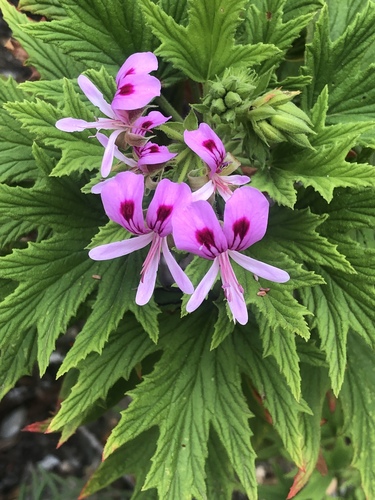
(c) Janine Schoombie, some rights reserved (CC BY-NC), uploaded by Janine Schoombie
iNaturalist· cc-by
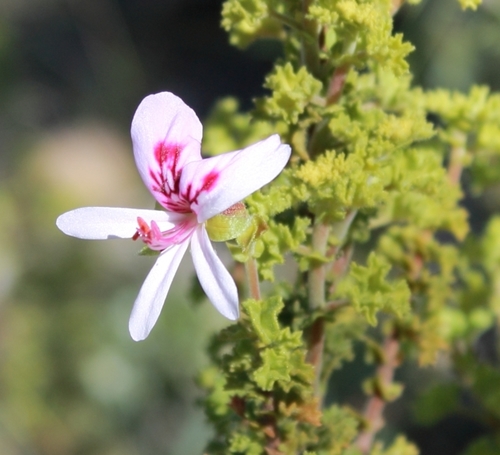
(c) Justin Ponder, some rights reserved (CC BY), uploaded by Justin Ponder
iNaturalist· cc-by-nc
(c) Fiona Hellmann, some rights reserved (CC BY-NC), uploaded by Fiona Hellmann
Summary
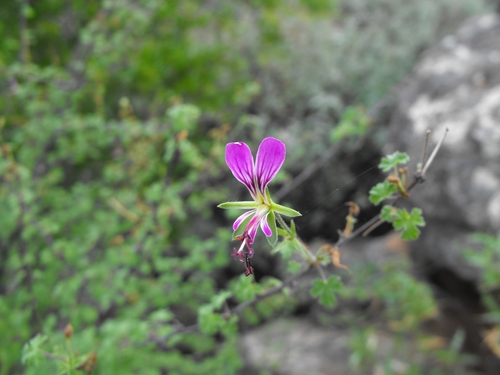
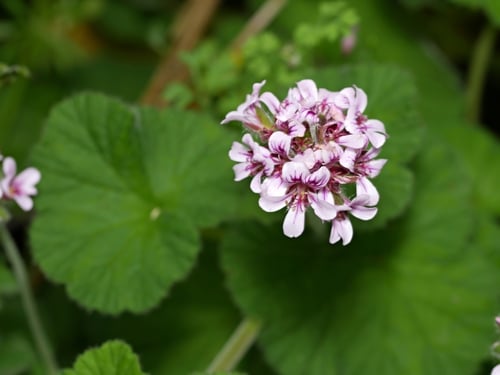
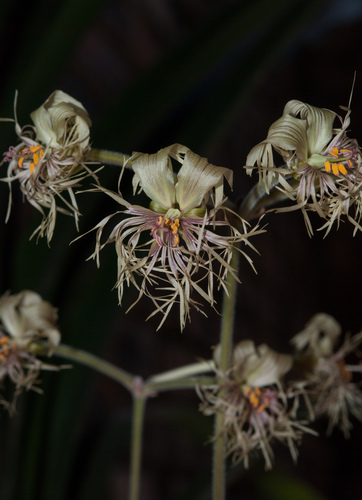
Source: WikipediaPelargonium triste, is a geophyte with flowering stems of about 25 cm (9.8 in) high on average, that is assigned to the Stork's bill family. It has hairy, divided and softly feathered leaves that are about twice as long as wide, resemble carrot leaves, and emerge from the tuberous rootstock directly at ground level. The bracts on the flowering stems are usually much smaller than the leaves at ground level. It carries inconspicuous, star-shaped flowers, each with a "spur" that is merged with the flower stalk, with five free green sepals, 5 pale yellow petals, 10 filaments, only 7 of them initially carrying an anther and a style with 5 curved branches. The flowers are crowded in umbels, and mostly there are slight to intense maroon to black markings that may be small or cover the entire petal except for a narrow line along the margins. In the evening, the flowers start to smell like cloves. Flowers may be found practically year round, but most proficiently from September to December. As typical for many species in the Stork's bill family, its fruits resemble the neck, head and bill of a stork. It is known as the night-scented pelargonium in English, kaneeltjie, pypkaneel or rooiwortel in Afrikaans and wit n/eitjie in the Khoi language.
Description
A small herb plant. It grows 50 cm high and spreads 60-100 cm wide. It keeps growing from year to year. It forms tubers. The leaves are finely divided and carrot like. The flowers are yellow and in heads of 5-20 flowers. They are 12 mm wide.
Edible Uses
The tuberous roots can be cooked like potatoes. A starch is also thought to be extractable from them.
Medicinal Uses
All parts of the plant are astringent.
Distribution
It is a subtropical plant. It suits hardiness zones 9-11.
Where It Grows
Africa, Australia, South Africa*, Southern Africa,
Propagation
Seed is best sown as soon as it is ripe in a greenhouse. Stored seed should be sown in early spring under glass. Germination requires a minimum temperature of 13°c and usually occurs within 2 weeks, though it can sometimes take several months. Prick seedlings out into individual pots when large enough to handle and grow on in the greenhouse for at least the first winter. If planting outdoors, set out in early summer and consider providing extra winter protection. Cuttings can be taken at almost any time during the growing season, though early summer is ideal to allow the new plant to establish before winter. The plant also spreads by means of its tuberous roots; young suckers can be potted up at any time of year and grown on in a greenhouse until established.
Other Uses
An essential oil is obtained from the plant.
Notes
There are about 230 Pelargonium species.
Nutrition
| Part | Moisture | kJ | kcal | Protein | Vit A | Vit C | Iron | Zinc |
|---|---|---|---|---|---|---|---|---|
| Bulb | 63.3 | 589 | 141 | 2 | — | 38.4 | 1.4 | 1.1 |
References (7)
- W. Aiton, Hort. kew. 2:418. 1789
- Cundall, P., (ed.), 2004, Gardening Australia: flora: the gardener's bible. ABC Books. p 996
- Fox, F. W. & Young, M. E. N., 1982, Food from the Veld. Delta Books. p 235
- Hedrick, U.P., 1919, (Ed.), Sturtevant's edible plants of the world. p 469
- Plants for a Future database, The Field, Penpol, Lostwithiel, Cornwall, PL22 0NG, UK. http://www.scs.leeds.ac.uk/pfaf/
Show all 7 references Hide references
- Ruiters-Welcome, A. K., 2019, Food plants of southern Africa. Ph.D. thesis. Univ. of Johannesburg p 64
- Welcome, A. K. & Van Wyk, B.-E., 2019, An inventory and analysis of the food plants of southern Africa. South African Journal of Botany 122 (2019) 136–179