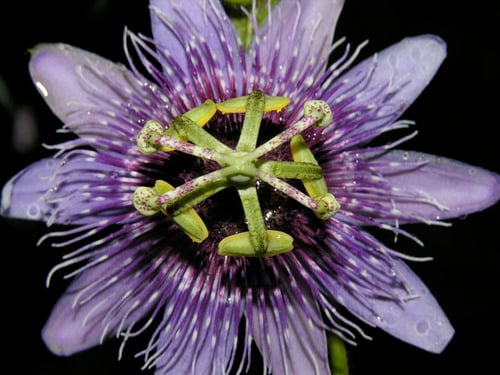
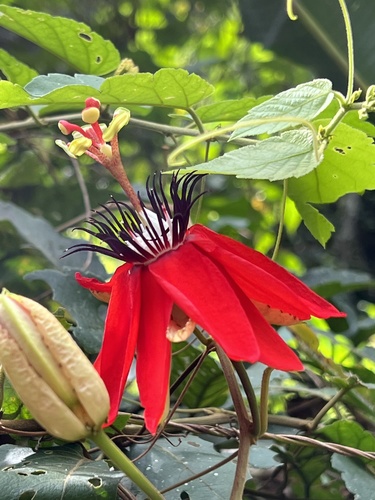
Passiflora antioquiensis
Karst.
Red Banana passionflower
iNaturalist· cc-by-nc
(c) David Monroy R, some rights reserved (CC BY-NC), uploaded by David Monroy R
Summary
Source: WikipediaPassiflora antioquiensis, the red banana passionfruit, is a species of flowering plant in the family Passifloraceae. It is native to Colombia and is named for the Antioquia Department in Colombia where the type specimen was collected. It was originally described by Gustav Karl Wilhelm Hermann Karsten in 1859. It has gained the Royal Horticultural Society's Award of Garden Merit. With Passiflora tripartita var. mollissima it was hybridised in the Veitch Nurseries in Exeter, England in the 1870s to yield Passiflora × exoniensis, which has also gained the Award of Garden Merit.
Description
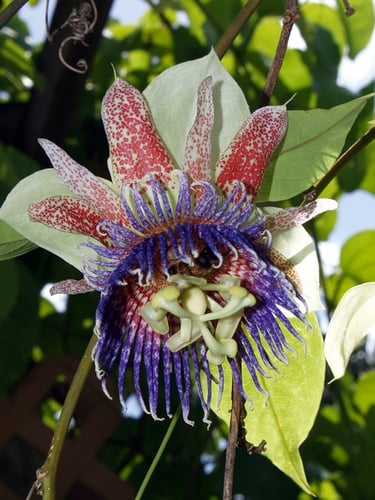
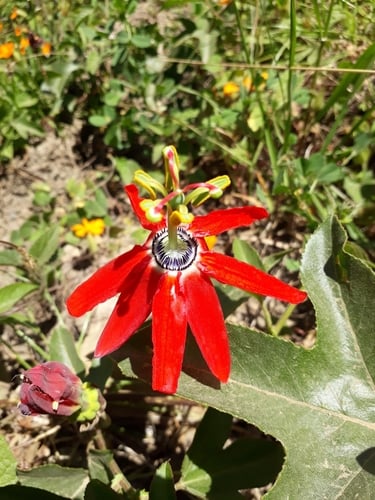
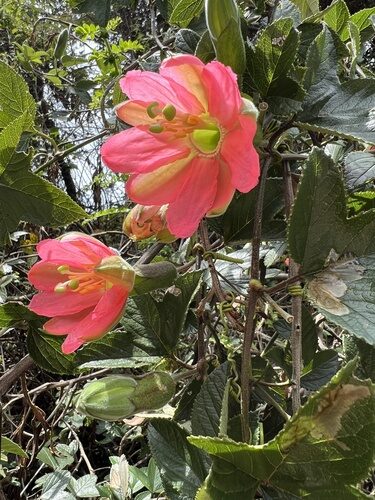
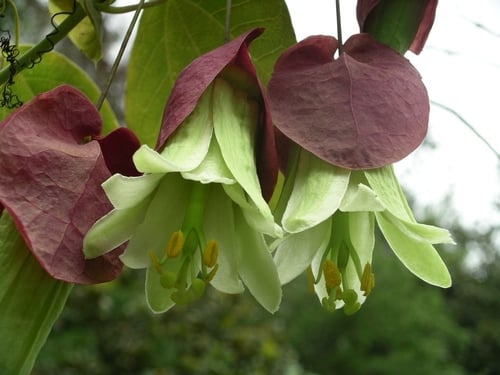
A vine. Young leaves are narrow and older leaves have 3 leaflets and are more broad. The red flowers hang on 40 cm long stems. The flowers can be 8-10 cm across. The fruit are banana shaped. They can be 10 cm long by 3 cm wide. They are yellow or red when ripe. The flesh is orange.
Edible Uses
The fruit can be eaten raw or used for making drinks. It has a sweet, vanilla-like flavour and is considered the best-flavoured passion fruit in the genus. The yellow, ellipsoid fruits have an aromatic pulp and measure 4 - 5cm long.
Traditional Uses
The fruit are eaten. They are also used for drinks.
This uses section is brief — help expand it
Medicinal Uses
None known
Distribution
A tropical plant. It grows in highland regions. It can grow in reasonable soil. It is fairly sensitive to cold temperatures. It needs good drainage and can grow in sun or light shade. It grows wild above 2,000 m in Papua New Guinea. In the Andes it grows between 800-2,000 m above sea level.
Where It Grows
Andes, Asia, Australia, Colombia, India, Indonesia, New Zealand, Papua New Guinea, PNG, SE Asia, South America*,
Cultivation
A plant of higher elevations in the moister tropics. It can also be grown successfully at lower elevations in the tropics and subtropics. Tolerant of occasional slight frosts. Requires a humus-rich, moist but well-drained soil and a position in dappled shade. Prefers a circumneutral soil, disliking very acid or very alkaline conditions. Passiflora species tend to flower and fruit more freely when grown in soils of only moderate fertility. Plants require a temperature no lower than around 16°c when they are flowering in order to ensure fruit set. Plants produce tendrils and climb by attaching these to other plants. Plants are very tolerant of pruning and can be cut back to ground level if required to rejuvenate the plant. Plants in this genus are notably resistant to honey fungus.
Propagation
Seed - best sown as soon as it is ripe along with the pulp, which helps break down the seed coat and speed up germination. Stored seed should be soaked for 24 hours in warm water; germination can be further improved by mixing the seed with the juice of a fresh passion fruit of any species. Even so, stored seeds can take up to 12 months to germinate. Place the seed tray in a shady position at a temperature of around 19 - 24°c. Prick seedlings out into individual containers as soon as they are large enough to handle and plant out when large enough. Cuttings of young shoots taken at the nodes root well in a neutral to slightly acid compost, though 100% sharp sand also produces good results. Cuttings of fully mature wood taken at a node can take 3 months but usually achieve a high percentage success rate. Layering is very easy. Air layering is also suitable.
Other Uses
None known
Production
Plants bear in 2 years. Plants last for 5 years.
Other Information
It is cultivated.
Notes
There are about 400 Passiflora species.
Synonyms
Also Known As
Curuba antioqueana, Gulupa fruta
References (27)
- Arora, R. K., 2014, Diversity in Underutilized Plant Species - An Asia-Pacific Perspective. Bioversity International. p 80
- Bodkin, F., 1991, Encyclopedia Botanica. Cornstalk publishing, p 764
- Brickell, C. (Ed.), 1999, The Royal Horticultural Society A-Z Encyclopedia of Garden Plants. Convent Garden Books. p 755
- Cárdenas M. 1989. Manual de Plantas Económicas de Bolivia. Enciclopedia Boliviana. “Los Amigos del Libro”, 2da edición. La Paz, Cochabamba. Bolivia
- Castillo, R. O., 1995, Plant Genetic Resources in the Andes: Impact, Conservation, and Management. Crop Science 35:355-360
Show all 27 references Hide references
- Coppens d'Eeckenbrugge, G., S.D. Segura and E. Hodson de Jaramillo. 1997. Les fruits de la passion. Pp. 291-312 In L'amélioration des plantes tropicales. (A. Charrier and M. Jacquot ,eds.). CIRAD
- Facciola, S., 1998, Cornucopia 2: a Source Book of Edible Plants. Kampong Publications, p 166
- Flowerdew, B., 2000, Complete Fruit Book. Kyle Cathie Ltd., London. p 136
- Fouqué, A. 1972. Espèces fruitières d'Amérique tropicale. Institut français de recherches fruitierès outre-mer (ifac)
- Gori, B., et al, 2022, Understanding the diversity and biogeography of Colombian edible plants. Scientific Reports 12:7835
- Gouldstone, S., 1983, Growing your own Food-bearing Plants in Australia. Macmillan p 114
- Hibbert, M., 2002, The Aussie Plant Finder 2002, Florilegium. p 219
- Kermath, B. M., et al, 2014, Food Plants in the Americas: A survey of the domesticated, cultivated and wild plants used for Human food in North, Central and South America and the Caribbean. On line draft. p 611
- Linnaea 30:162. 1859-1860
- Lopez-Diago, D. & Garcia, N., 2021, Wild edible fruits of Colombia. Biota ColomBiana 22 (2) p 46
- Lord, E.E., & Willis, J.H., 1999, Shrubs and Trees for Australian gardens. Lothian. p 335
- Lyle, S., 2006, Discovering fruit and nuts. Land Links. p 316
- Martin, F. W., et al, 1987, Perennial Edible Fruits of the Tropics. USDA Handbook 642 p 50
- National Research Council. 1989. Lost crops of the Incas: little-known plants of the Andes with promise for worldwide cultivation. National Academy Press, Washington DC, U.S.A.
- PROSEA No. 2
- Purseglove, J.W., 1968, Tropical Crops Dicotyledons, Longmans. p 421
- Roa, J. A. G. & Boada, D. S. G., 2018, Fundación para el Fortalecimiento de la Fruticultura y Plantas Alimenticias no Convencionales en Colombia.
- Ulmer, T., & MacDougal, J.M., 2004, Passiflora Passionflowers of the World. Timber Press. p 69
- Uphof,
- USDA, ARS, National Genetic Resources Program. Germplasm Resources Information Network - (GRIN). [Online Database] National Germplasm Resources Laboratory, Beltsville, Maryland. Available: www.ars-grin.gov/cgi-bin/npgs/html/econ.pl (10 April 2000)
- Wiersema, J. H. & Leon, B., 2013, World Economic Plants. A Standard Reference CRC Press. 2nd Ed. p 499
- World Checklist of Useful Plant Species 2020. Royal Botanic Gardens, Kew