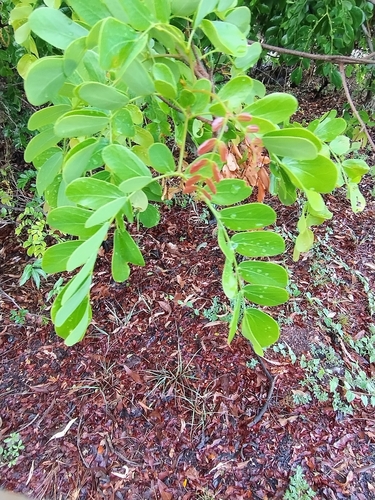
Parkia filicoidea
Welw. ex Oliver
African locust bean
iNaturalist· cc-by-nc
(c) Mark Hyde, Bart Wursten and Petra Ballings, some rights reserved (CC BY-NC)
iNaturalist· cc-by-nc
(c) Mark Hyde, Bart Wursten and Petra Ballings, some rights reserved (CC BY-NC)
iNaturalist· cc-by-nc
(c) Mark Hyde, Bart Wursten and Petra Ballings, some rights reserved (CC BY-NC)
Summary
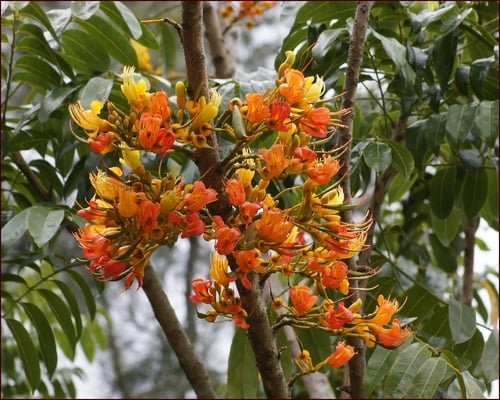
Source: WikipediaParkia filicoidea, or African locust bean ('filicoidea' - fern-like foliage), is a large, spreading flat-crowned tree to 30 metres tall, the bole of which may be narrowly buttressed to a height of about 3 metres, and up to 120 cm DBH. It occurs in wet evergreen or semi-deciduous forest, sometimes on forest fringes, riverbanks and lakes, termite mounds, at elevations up to 1000 metres from Côte d'Ivoire, east to Sudan and Somalia, Uganda, Kenya, Malawi and south to Angola, Zambia, Zimbabwe and Mozambique. Bark on trunk scaly or smooth, grey to yellow-brown, branchlets glabrous to puberulous. Upper surface of leaf petiole usually with 2 narrow glands; rhachis puberulous; 4–11 pinna pairs; 11–17 pinnule pairs, oblong, rounded at apex, asymmetrically rounded or subtruncate at base, averaging 1.2–3.2 cm. long, 5–12 mm. wide, glabrous but slightly puberulous near base, 2 longitudinal nerves more distinct than the others. Its flowers are unusual in being pendant on long stalks - 9–52 cm. long - in densely-packed claviform heads of about 7 cm diameter, brick-red to reddish-pink, with a pungent smell. The ensuing black, shiny, pods form in bunches, are 25–80 cm long and 2–4 cm wide, and enclose a dry, powdery, yellowish-orange pulp, eaten as a snack or made into a yellow meal, and in which are embedded some 20 dark-brown seeds. The mature seedpod breaks into segments, which remain connected to one edge of the pod. The tree is often planted as fodder, and also to improve the soil's nutrients. It propagates readily by seed, which having no dormant period will deteriorate rapidly, and should be sown quickly. Seeds freshly extracted will germinate even in the absence of water. Seeds found in elephant and baboon droppings readily germinated. Seeds are boiled and allowed to ferment, producing strong-smelling, blackish, paste used as a food and seasoning. This smell, caused by lipid changes during processing and storage, is eliminated by frying or roasting. Seeds have a high percentage of protein (32%) and a low fat content (10%). Seed oil is 54% unsaturated fatty acids - the main fatty acids being oleic acid (43%), stearic acid (17%) and linoleic acid (11%). Parkia filicoidea is briefly deciduous, mostly while flowering during the dry season, though flowering trees have been recorded throughout the year in Kenya and Tanzania. Sterile, nectar-producing flowers, attract pollinating bats at night and squirrels by day. Fruits develop over the ensuing 2 – 3 months. The species is symbiotic with some soil bacteria, forming root nodules and fixing atmospheric nitrogen, part of which is utilized by the plant and the remainder by neighbouring plants. The bark of this species is used in tribal medicine, a decoction is taken to stimulate lactation (galactagogue), as a treatment for malaria, and to ease rheumatism and toothache. The fruit pulp, the leaves and the seeds are also used to feed livestock and poultry. The timber is white, soft, and easily worked, with interlocked grain and coarse texture, showing a tendency to picking-up during planing. It is not durable and prone to termite, pinhole borer and marine borer attacks. Heartwood is straw-coloured with a pink or green tint, becoming reddish-brown on exposure. Freshly-cut wood has an unpleasant odour.
Description
A deciduous tree up to 30-35 m tall. It has a spreading flat crown. The trunk has small rounded buttresses. The bark is scaly or smooth and grey to yellow brown. The bark becomes dark and cracked with age. If the bark is cut it has an orange coloured resin. The leaves are feathery. A leaf is made up of 6-9 pairs of leaflets each divided into 16-24 pairs of smaller leaflets. These are about 2 cm long and 5-8 mm wide. The flowers are small in bright red club shaped heads. These hang down on stalks 30 cm long. The flower heads are up to 8 cm long. The fruit are pods which hang down in clusters. They are dark brown to purple. They are 30-60 cm long and 2 cm wide with their stalk. The pod is narrowed slightly between the seeds. The seeds are red brown in a dry mealy pulp. The pulp is yellow. The pulp is edible.
Edible Uses
The yellow pulp inside the pods is eaten; seeds are boiled, fermented, and eaten (the strong smell is removed by frying or roasting), or powdered for flavoring soups and rice dishes; seeds are pressed for cooking oil; and the leaves are cooked as a vegetable.
Traditional Uses
The pods are eaten cooked. The pulp in the pods is eaten. The seeds are boiled and fermented then eaten. This has a strong smell but is removed by frying or roasting. The seeds can also be powdered and used for flavouring soups and rice dishes. The leaves are cooked as used as a vegetable. The seeds are pressed for cooking oil.
Medicinal Uses
Seeds contain 26% protein and are rich in calcium.
Distribution
A tropical and subtropical tree of lowland rainforests. It grows in Africa in forests near streams. It occurs in subhumid and humid places with a rainfall between 950 and 1750 mm annually. It grows between 250-1,500 m above sea level. It can grow in arid places.
Where It Grows
Africa, Angola, Cameroon, Central Africa, Central African Republic, CAR, Chad, Congo, Côte d'Ivoire, East Africa, Gabon, Ghana, Ivory Coast, Kenya, Malawi, Mozambique, Nigeria, Southern Africa, Sudan, Tanzania, Togo, Uganda, West Africa, Zambia, Zimbabwe,
Cultivation
Plants can be grown from seed. To extract the seed the pod is crushed then the seed removed from the pulp. Before sowing the seed they should be boiled briefly then alowed to cool and soaked for 12 hours.
Propagation
Parkia filicoidea can be propagated by seed. The seeds have no period of dormancy and deteriorate rapidly, so they should be sown quickly. Removal of the seedcoat, boiling for a short time or soaking in water overnight improve germination. Fresh seeds extracted from the fruit already started to germinate without any contact with external water. In Kenya seeds found in fresh elephant and baboon faeces germinated soon after collection. In tests in Malawi, however, seeds failed to germinate regardless of the pre-treatment
Other Uses
The bark contains 12 - 14% tannin. A red dye is obtained from the bark. The tough, inner lining of the seedpods is used for cordage. The white wood is soft, moderately easy to work with hand and machine tools, and a reduced cutting angle is necessary to avoid picking-up during planing. The nailing and gluing properties are satisfactory. The wood is not durable and is liable to termite, pinhole borer and marine borer attacks, but it is comparatively easy to treat with preservatives. The heartwood is straw-coloured with a pink or green sheen, turning reddish brown on exposure, and often indistinctly demarcated from the sapwood. The grain is interlocked, texture coarse. Growth rings distinct. The fresh wood has an unpleasant odour. The wood is used for poles, mortars, water containers, stools and beehives. It is suitable for light construction, interior trim, furniture, cabinet work, vehicle bodies, sporting goods, toys, novelties, handles, boxes, crates, matches, plywood, hardboard and particle board. The wood is used as firewood and for charcoal production. The tree has an open, widely-spreading crown, and also fixes atmospheric nitrogen, this makes it useful as a shade tree in plantations.
Production
In Tanzania mature fruit are collected from January to April.
Notes
26% protein in seeds. Rich in calcium, Also as Mimosaceae.
Nutrition
| Part | Moisture | kJ | kcal | Protein | Vit A | Vit C | Iron | Zinc |
|---|---|---|---|---|---|---|---|---|
| Seeds dried | 7 | 1780 | 426 | 32.3 | — | 6 | 33.2 | — |
| Fruit | 13.2 | 1263 | 303 | 3.4 | — | — | 3.6 | — |
Synonyms
Also Known As
Durumi, Iseha, M'kundi, Micunti, Mkunde, Mkundi, Mnienzi, Mnyesa, Mucunti, Mucuti, Muindi, Musyepwa, Mwensa, Nkundi, Skapya
References (32)
- Atato, A., et al, 2010, Diversity of Edible Wild Fruit Tree Species of Togo. Global Science Books.
- Burkill, I.H., 1966, A Dictionary of the Economic Products of the Malay Peninsula. Ministry of Agriculture and Cooperatives, Kuala Lumpur, Malaysia. Vol 2 (I-Z) p 1697
- Chapman, J. D. & Chapman, H. M., 2001, The Forest Flora of Taraba and Andamawa States, Nigeria. WWF & University of Canterbury. p 184
- Dale, I. R. and Greenway, P. J., 1961, Kenya Trees and Shrubs. Nairobi. p 305
- Facciola, S., 1998, Cornucopia 2: a Source Book of Edible Plants. Kampong Publications, p 152
Show all 32 references Hide references
- FAO, 1988, Traditional Food Plants, FAO Food and Nutrition Paper 42. FAO Rome p 389
- Fl. trop. Afr. 2:324. 1871
- Fowler, D. G., 2007, Zambian Plants: Their Vernacular Names and Uses. Kew. p 35
- Garba, A., Useful Plants in the Chad region of North-East Nigeria.
- Grivetti, L. E., 1980, Agricultural development: present and potential role of edible wild plants. Part 2: Sub-Saharan Africa, Report to the Department of State Agency for International Development. p 66
- Grubben, G. J. H. and Denton, O. A. (eds), 2004, Plant Resources of Tropical Africa 2. Vegetables. PROTA, Wageningen, Netherlands. p 563
- ILDIS Legumes of the World http:www:ildis.org/Legume/Web
- Jardin, C., 1970, List of Foods Used In Africa, FAO Nutrition Information Document Series No 2.p 27, 153
- Katende, A.B., Birnie, A & Tengnas B., 1995, Useful Trees and Shrubs for Uganda. Identification, Propagation and Management for Agricultural and Pastoral Communities. Technical handbook No 10. Regional Soil Conservation Unit, Nairobi, Kenya. p 476
- Kiple, K.F. & Ornelas, K.C., (eds), 2000, The Cambridge World History of Food. CUP p 1714
- Le Houerou, H. N., (Ed.), 1980, Browse in Africa. The current state of knowledge. International Livestock Centre for Africa, Ethiopia. p 163
- Lovett, J. C. et al, Field Guide to the Moist Forest Trees of Tanzania. p 81
- Macmillan, H.F. (Revised Barlow, H.S., et al) 1991, Tropical Planting and Gardening. Sixth edition. Malayan Nature Society. Kuala Lumpur. p 327
- Malaisse, F., 1997, Se nourrir en floret claire africaine. Approche ecologique et nutritionnelle. CTA., p 67
- Menninger, E.A., 1977, Edible Nuts of the World. Horticultural Books. Florida p 97
- Mutie, F. M., et al, 2023, Important Medicinal and Food Taxa (Orders and Families) in Kenya, Based on Three Quantitative Approaches. Plants 2023, 12, 1145
- Peters, C. R., O'Brien, E. M., and Drummond, R.B., 1992, Edible Wild plants of Sub-saharan Africa. Kew. p 130
- Prins, H. & Maghembe, J. A., 1994, Germination studies on seed of fruit trees indigenous to Malawi. Forest Ecology and Management 64:111-125
- Purseglove, J.W., 1968, Tropical Crops Dicotyledons, Longmans. p 208
- Royal Botanic Gardens, Kew (1999). Survey of Economic Plants for Arid and Semi-Arid Lands (SEPASAL) database. Published on the Internet; http://www.rbgkew.org.uk/ceb/sepasal/internet [Accessed 28th April 2011]
- Ruffo, C. K., Birnie, A. & Tengnas, B., 2002, Edible Wild Plants of Tanzania. RELMA p 514
- Terra, G.J.A., 1973, Tropical Vegetables. Communication 54e Royal Tropical Institute, Amsterdam, p 64
- van Wyk, B., 2005, Food Plants of the World. An illustrated guide. Timber press. p 278
- Vickery, M.L. and Vickery, B., 1979, Plant Products of Tropical Africa, Macmillan. p 25
- Vivien, J. & Faure, J.J., 1985, Abres des forets dense d'Afrique Centrale. Agence de Cooperation Culturelle et Technique. Paris. p 294
- White, F., Dowsett-Lemaire, F. and Chapman, J. D., 2001, Evergreen Forest Flora of Malawi. Kew. p 317
- Williamson, J., 2005, Useful Plants of Malawi. 3rd. Edition. Mdadzi Book Trust. p 188