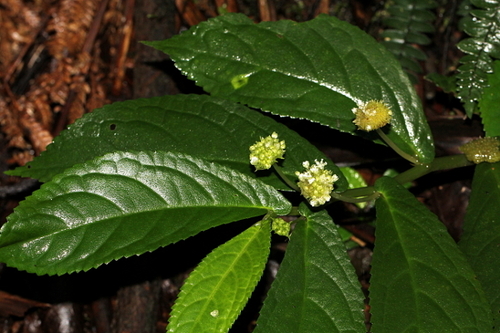
Parietaria judaica
L.
Pellitory of the wall
iNaturalist· cc-by-nc
(c) Sebastian Ćato, some rights reserved (CC BY-NC), uploaded by Sebastian Ćato
iNaturalist· cc-by-nc
(c) Valerio Lazzeri, some rights reserved (CC BY-NC)
iNaturalist· cc-by-nc
(c) jaigol, some rights reserved (CC BY-NC), uploaded by jaigol
Summary
Source: WikipediaParietaria judaica, spreading pellitory, is a species of herbaceous perennial flowering plant in the family Urticaceae. It is native to the eastern Mediterranean and Middle East, and is widely established worldwide as an urban weed. Its pollen is a significant cause of asthma and other allergies in warmer countries, but it is also valued as a contributor to biodiversity in polluted cities and it has been used as a medicinal herb.
Description
A perennial herb which grows 60 cm tall. It spreads to 60 cm across. Male and female plants must be grown if seed is required. The leaves are oval and have hairs on the veins underneath. The flowers are green and in clusters in the axils of the leaves. The flowers are either male or female and borne on the same plant.
Edible Uses
The young plant can be eaten raw or cooked, and the young shoots make a good addition to mixed salads.
Traditional Uses
The young shoots are eaten raw or cooked.
This uses section is brief — help expand it
Medicinal Uses
Pellitory of the wall has been valued for over 2,000 years as a diuretic, a soother of chronic coughs, and a balm for wounds and burns. European herbal medicine regards it as having a restorative action on the kidneys, supporting and strengthening their function. The whole herb, gathered in flower, is cholagogue, slightly demulcent, diuretic, laxative, refrigerant, and vulnerary. It is an effective remedy for kidney and bladder stones and urinary complaints such as cystitis and nephritis. It should not be prescribed to people with hay fever or other allergic conditions. The leaves can be applied externally as a poultice on wounds and have a soothing effect on simple burns and scalds. The plant is harvested when flowering and can be used fresh or dried.
Known Hazards
Should not be prescribed to people with hay fever or other allergic conditions.
Distribution
It is a temperate plant. It grows on hedgebanks and dry walls. It does best in an alkaline soil. It grows in well drained to dry soils and can grow in full sun or light shade. In Argentina it grows from sea level to 1,500 m above sea level. It suits hardiness zones 5-10. Hobart Botanical Gardens 1
Where It Grows
Argentina, Australia, Bolivia, Brazil, Britain, Central America, Central Asia, Chile, Europe*, France, Haiti, Israel, Italy, Luxembourg, Mediterranean, Middle East, New Zealand, Palestine, Paraguay, Sicily, South America, Spain, Tajikistan, Tasmania, Turkey, Türkiye, Uruguay, West Indies,
Cultivation
Prefers a well-drained to dry alkaline soil in full sun or semi-shade. The plant grows well on drystone walls. This plant is sometimes erroneously called P. officinalis. The true P. officinalis. L. is an European plant that is not found in Britain, P. judaica is its British representative. The pollen of this plant is one of the earliest and most active of the hay fever allergens. Dioecious. Male and female plants must be grown if seed is required.
Propagation
Sow seed in spring or autumn in a cold frame. Prick out seedlings when large enough to handle and plant out in summer. If sufficient seed is available, sow in situ in autumn or spring. Divide in spring — larger divisions can go directly into permanent positions, while smaller divisions are better potted up and grown on in light shade in a cold frame until well established before planting out in late spring or early summer.
Other Uses
The whole plant is used for cleaning windows and copper containers.
Notes
There are about 20 Parietaria species.
Nutrition
| Part | Moisture | kJ | kcal | Protein | Vit A | Vit C | Iron | Zinc |
|---|---|---|---|---|---|---|---|---|
| Leaves | 80 | 155 | 38 | 5.4 | — | — | — | — |
Synonyms
Also Known As
Erva-de-santaana, Hierba de los gatos, Hierba de los muros, Parietaire, Parietaria, Pellitory-of-the-wall, Quebra-paredes, Spreading Pellitory, Wila itapallo, Yerba de las murallas
References (16)
- Blamey, M and Grey-Wilson, C., 2005, Wild flowers of the Mediterranean. A & C Black London. p 35
- Cordero, S. E., Abello, L. A., & Galvez, F. L., 2017, Plantas silvestres comestibles y medicinales de Chile y otras partes del mundo. CORMA p 214
- Cundall, P., (ed.), 2004, Gardening Australia: flora: the gardener's bible. ABC Books. p 986
- Dashorst, G.R.M., and Jessop, J.P., 1998, Plants of the Adelaide Plains & Hills. Botanic Gardens of Adelaide and State Herbarium. p 48
- Facciola, S., 1998, Cornucopia 2: a Source Book of Edible Plants. Kampong Publications, p 243 (As Parietaria officinalis)
Show all 16 references Hide references
- Flora of Australia, Volume 3, Hamamelidales to Casuarinales, Australian Government Publishing Service, Canberra (1989) p 92, Fig 14
- Fl. palaest. 32. 1756
- Guil-Guerrero, J. L., et al, 2001, Edible Wild Plants. in Recent Progress in Medicinal Plants Vol. 8 Sci. Tech publishing, Texas (As Parietaria diffusa)
- Hedrick, U.P., 1919, (Ed.), Sturtevant's edible plants of the world. p 463 (As Parietaria officinalis)
- Hibbert, M., 2002, The Aussie Plant Finder 2002, Florilegium. p 219
- Hussey, B.M.J., Keighery, G.J., Cousens, R.D., Dodd, J., Lloyd, S.G., 1997, Western Weeds. A guide to the weeds of Western Australia. Plant Protection Society of Western Australia. p 226
- Malezas Comestibles del Cono Sur, INTA, 2009, Buernos Aires
- Plants for a Future database, The Field, Penpol, Lostwithiel, Cornwall, PL22 0NG, UK. http://www.scs.leeds.ac.uk/pfaf/
- Plants for a Future database, The Field, Penpol, Lostwithiel, Cornwall, PL22 0NG, UK. http://www.scs.leeds.ac.uk/pfaf/ (As Parietaria officinalis)
- Signorini, M. A., et al, 2009, Plants and traditional knowledge: An ethnobotanical investigation on Monte Ortobene (Nuoro, Sardinia). Journal or Ethnobiology and Ethnomedicine, 5:6 (As Parietaria diffusa)
- Tasmanian Herbarium Vascular Plants list p 56