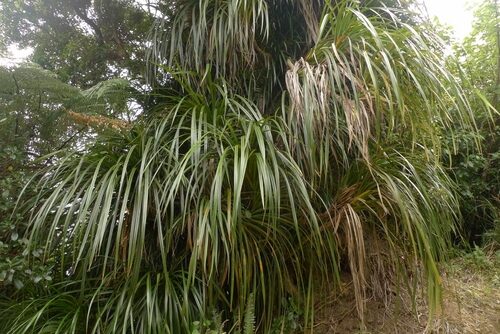
Pandanus yalna
R. Tucker
Yalna pandan
wikimedia· cc-by-sa
Steve Fitzgerald (via Wikimedia Commons)
wikimedia· cc-by-sa
Steve Fitzgerald (via Wikimedia Commons)
wikimedia· cc-by-sa
Steve Fitzgerald (via Wikimedia Commons)
Description
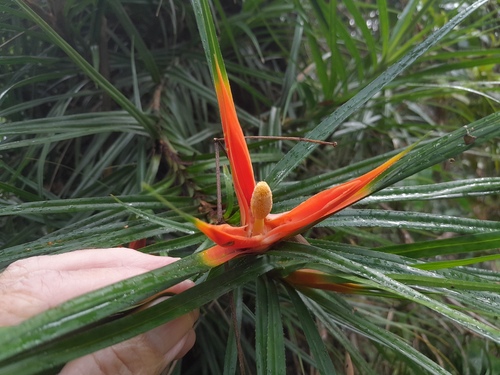
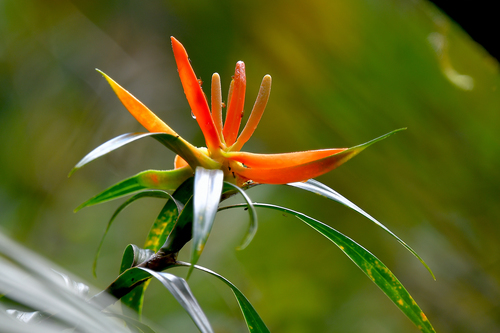
A medium sized tree. It grows 10-20 m high and spreads 5-10 m wide. It has few branches. The trunk is 8 m high and 100 cm across. It has prop roots. The leaves are 2-3 m long by 6-10 cm wide. They are strap shaped and mid green. There are spines on the midrib and edges. The male flowering stalk is branched and 15-35 cm long. It hangs down. The male spikes are 8-12 cm long. They are white and have white bracts underneath them. These can be 175 cm long. The female flowering stalks are unbranched. They have white bracts underneath them. The fruiting head is 18-25 cm long by 18-21 cm wide. It ripens to orange-yellow. There are 10-30 seeds in each of the fingers. The seeds are 2.2 cm long by 0.1 cm wide.
Edible Uses
Like many other species of this genus, the swamp pandan has been used historically for a variety of purposes. The long leaves are easily torn into long strips and used for weaving of baskets, bags, mats, sails, etc, and various other parts of the plant are used for medicines.
Distribution
It is a tropical plant. It grows in moist to wet sites. It can be in water 1.5 m deep. They form stolons or runners when growing in water.
Where It Grows
Australia*,
Cultivation
Plants can be grown from seed or runners or stolons which develop roots.
Notes
There are about 600 Pandanus species. They grow in the tropics.
References (3)
- Austrobaileya 2:228, 1986
- Cooper, W. and Cooper, W., 2004, Fruits of the Australian Tropical Rainforest. Nokomis Editions, Victoria, Australia. p 390
- Lazarides, M. & Hince, B., 1993, Handbook of Economic Plants of Australia, CSIRO. p 179