Freycinetia excelsa
F. Muell.
Slender Climbing Pandan
iNaturalist· cc-by-sa
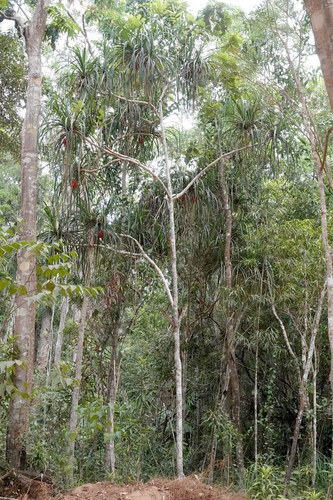
(c) Steve Fitzgerald, some rights reserved (CC BY-SA), uploaded by Steve Fitzgerald
iNaturalist· cc-by
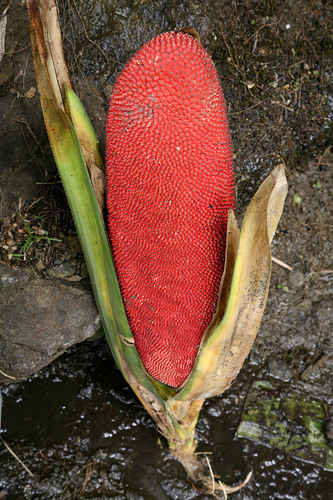
(c) Matthew Borella, some rights reserved (CC BY)
iNaturalist· cc-by
(c) Matthew Borella, some rights reserved (CC BY)
Summary
Source: WikipediaFreycinetia excelsa is a species of climbing plant in the family Pandanaceae. Naturally found growing in northern and eastern Australia, as far south as the Tweed Valley in New South Wales.
Description
It partly attaches to and grows from other plants. It is an evergreen vine. It climbs to a height of 30 m. The stem is vigorous with many branches. It scrambles over logs and rocks. The stem is less than 1 cm across. The leaves are fairly rigid and curve and have spiny edges. They are 30-50 cm long and 0.6-0.8 cm wide. The form a short sheath around the stem at their base. The flowers are small and have red bracts around them. The bracts are 5-7 cm long by 2.5-3.5 cm wide. The female heads are in groups of 1-4 and are 3-4 cm long by 2-3 cm wide. The male spikes are in groups of 1-3 and are 2-3 cm long by 1-1.5 cm wide. The fruit is a cluster of berries. Each berry is 0.7 cm across and they are bright red. The fruit are produced at the stem tips. The fruit are edible
Edible Uses
The fruit are eaten, though they burn the back of the throat, possibly due to oxalates.
Traditional Uses
The fruit are eaten but burn the back of the throat possibly due to oxalates.
This uses section is brief — help expand it
Known Hazards
Fruit may burn the back of the throat, possibly due to oxalates.
Distribution
A tropical plant. It grows in tropical and subtropical places. In tropical Queensland it grows from sea level to 1250 m altitude. It needs a protected, partly shady position. It is damaged by drought and frost.
Where It Grows
Australia*, Pacific, Papua New Guinea, PNG,
Cultivation
It is grown by dividing the stem. They can be grown from seed.
Production
In Australia, fruit occur from January to April.
Notes
There are about 100-175 Freycinetia species.
Synonyms
Also Known As
Giant climbing pandan
References (10)
- Bodkin, F., 1991, Encyclopedia Botanica. Cornstalk publishing, p 481
- Cooper W & Cooper W T, 1994, Fruits of the Rain Forest. RD Press p 144
- Cooper, W. and Cooper, W., 2004, Fruits of the Australian Tropical Rainforest. Nokomis Editions, Victoria, Australia. p 382
- Cronin, L., 1989, The Concise Australian Flora. Reed. p 255
- Edible and Useful Native Plants (off internet)
Show all 10 references Hide references
- Elliot, W.R., & Jones, D.L., 1992, Encyclopedia of Australian Plants suitable for cultivation. Vol 4. Lothian. p 318
- Jackes, B.R., 2001, Plants of the Tropics. Rainforest to Heath. An Identification Guide. James Cook University. p 72
- Jones, D.L. & Gray, B., 1977, Australian Climbing Plants. Reed. p 104
- Nicholson, N & H., 1994, Australian Rainforest Plants 4, Terania Rainforest Publishing. NSW. p 36
- Townsend, K., 1994, Across the Top. Gardening with Australian Plants in the tropics. Society for Growing Australian Plants, Townsville Branch Inc. p 220