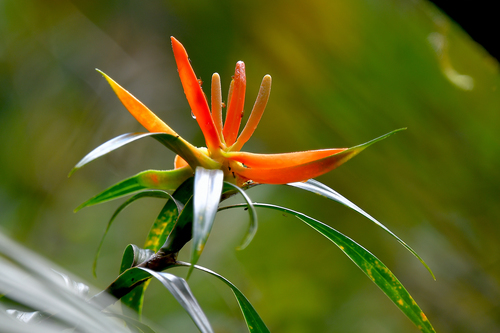
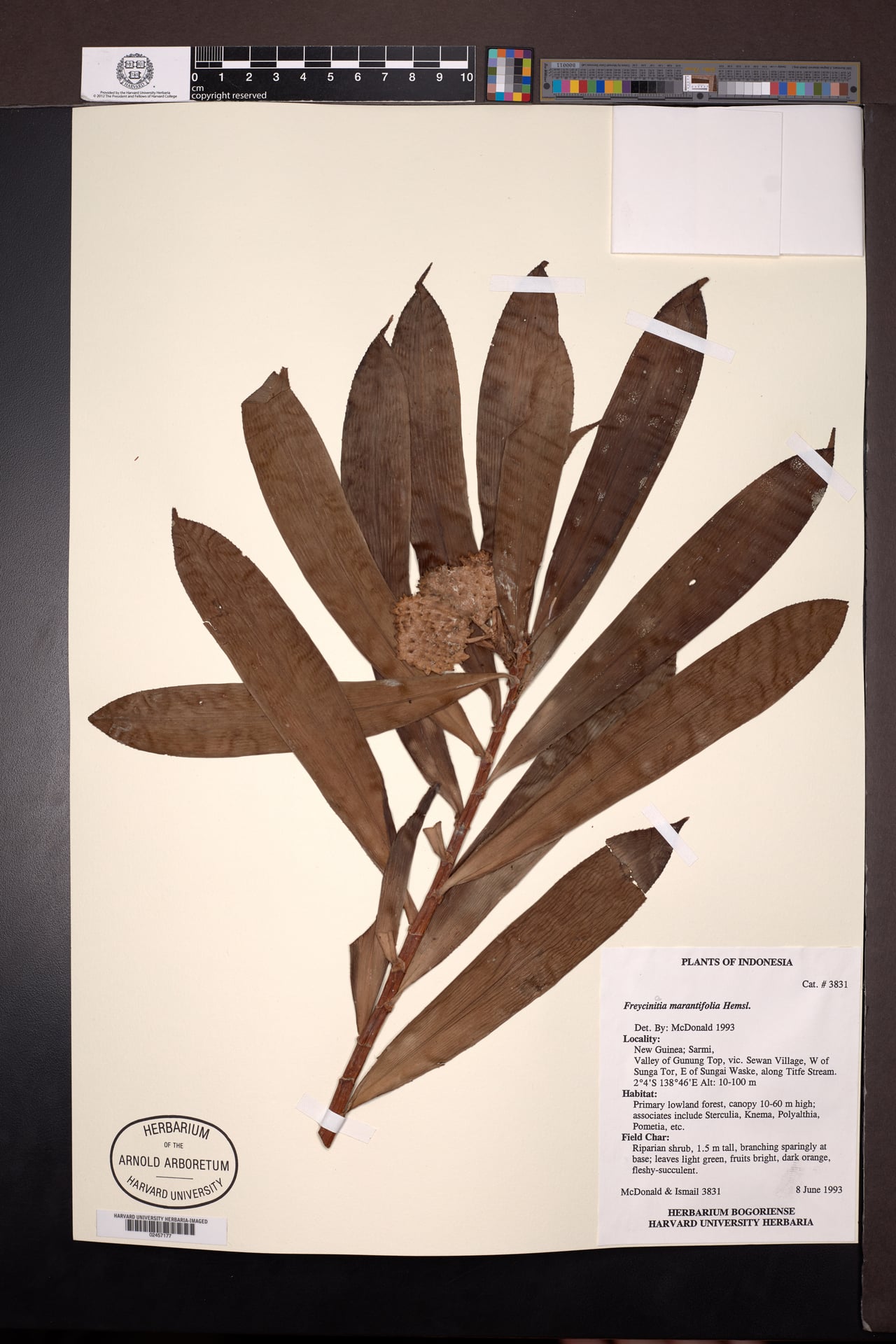
Pandanus amaryllifolius
Roxb.
Fragrant screw pine
iNaturalist· cc-by-nc
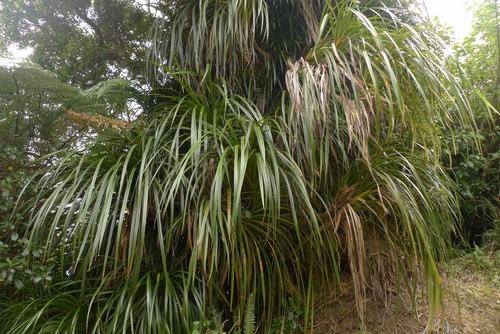
(c) mfinky, some rights reserved (CC BY-NC)
iNaturalist· cc-by-nc
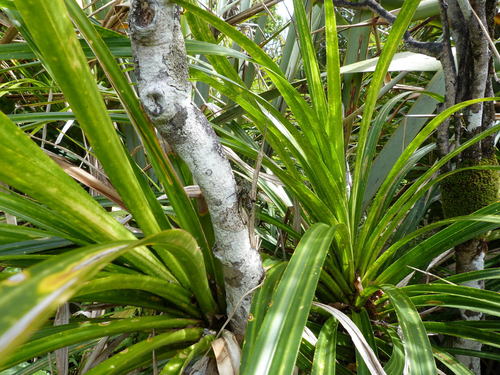
(c) hong_xiang_how, some rights reserved (CC BY-NC)
iNaturalist· cc-by-nc-sa
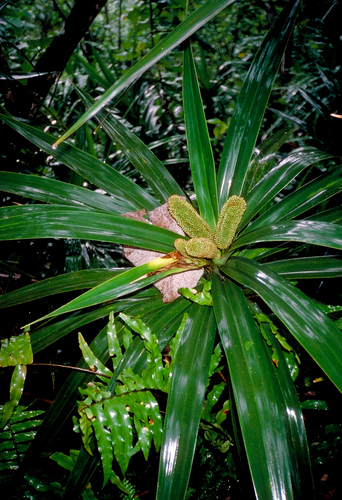
(c) Iman Akbar, some rights reserved (CC BY-NC-SA), uploaded by Iman Akbar
Summary
Source: WikipediaPandanus amaryllifolius is a tropical plant in the Pandanus (screwpine) genus, which is commonly known as pandan (; Malay: [ˈpandan]). It has fragrant leaves which are used widely for flavouring in the cuisines of Southeast Asia. It is also featured in some South Asian cuisines (such as Sri Lankan cuisine) and in Hainanese cuisine from China.
Description
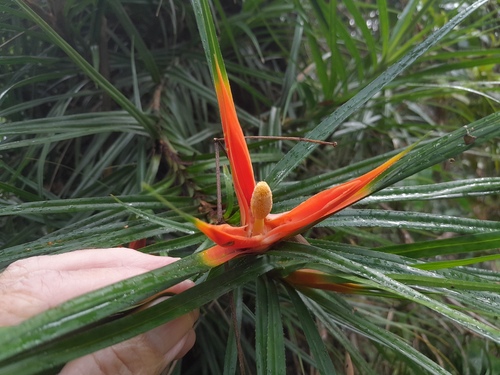
A shrub 2-4 m tall. Often the plant is small due to repeated cutting. It can grow 8 m tall. There are stilt like aerial roots on the stems near the base. It develops suckers and forms clumps. The leaves are arranged in spirals. The leaves are narrow and folded like a fan. They have sharp edges. They are 75 cm long and 2.5 cm wide. They droop about half way along. The plant rarely flowers. The flowers are white and the fruit heads are 20 cm across.
Edible Uses
The fragrant young leaves are cooked and eaten, and are widely used fresh or dried to flavour rice, cassava, and especially sweet dishes. Juice extracted from the leaves adds fragrance to teas and desserts such as cakes and kueh. The leaves impart a garlic-like flavour, a distinctive musky odour, and a natural green colour to food, with the chlorophyll pigments acting as a natural green colouring agent. Leaves are also used to wrap foods such as rice dumplings, though the leaves themselves are removed before serving. In Indonesia, rice is sometimes steamed in baskets woven from the leaves. In Thailand, seasoned chicken pieces are wrapped in leaves and fried. Leaves are also fashioned into small containers for puddings and jellies throughout Southeast Asia. Most members of this genus have more or less edible fruits, seeds, and inner leaf bases. The cylindrical fruit is a syncarp composed of individual drupes — hard, woody wedges each containing a few slender seeds. Each wedge has a fleshy base with sweet-smelling orange pulp that, in many species, has a delicious flavour, though this pulp must be cooked to destroy a harmful substance. The seeds often have a delicious nutty flavour when eaten raw or cooked, though they are fiddly to extract; they contain 44–50% fat and 20–34% protein. The inner base of young leaves can be eaten raw.
Traditional Uses
The young leaves are used to scent rice or colour cakes green. They are used for flavouring. Chicken is also wrapped in pandan leaves and deep fried. A strip of leaf about 10 cm long is dropped in the pot during cooking of rice.
Medicinal Uses
The leaves are diuretic and cardiotonic. An infusion is used as a sedative for restlessness and as a traditional treatment for diabetes. Externally, leaves are applied to treat skin diseases and used as a relaxing soak against restlessness. They are also soaked in coconut oil, which is then used as an embrocation for rheumatic troubles. Three piperidine alkaloids have been isolated and identified from the leaves. The antidiabetic action appears linked to 4-hydroxybenzoic acid, isolated from the roots, which shows hypoglycaemic effects and increases serum insulin levels and liver glycogen content.
Known Hazards
The fruit pulp contains a harmful substance requiring cooking before consumption.
Distribution
A tropical plant. It is native to SE Asia. It grows in forests ad can grow in full sun or light shade.
Where It Grows
Asia, Australia, Cambodia, China, East Africa, East Timor, Hawaii, India, Indochina, Indonesia*, Laos, Madagascar, Malaysia, Maldives, Pacific, Philippines, SE Asia, Singapore, Sri Lanka, Thailand, Timor-Leste, USA, Vietnam,
Cultivation
Fragrant Pandan is a plant of the humid lowland tropics. Apart from the continuous harvesting of fragrant pandan, there are some indications that ever-wet climatic conditions are less favourable for the large growth form's development, thus assisting in perpetuating the small growth form. Fragrant Pandan succeeds in full sun or light shade in moderately fertile, well-drained soil. Fragrant pandan tolerates shade very well. Continual harvesting of the leaves from the shrub form will prevent it from developing into the tree form. When abandoned or allowed to develop without hindrance, it grows very slowly but eventually will enter into the 'large' growth phase and develop a stout trunk. The odour of the leaves remains the same in both growth forms. Harvesting of fragrant pandan may start about six months after planting and may continue for several years. Individual leaves are cut, leaving the top with 3 - 4 leaves intact. Branches do not have dormant buds and will not resprout if cut back into the old wood. A one-ha plot in the Philippines, with fragrant pandan under pepper and some fruit trees, was harvested twice a week, yielding 60 kg of fresh leaves per harvest, or 6 t/ha per year. A dioecious species, but only the male form is known, so seeds cannot be produced. Can be grown in pots (35L+)
Propagation
Seed is not available for this plant as only male forms are known. Propagate by removing suckers from the leaf axils during the growing season; these can be planted straight away or rooted in a sandy medium. Alternatively, take cuttings of lateral shoots and insert them obliquely into the planting medium.
Other Uses
The aromatic leaves are used for perfume. In Thailand, pandan leaves are used as a natural air freshener in vehicles. Freshly chopped leaves are mixed with flower petals to make potpourri. The scent in the leaves is thought to be not an essential oil but a volatile product of oxidative degradation of a yellow carotenoid pigment, though a tiny amount of essential oil is also present. The leaves can be woven into small baskets and containers for desserts, and made into sleeping mats. An extract of the leaves is used as an ingredient in commercial cosmetic preparations as a deodorant and masking agent. The essential oil has insect-repellent activity against the common cockroach (Periplaneta americana). Pandan leaves and their extract are used as food preservatives due to antibacterial and antifungal properties, particularly against mould. Bottled pandan extract is commercially available, often with added green food colouring. The powdered leaves may also be used as a repellent against Callosobruchus chinensis infestation of mung-bean seeds.
Other Information
The leaves are sold in markets as well as in shops worldwide. It is cultivated.
Notes
There are about 700 Pandanus species. They grow in the tropics.
Synonyms
Also Known As
Bai toey hom, Bai toey, Ban lan ye, Boro, Curry leaf, Daun pandan, Hedan, La dua, Pandan bau, Pandan rampai, Pandan wangi, Pandan, Pandano, Pandanus leaf, Raampa, Raampe faiy, Rampe, Taey, Toei hom
References (29)
- Bodkin, F., 1991, Encyclopedia Botanica. Cornstalk publishing, p 758 (As Pandanus odorus)
- Bremness, L., 1994, Herbs. Collins Eyewitness Handbooks. Harper Collins. p 70 (As Pandanus latifolius)
- Burkill, I.H., 1966, A Dictionary of the Economic Products of the Malay Peninsula. Ministry of Agriculture and Cooperatives, Kuala Lumpur, Malaysia. Vol 2 (I-Z) p 1673, 1677 (As Pandanus odorus)
- Facciola, S., 1998, Cornucopia 2: a Source Book of Edible Plants. Kampong Publications, p 165
- Fl. ind. ed. 1832, 3:743. 1832 (Hort. bengal. 71. 1814, nom. nudum)
Show all 29 references Hide references
- Fl. Males. Bull. 5:81. 1925 (As Pandanus odorus)
- Foo, J.T.S.(ed), 1996, A Guide to Common Vegetables. Singapore Science Foundation. p 122 (As Pandanus amaryllifolius)
- Hemphill, I, 2002, Spice Notes. Macmillan. p 273 (As Pandanus amaryllifolius)
- Jacquat, C., 1990, Plants from the Markets of Thailand. D.K. Book House p 113 (As Pandanus amaryllifolius)
- Luczaj, L., et al, 2021, Wild food plants and fungi sold in the markets of Luang Prabang, Lao PDR. Journal of Ethnobiology and Ethnomedicine (2021) 17:6
- Macmillan, H.F. (Revised Barlow, H.S., et al), 1991, Tropical Planting and Gardening. Sixth edition. Malayan Nature Society. Kuala Lumpur. p 357 (As Pandanus amaryllifolius)
- Martin, F.W. & Ruberte, R.M., 1979, Edible Leaves of the Tropics. Antillian College Press, Mayaguez, Puerto Rico. p 211 (As Pandanus latifolius), (Also as Pandanus odorus)
- Mulherin, J., 1994, Spices and natural flavourings. Tiger Books, London. p 17 (As Pandanus odorus)
- Norrington, L., & Campbell, C., 2001, Tropical Food Gardens. Bloomings Books. p (As Pandanus amaryllifolius)
- Owen, S., 1993, Indonesian Food and Cookery, INDIRA reprints. p 53 (As Pandanus odorus)
- Phon, P., 2000, Plants used in Cambodia. © Pauline Dy Phon, Phnom Penh, Cambodia. p 487 (As Pandanus amaryllifolius)
- PROSEA (Plant Resources of South East Asia) handbook, Volume 2, 1991, Edible fruits and nut. p 243
- Purseglove, J.W., 1972, Tropical Crops. Monocotyledons. Longmans p 512 (As Pandanus odorus)
- Selvam, V., 2007, Trees and shrubs of the Maldives. RAP Publication No. 2007/12 p 220
- Solomon, C., 2001, Encyclopedia of Asian Food. New Holland. p 269 (As Pandanus latifolius)
- Staples, G.W. and Herbst, D.R., 2005, A tropical Garden Flora. Bishop Museum Press, Honolulu, Hawaii. p 739
- Sujanapal, P., & Sankaran, K. V., 2016, Common Plants of Maldives. FAO & Kerala FRI, p 191
- Sukarya, D. G., (Ed.) 2013, 3,500 Plant Species of the Botanic Gardens of Indonesia. LIPI p 741
- Sukenti, K., et al, 2016, Ethnobotanical study on local cuisine of the Sasak tribe in Lombok Island, Indonesia. Journal of Ethnic Foods. 3 (2016) 189-200 p 198
- van Wyk, B., 2005, Food Plants of the World. An illustrated guide. Timber press. p 275
- Wiersema, J. H. & Leon, B., 2013, World Economic Plants. A Standard Reference CRC Press. 2nd Ed. p 491
- Woodward, P., 2000, Asian Herbs and Vegetables. Hyland House. p 107
- World Checklist of Useful Plant Species 2020. Royal Botanic Gardens, Kew
- Zeven, A. C. & de West, J. M. J., 1982, Dictionary of cultivated plants and their regions of diversity. Wageningen. p 61