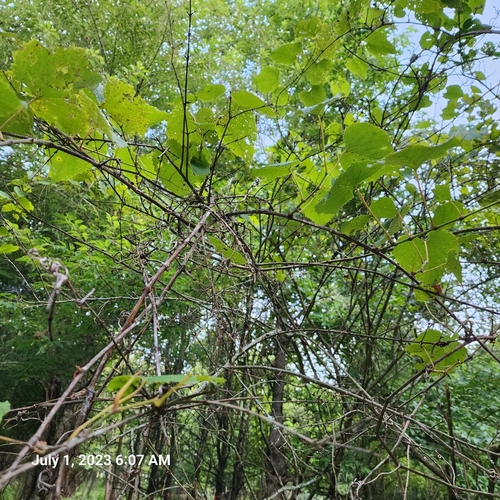
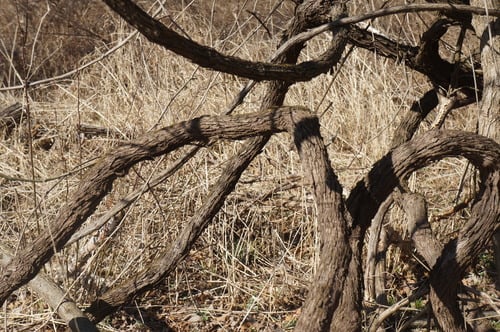
Ampelocissus africana
(Lour.) Merr.
Simple-leaved wild grape
iNaturalist· cc-by-nc
(c) Mark Hyde, Bart Wursten and Petra Ballings, some rights reserved (CC BY-NC)
iNaturalist· cc-by-nc
(c) Mark Hyde, Bart Wursten and Petra Ballings, some rights reserved (CC BY-NC)
iNaturalist· cc-by-nc
(c) Mark Hyde, Bart Wursten and Petra Ballings, some rights reserved (CC BY-NC)
Summary
Source: WikipediaAmpelocissus africana is a species of flowering plant in the grape family, Vitaceae. It is a type of woody vine or liana that bears edible fruit. It was originally described botanically in 1790 by João de Loureiro as Botria africanus, which is the basionym for its treatment here under Ampelocissus.
Description
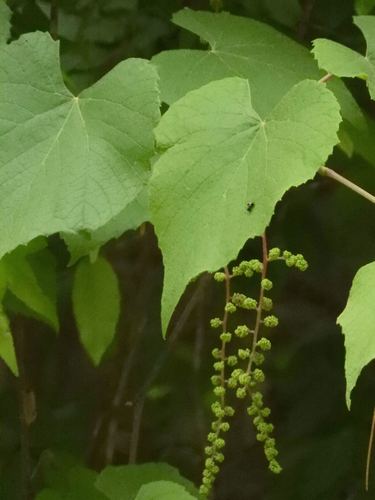
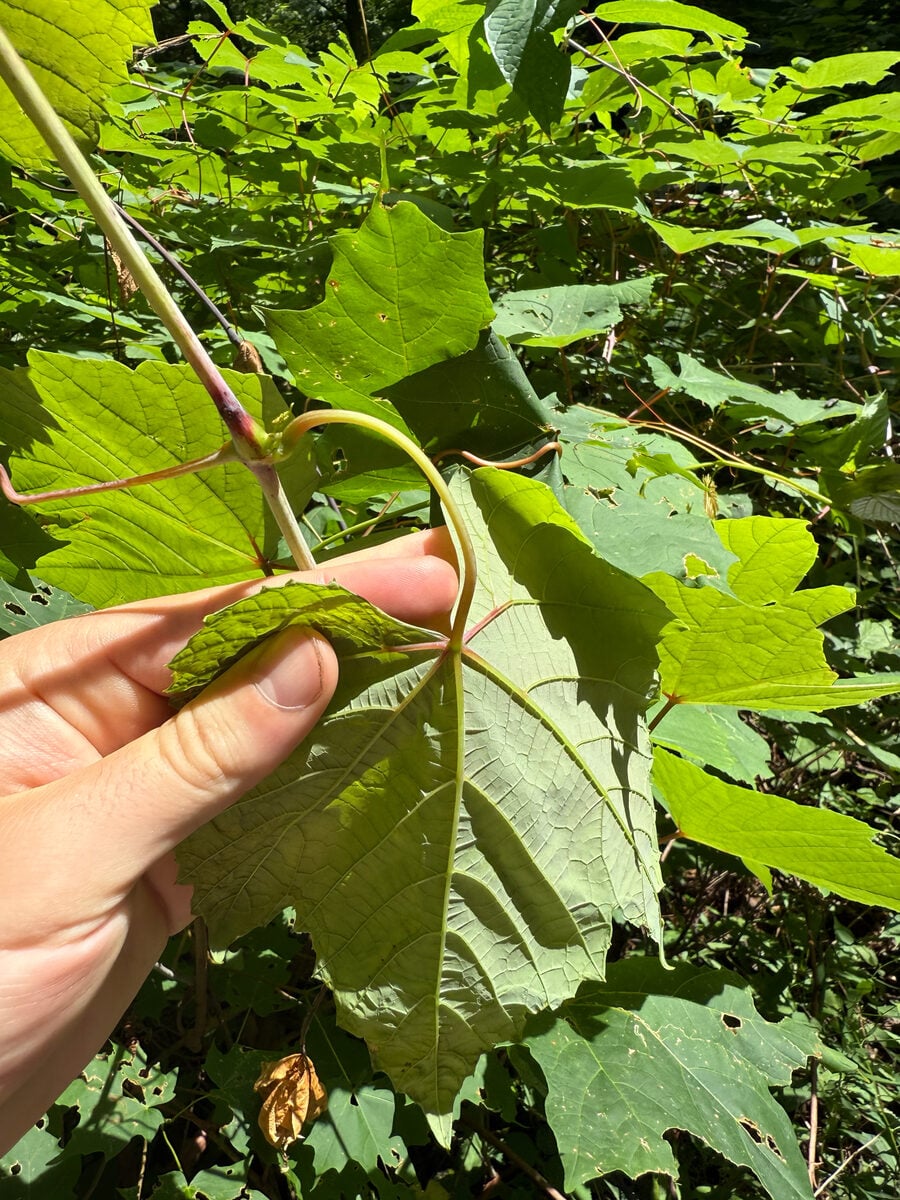
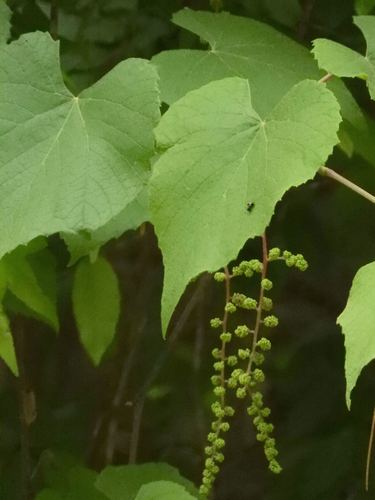
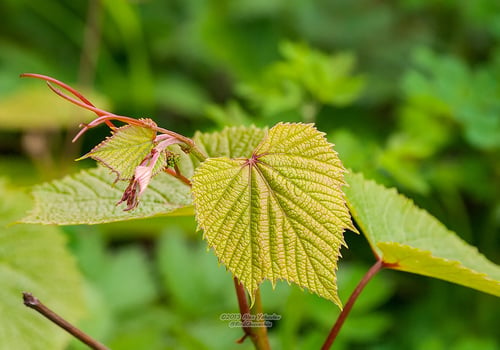
A large climbing herb. It grows 2-8 m high. It has soft stems. These arise from a large fairly soft underground rootstock. The young branches are densely hairy. It has tendrils. The leaves are simple. The leaf blade is 20 cm across. It is broadly oval. There are teeth along the edge. The base is heart shaped. The flowers are in clusters. They are small and greenish-yellow. The fruit is 1 cm across. The fruit are blackish berries. The fruit have large seeds. The seeds are shiny and brown. They are 7 mm long by 4 mm wide.
Edible Uses
Ripe fruit are eaten as a dessert fruit or raw as a snack. Young leaves are cooked and used as a sauce or side dish. The root is used in sauces and for flavouring.
Traditional Uses
The root is used in sauces and for flavouring. The ripe fruit are eaten as a dessert fruit. It is also eaten raw as a snack. The young leaves are cooked and used as a sauce or side dish.
Medicinal Uses
The roots are pounded, soaked in water, boiled and drunk to treat intestinal worms and leprosy.
Distribution
A tropical plant. It grows in savanna in rocky places. It does not grow in humid soils. It grows in woodland and at the edges of forests. It is most common in the lowlands. In Zimbabwe it grows in areas with a rainfall between 500-650 mm per year. It can grow in arid places. It grows in hot, dry climates.
Where It Grows
Africa, Benin, Botswana, Burkina Faso, Cameroon, Central Africa, Central African Republic, CAR, Chad, Côte d'Ivoire, East Africa, Ghana, Guinea, Guinée, Guinea-Bissau, Ivory Coast, Kenya, Malawi, Mali, Mozambique, Namibia, Nigeria, Senegal, South Africa, Southern Africa, South Sudan, Sudan, Tanzania, Uganda, West Africa, Zambia, Zimbabwe,
Cultivation
Plants can be grown from seeds or by cuttings.
Propagation
Seed - Cuttings.
Production
The vines emerge, grow, flower and fruit within 3 months. In Tanzania fruit are collected between April and August. The stems are cut to harvest the leaves.
Notes
There are about 95 Ampelocissus species.
Synonyms
Also Known As
Amajambe, Anunu, Ghoe, Ianbi, Kalimbwe, Mubanta, Mudzambiringa, Muzinda-ngulube, Mzabibu pori, Olok, Rogon daji
References (35)
- Agea, J. G., et al 2011, Wild and Semi-wild Food Plants of Bunyoro-Kitara Kingdom of Uganda: etc. Environmental Research Journal 5(2) 74-86
- Bircher, A. G. & Bircher, W. H., 2000, Encyclopedia of Fruit Trees and Edible Flowering Plants in Egypt and the Subtropics. AUC Press. p 25 (As Ampelocissus grantii)
- Burkill, H. M., 1985, The useful plants of west tropical Africa, Vol. 5. Kew.
- Busson, 1965,
- Dalziel, J. M., 1937, The Useful plants of west tropical Africa. Crown Agents for the Colonies London.
Show all 35 references Hide references
- Food Composition Tables for use in Africa FAO http://www.fao.org/infoods/directory No. 1057 (As Ampelocissus grantii)
- Fowler, D. G., 2007, Zambian Plants: Their Vernacular Names and Uses. Kew. p 63
- Fox, F. W. & Young, M. E. N., 1982, Food from the Veld. Delta Books. p 367
- Gallagher, D. E., 2010, Farming beyond the escarpment: Society, Environment, and Mobility in Precolonial Southeastern Burkina Faso. PhD University of Michigan.
- Godfrey, J. et al, 2013, Harvesting, preparationand preservation of commonly consumed wild and semi-wild food plants in Bunyoro-Kitara Kingdom, Uganda. Int. J. Med. Arom. Plants. Vol.3 No.2 pp 262-282
- Grivetti, L. E., 1980, Agricultural development: present and potential role of edible wild plants. Part 2: Sub-Saharan Africa, Report to the Department of State Agency for International Development. p 43
- Hahn, K., et al, 2018, The Use of Wild Plants for Food: a National Scale Analysis for Burkina Faso (West Africa) Flora et Vegetatio Sudano-Sambesica 21, 25-33
- Hedrick, U.P., 1919, (Ed.), Sturtevant's edible plants of the world. p 681 (As Vitis africana)
- Jardin, C., 1970, List of Foods Used In Africa, FAO Nutrition Information Document Series No 2.p 119 (As Ampelocissus grantii)
- La Vigne Amer. 1885:32. 1885; A. L. P. P. de Candolle & A. C. de Candolle, Monogr. phan. 5(2):394. 1887 (As Ampelocissus grantii)
- Maroyi, A., 2011, The Gathering and Consumption of Wild Edible Plants in Nhema Communal Area, Midlands Province, Zimbabwe. Ecology of Food and Nutrition 50:6, 506-525
- Maroyi, A. & Cheikhyoussef, A., 2017, Traditional knowledge of wild edible fruit in southern Africa: A comparative use patterns in Namibia and Zimbabwe. Indian Journal of Traditional Knowledge. 16(3): 385-392
- Masters, T., 2021, Traditional food plants of the upper Aswa River catchment of northern Uganda—a cultural crossroads. Journal of Ethnobiology and Ethnomedicine (2021) 17:24
- Moksia, F., et al, 2019, Diversity and Socio-Economic Value of Wild Edible Plants in the Mounts Mandara Region, Cameroon. International Journal of Sciences. Vol. 8:10
- MORTIMORE,
- Mpasiwakomu, R. A., 2017, The Diversity and Utilization of Wild Edible and Medicinal Plant Species found in Uvinza Miombo Woodlands, Tanzania. M. Sc. thesis University of Tanzania.
- Msuya, T. S., et al, 2010, Availability, Preference and Consumption of Indigenous Foods in the Eastern Arc Mountains, Tanzania, Ecology of Food and Nutrition, 49:3, 208-227
- Peters, C. R., O'Brien, E. M., and Drummond, R.B., 1992, Edible Wild plants of Sub-saharan Africa. Kew. p 200
- Pickering, H., & Roe, E., 2009, Wild Flowers of the Victoria Falls Area. Helen Pickering, London. p 114
- Royal Botanic Gardens, Kew (1999). Survey of Economic Plants for Arid and Semi-Arid Lands (SEPASAL) database. Published on the Internet; http://www.rbgkew.org.uk/ceb/sepasal/internet [Accessed 13th June 2011]
- Ruffo, C. K., Birnie, A. & Tengnas, B., 2002, Edible Wild Plants of Tanzania. RELMA p 128
- Ruiters-Welcome, A. K., 2019, Food plants of southern Africa. Ph.D. thesis. Univ. of Johannesburg p 107
- Seidemann J., 2005, World Spice Plants. Economic Usage, Botany, Taxonomy. Springer. p 38
- Tallantire & Goode, 1975,
- Trans. Amer. Philos. Soc. ser. 2, 24:253. 1935
- Tredgold, M.H., 1986, Food Plants of Zimbabwe. Mambo Press. p 1
- Welcome, A. K. & Van Wyk, B.-E., 2019, An inventory and analysis of the food plants of southern Africa. South African Journal of Botany 122 (2019) 136–179
- Wild, 1975,
- World Checklist of Useful Plant Species 2020. Royal Botanic Gardens, Kew
- www.zimbabweflora.co.zw 2011