Panax quinquefolius
L.
American ginseng, Xi yang shen
iNaturalist· cc-by-nc
(c) Lori A Owenby, some rights reserved (CC BY-NC), uploaded by Lori A Owenby
iNaturalist· cc-by
(c) John Rusk, some rights reserved (CC BY)
iNaturalist· cc-by-nc
(c) Penn State, some rights reserved (CC BY-NC)
Summary
Source: WikipediaPanax quinquefolius is a slow-growing perennial reaching 0.3 m (1 ft) tall by 0.5 m (1 ft 8 in) wide. Hardy to UK zone 3. Flowers in June. Hermaphrodite. Tolerates light sandy, medium loamy, and heavy clay soils with mildly acidic, neutral, or mildly alkaline pH. Grows in full shade to semi-shade and prefers moist soil.
Description
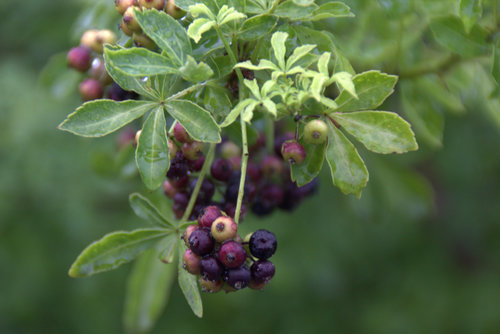
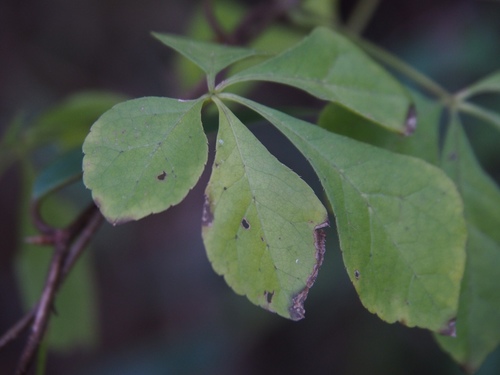
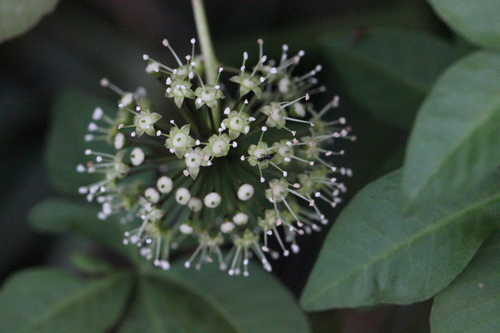
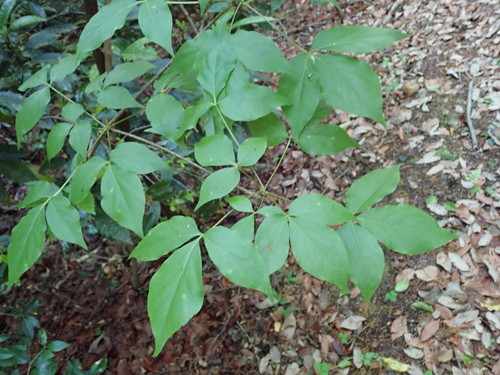
A perennial herb. It grows up to 30 cm high. It spreads to 50 cm across. It has an aromatic branched rootstock. The leaves have short stalks. The leaves are divided into 3-7 leaflets that have teeth along the edge. The leaflets can be 15 cm long. The flowers are small and green-white. The fruit are red berries.
Edible Uses
A tea can be made from both the leaves and roots. The aromatic root is also candied and used as a masticatory.
Traditional Uses
A tea is made from the leaves and roots. The root is candied and chewed. The root is steamed for 4 hours over boiling water before drying and packing.
Medicinal Uses
This North American species of ginseng is said to have similar properties to Oriental ginseng (P. ginseng), though with a milder action, making it more likely to be prescribed for younger patients. It is cultivated in parts of America as a medicinal crop and is frequently harvested from the wild. The root is considered adaptogen, cardiotonic, demulcent, panacea, sedative, sialagogue, stimulant, and stomachic. It is used to treat chronic cough, low-grade fever, spontaneous or night sweating, and fatigue from chronic consumptive disease. Taken over an extended period, it is said to increase mental efficiency and physical performance while helping the body adapt to high or low temperatures and stress. Large doses are said to raise blood pressure, so some caution is advised. The root is harvested in autumn and dried for later use. Ginseng has a history of herbal use spanning over 5,000 years and is highly regarded in Oriental medicine for promoting health, general vigour, and longevity. The root is also alterative, carminative, emetic, and expectorant. It stimulates and relaxes the nervous system, encourages hormone secretion, improves stamina, lowers blood sugar and cholesterol levels, and increases resistance to disease. It is used internally to treat debility associated with old age or illness, lack of appetite, insomnia, stress, shock, and chronic illness. Ginseng is not normally prescribed for pregnant women, patients under 40, or those with depression, acute anxiety, or acute inflammatory disease. It is typically taken for no more than 3 weeks. Excess use can cause headaches, restlessness, raised blood pressure, and other side effects, particularly when combined with caffeine, alcohol, turnips, or bitter and spicy foods. Roots are preferably harvested from plants 6–7 years old and can be used fresh or dried. A dose of 10ug/ml of ginseng saponins has been shown to be significantly radio-protective when administered prior to gamma-irradiation. The leaf is emetic and expectorant.
Known Hazards
Individuals requiring anticoagulant therapy, such as warfarin, should avoid use of ginseng. It is not recommended for individuals with impaired liver or renal function, or during pregnancy or breastfeeding. Other adverse effects include headaches, anxiety, trouble sleeping and an upset stomach. Through the cultivated procedures for American ginseng, fungal molds, pesticides, and various metals and residues have contaminated the crop, leading to health concerns.
Distribution
It is a temperate plant. It requires a deep moist humus rich soil. It should be in a shady position. It needs a well-drained slightly acid soil. It suits hardiness zone 3-9.
Where It Grows
Asia, Australia, Britain, Canada*, China, Europe, France, Germany, Korea, Myanmar, Netherlands, North America, SE Asia, Tasmania, USA*,
Cultivation
Requires a deep moist humus rich soil in a shady position in a woodland. Requires deep shade, growing well on north-facing slopes and in woodland. Often grown as a medicinal plant, though considered to be inferior to Korean ginseng, P. ginseng. It is exported from N. America, mainly to Hong Kong. Thick or swollen - fibrous or tap root.
Propagation
Sow seed in a shady position in a cold frame, preferably as soon as it is ripe, otherwise as soon as it is obtained. Germination can be very slow and erratic. Prick out seedlings into individual pots when large enough to handle and grow on in a shady position in a greenhouse or frame for at least their first winter. Ensure pots are deep enough to accommodate the roots. Plant out into permanent positions in late summer. Alternatively, propagate by division in spring.
Other Uses
None known.
Other Information
It is cultivated commercially.
Notes
It is important as a medicinal herb and also added to soups. It has anticancer properties.
Synonyms
Also Known As
Five finger's root, Genseng, Garantogen, Garantogere, Grantogen, Jinshard, Manroot, Ninsin, Sang, Tartar root, True ginseng, Xi yang shen, Wild ginseng
References (23)
- Bodkin, F., 1991, Encyclopedia Botanica. Cornstalk publishing, p 757
- Bremness, L., 1994, Herbs. Collins Eyewitness Handbooks. Harper Collins. p 199
- Esperanca, M. J., 1988. Surviving in the wild. A glance at the wild plants and their uses. Vol. 1. p 53
- Facciola, S., 1998, Cornucopia 2: a Source Book of Edible Plants. Kampong Publications, p 26
- Gouldstone, S., 1983, Growing your own Food-bearing Plants in Australia. Macmillan p 169
Show all 23 references Hide references
- Hedrick, U.P., 1919, (Ed.), Sturtevant's edible plants of the world. p 66 (As Aralia quinquefolia)
- Heywood, V.H., Brummitt, R.K., Culham, A., and Seberg, O. 2007, Flowering Plant Families of the World. Royal Botanical Gardens, Kew. p 42
- Hibbert, M., 2002, The Aussie Plant Finder 2002, Florilegium. p 218
- Hu, Shiu-ying, 2005, Food Plants of China. The Chinese University Press. p 586 (As quinquefolium)
- Jackes, D. A., Edible Forest Gardens
- Kermath, B. M., et al, 2014, Food Plants in the Americas: A survey of the domesticated, cultivated and wild plants used for Human food in North, Central and South America and the Caribbean. On line draft. p 603
- Kintzios, S. E., 2006, Terrestrial Plant-Derived Anticancer Agents and Plant Species Used in Anticancer research Critical Reviews in Plant Sciences. 25: pp 79-113
- Kiple, K.F. & Ornelas, K.C., (eds), 2000, The Cambridge World History of Food. CUP p 1778
- Lim, T. K., 2015, Edible Medicinal and Non Medicinal Plants. Volume 9, Modified Stems, Roots, Bulbs. Springer p 63
- MacKinnon, A., et al, 2009, Edible & Medicinal Plants of Canada. Lone Pine. p 182
- Macmillan, H.F. (Revised Barlow, H.S., et al), 1991, Tropical Planting and Gardening. Sixth edition. Malayan Nature Society. Kuala Lumpur. p 364
- Plants for a Future database, The Field, Penpol, Lostwithiel, Cornwall, PL22 0NG, UK. http://www.scs.leeds.ac.uk/pfaf/
- Solomon, C., 2001, Encyclopedia of Asian Food. New Holland. p 174 (As Aralia quinquifolia)
- Sp. pl. 2:1058. 1753
- Toupal, R. S. & Hollenback, K., 2009, An Ethnobotany of Indiana Dunes National Lakeshore: Plant Uses of the Ojibwa People. Bureau of Applied Research in Anthropology. University of Arizona
- van Wyk, B., 2005, Food Plants of the World. An illustrated guide. Timber press. p 274
- Wiersema, J. H. & Leon, B., 2013, World Economic Plants. A Standard Reference CRC Press. 2nd Ed. p 490
- World Checklist of Useful Plant Species 2020. Royal Botanic Gardens, Kew