Osbeckia australiana
Naudin
Osbeckia
iNaturalist· cc-by-nc
(c) Liana, some rights reserved (CC BY-NC), uploaded by Liana
iNaturalist· cc-by-nc-nd
(c) QuestaGame, some rights reserved (CC BY-NC-ND), uploaded by QuestaGame
iNaturalist· cc-by-nc-nd
(c) QuestaGame, some rights reserved (CC BY-NC-ND), uploaded by QuestaGame
Description
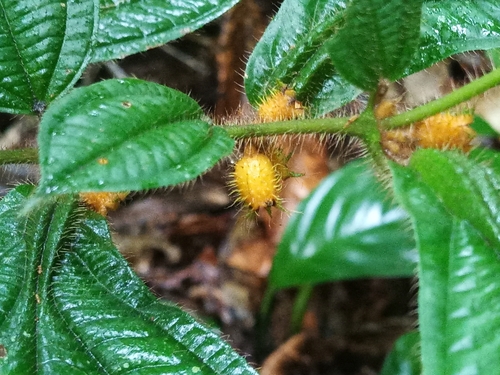
A slender shrub. It grows to 1.5-2 m high and spreads 0.5-1.5 m wide. The leaves and stem are hairy. The leaves are opposite and narrow. The have hairs on both sides. The leaf blade is 3-7 cm long by 0.4-0.9 cm wide. It is dull green above and has 3 distinct veins along it. The flowers are purple with yellow stamens in the centre. There are 5 petals. The flowers are 1.5-4 cm across. The flowers occur singly at or near the ends of branches. The fruit have a woolly pulp of fibres. They are nearly round and 0.8-1.2 cm across. They are cream-brown when ripe. There are many small seeds inside.
Edible Uses
Young fruit are eaten raw.
Traditional Uses
The young fruit are eaten raw.
This uses section is brief — help expand it
Distribution
It is a tropical plant. It grows in sandstone country on moist shady banks near freshwater streams. Plants need shade. It grows in monsoonal rainforests in northern Australia. It is damaged by frost. It suits hardiness zones 10-12.
Where It Grows
Australia*,
Cultivation
Plants can be grown from seed or cuttings.
Notes
There are about 60 Osbeckia species.
Synonyms
References (10)
- Bodkin, F., 1991, Encyclopedia Botanica. Cornstalk publishing, p 747
- Brock, J., 1993, Native Plants of Northern Australia, Reed. p 270
- Cherikoff V. & Isaacs, J., The Bush Food Handbook. How to gather, grow, process and cook Australian Wild Foods. Ti Tree Press, Australia p 200
- Cundall, P., (ed.), 2004, Gardening Australia: flora: the gardener's bible. ABC Books. p 960
- Dunlop, C.R., Leach, G.J. & Cowie, I.D., 1995, Flora of the Darwin Region. Vol 2. Northern Territory Botanical Bulletin No 20. p 141
Show all 10 references Hide references
- Elliot, W.R., & Jones, D.L., 1997, Encyclopedia of Australian Plants suitable for cultivation. Vol 7. Lothian. p 120 (Drawing & Photo)
- Etherington, K., & Imwold, D., (Eds), 2001, Botanica's Trees & Shrubs. The illustrated A-Z of over 8500 trees and shrubs. Random House, Australia. p 503
- Nicholson, N & H., 1996, Australian Rainforest Plants 3, Terania Rainforest Publishing. NSW. p 43
- Paczkowska, G. & Chapman, A.R., 2000, The Western Australian Flora. A Descriptive Catalogue. Western Australian Herbarium. p 294
- Wheeler, J.R.(ed.), 1992, Flora of the Kimberley Region. CALM, Western Australian Herbarium, p 549