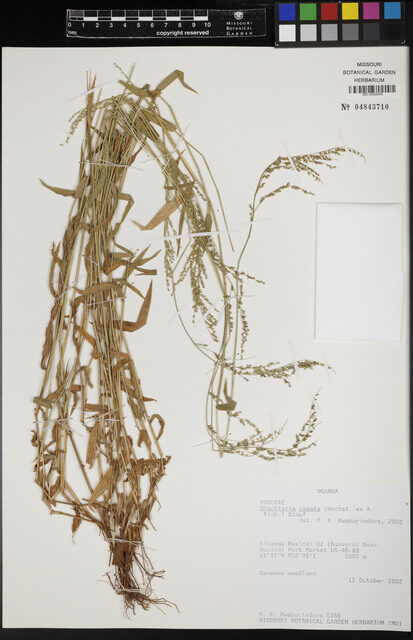
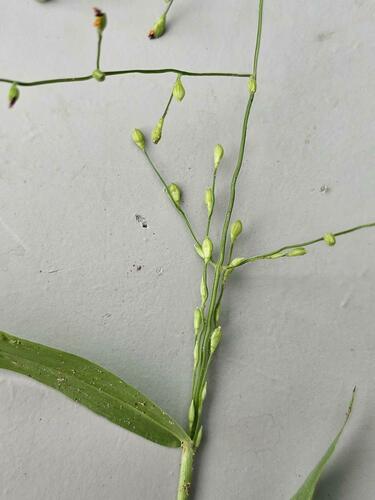
Oryza longistaminata
A Chev. et Roehr.
iNaturalist· cc-by-sa
(c) Desmanthus4food, some rights reserved (CC BY-SA)
iNaturalist· cc-by-sa
(c) Desmanthus4food, some rights reserved (CC BY-SA)
Summary
Source: WikipediaOryza longistaminata is a perennial species of grass from the same genus as cultivated rice (O. sativa). It is native to most of sub-Saharan Africa and Madagascar. It has been introduced into the United States, where it is often regarded as a noxious weed. Its common names are longstamen rice and red rice. The host resistance gene, Xa21, from O. longistaminata, has been integrated into the genome of O. sativa as it confers broad resistance to rice blight disease caused by Xanthomonas oryzae pv. oryzae.
Description
A cereal grass that keeps growing from year to year. It has extensive underground stems or rhizomes. It forms tussocks. The stalks grow 1.3 m high and are 1 cm across. They are soft and spongy and form roots from the nodes. The leaf blade is 45 cm long and 15 mm wide.
Edible Uses
The seed is cooked and said to have a good flavour; it can also serve as a famine food. In appearance it resembles Asian rice (Oryza sativa). Harvesting presents some challenges — the grain shatters very readily, so one approach is to reap the entire panicle just before it reaches full maturity. Alternatively, the ripe panicle can be shaken over a basket or calabash to catch the falling grain. The long, rough awns on the panicle make handling uncomfortable.
Medicinal Uses
None known
Distribution
A tropical plant. It grows in creeks and damp areas. It can grow in shallow ponds and swamps. It grows between 900-1,100 m above sea level. It grows in areas with an annual rainfall of 600 mm. It can grow in arid places.
Where It Grows
Africa, Angola, Botswana, Burkina Faso, Cameroon, Central Africa, Congo DR, Côte d'Ivoire, East Africa, Ethiopia, Gabon, Ghana, Guinea, Guinée, Guinea-Bissau, Ivory Coast, Kenya, Liberia, Madagascar, Malawi, Mali, Mozambique, Namibia, Nigeria, Senegal, Sierra Leone, South Africa, Southern Africa, South Sudan, Sudan, Tanzania, Togo, Uganda, West Africa, Zambia, Zimbabwe,
Cultivation
Requires a sunny position. Prefers black cotton soils, Kalahari sand, and alluvium. Plants can succeed in water up to 4 metres deep, but generally it is less than 1 metre. The plant can become a noxious weed in rice paddy fields, suppressing cultivated-rice strains. Plants can flower at any time of the year. The plant does not always set seed well, propagating itself mainly by means of its extensive rhizomes.
Propagation
Propagate by seed or division. Seed less than 12 months old often shows strong dormancy. Heat treatment is generally effective at breaking dormancy — alternating between 34°C for 16 hours and 11°C for 8 hours usually works, though the time required varies. Surface sow into light shade and do not allow the seed to dry out; germination should occur within 7 days at 30°C. Prick out 2–3 seedlings into individual pots when large enough to handle, then move to a sunny position after a few days and grow on until ready to plant out.
Other Uses
Where the plant has grown in floodwater and produced particularly long straw, that straw is valued for thatching. The species is considered most significant for its role in rice breeding programmes: it carries resistance genes to several diseases affecting cultivated rice (Oryza sativa), and resistance to bacterial leaf blight has already been successfully transferred. Although it can act as a host for rice yellow mottle virus (RYMV), it generally tolerates the disease better than Oryza sativa, and some accessions are immune. The plant is also a potential source of genes for developing perennial forms of Oryza sativa, which could provide permanent ground cover and help reduce erosion.
Production
It is difficult to harvest because the grain shatters.
Other Information
It is a famine food.
Notes
There are about 20 Oryza species. This is a diploid species with AbAb genome.
Synonyms
Also Known As
Alumo, Aro-de-ganga, Arroz-bravo, Arroz-selvagin, Bahure, Bange saga, Barimale, Bawu, Bororo, Bugau, Cadja, Cumaro-maro, Kolkodo, Kuma malo, Lop, Lou, M'baia, Mababa, Malo-sanfe, Malu-lante, Maro-djine, Maro-guelode, Marocumare, N'djangante, N'tanse, N'tante, Omano-mane, Pungane, Pungue, Sibuyuyu, Sulefagi, Undjangante, Untante
References (12)
- Abbiw, D.K., 1990, Useful Plants of Ghana. West African uses of wild and cultivated plants. Intermediate Technology Publications and the Royal Botanic Gardens, Kew. p 26
- Awas, T., 1997, A Study on the Ecology and Ethnobotany of Non-cultivated Food Plants and Wild Relatives of Cultivated crops in Gambella Region, Southwestern Ethiopia. Addis Ababa University. p 78
- Burkill, H. M., 1985, The useful plants of west tropical Africa, Vol. 2. Kew.
- Chang, T.T., 1979, Rice, in Simmonds N.W.,(ed), Crop Plant Evolution. Longmans. London. p 98
- Compt. Rend. Hebd. Seances Acad. Sci. 159:561. 1914
Show all 12 references Hide references
- Fowler, D. G., 2007, Zambian Plants: Their Vernacular Names and Uses. Kew. p 71
- Gallagher, D. E., 2010, Farming beyond the escarpment: Society, Environment, and Mobility in Precolonial Southeastern Burkina Faso. PhD University of Michigan.
- Jardin, C., 1970, List of Foods Used In Africa, FAO Nutrition Information Document Series No 2.p 4
- Lulekal, E., et al, 2011, Wild edible plants in Ethiopia: a review on their potential to combat food insecurity. Afrika Focus - Vol. 24, No 2. pp 71-121
- National Research Council, 1996, Lost Crops of Africa. Volume 1: Grains/ National Academy Press, Washington, D.C. p 37, 271
- Royal Botanic Gardens, Kew (1999). Survey of Economic Plants for Arid and Semi-Arid Lands (SEPASAL) database. Published on the Internet; http://www.rbgkew.org.uk/ceb/sepasal/internet [Accessed 3rd June 2011]
- World Checklist of Useful Plant Species 2020. Royal Botanic Gardens, Kew