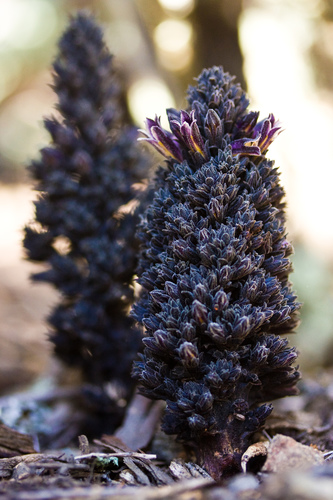
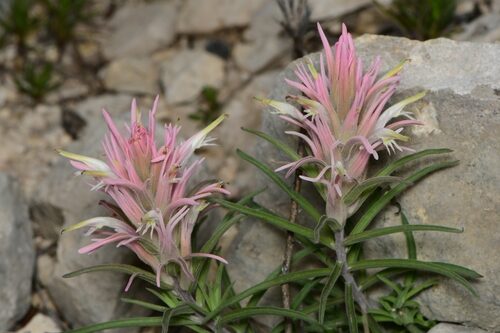
Orobanche minor
Smith
Lesser broomrape
iNaturalist· cc-by-sa
(c) David Whyte, some rights reserved (CC BY-SA), uploaded by David Whyte
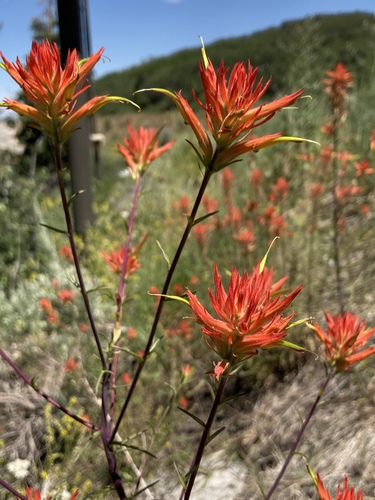
iNaturalist· cc-by
(c) Arnim Littek, some rights reserved (CC BY), uploaded by Arnim Littek
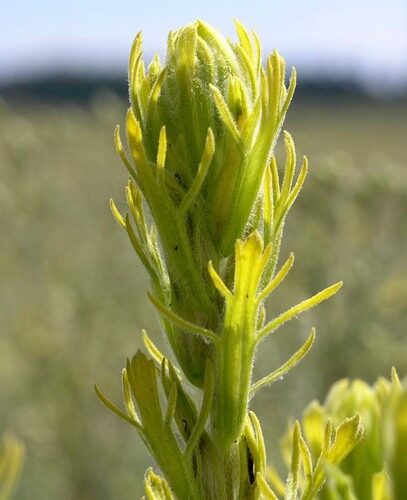
iNaturalist· cc-by-nc
(c) Sergio, some rights reserved (CC BY-NC), uploaded by Sergio
Summary
Source: WikipediaOrobanche minor, the hellroot, common broomrape, lesser broomrape, small broomrape, broomrape minor or clover broomrape, is a holoparasitic flowering plant belonging to the family Orobanchaceae. It is one of about 150 non-photosynthetic plants in the genus Orobanche that parasitize autotrophic plants.
Description
A plant which keeps growing from year to year and which has erect annual shoots. It grows as a parasite living on the roots of clover or tobacco. It grows about 40 cm high. It has glandular hairs. They are brown or yellow. The scale leaves are oval or sword shaped and 1-2 cm long. The flower spike is dense. It becomes lax before flowering. The flowers do not have stalks. The fruit is a capsule 8-9 mm long. There are many seeds.
Edible Uses
None known.
Traditional Uses
The tender underground shoots have been prepared and eaten like asparagus.
This uses section is brief — help expand it
Medicinal Uses
None known.
Distribution
It is a temperate and Mediterranean plant. It grows attached to a range of plants especially legumes. In Africa it grows up to 3,000 m above sea level. Tasmania Herbarium.
Where It Grows
Africa, Albania, Algeria, Australia, Austria, Belgium, Bulgaria, Britain, Canary Is., Caucasus, Central America, Chile, Colombia, Costa Rica, Crete, Cyprus, East Africa, Egypt, Eritrea, Ethiopia, Europe, France, Germany, Greece, Hungary, Iraq, Ireland, Italy, Kenya, Libya, Luxembourg, Malawi, Mediterranean*, Morocco, Mozambique, Netherlands, New Zealand, Norfolk Island, North America, Oman, Poland, Portugal, Reunion, Romania, Rwanda, Saudi Arabia, Sicily, Socotra, Somalia, South Africa, Spain, Sudan, Sweden, Switzerland, Tanzania, Tasmania, Tunisia, Turkey, Türkiye, Uganda, Ukraine, USA, Yemen, Yugoslavia, Zambia, Zimbabwe,
Cultivation
207222
Other Uses
None known.
Notes
There are about 140 Orobanche species.
Synonyms
References (8)
- Blamey, M and Grey-Wilson, C., 2005, Wild flowers of the Mediterranean. A & C Black London. p 417
- Curtis, W.M., 1993, The Student's Flora of Tasmania. Part 3 St David's Park Publishing, Tasmania, p 533
- Flora of Australia Volume 49, Oceanic Islands 1, Australian Government Publishing Service, Canberra. (1994) p 341
- Hussey, B.M.J., Keighery, G.J., Cousens, R.D., Dodd, J., Lloyd, S.G., 1997, Western Weeds. A guide to the weeds of Western Australia. Plant Protection Society of Western Australia. p 188
- Kew Plants of the World Online
Show all 8 references Hide references
- Paczkowska, G . & Chapman, A.R., 2000, The Western Australian Flora. A Descriptive Calatogue. Western Australian Herbarium. p 415
- Smith & Sowerby, Engl. bot. 6: t. 422. 1797
- Tasmanian Herbarium Vascular Plants list p 42