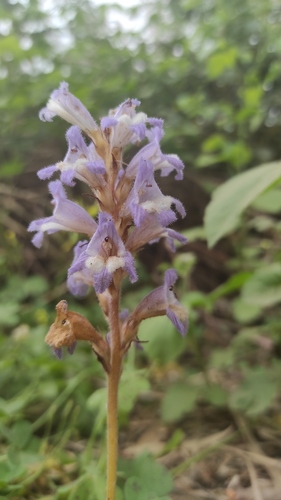
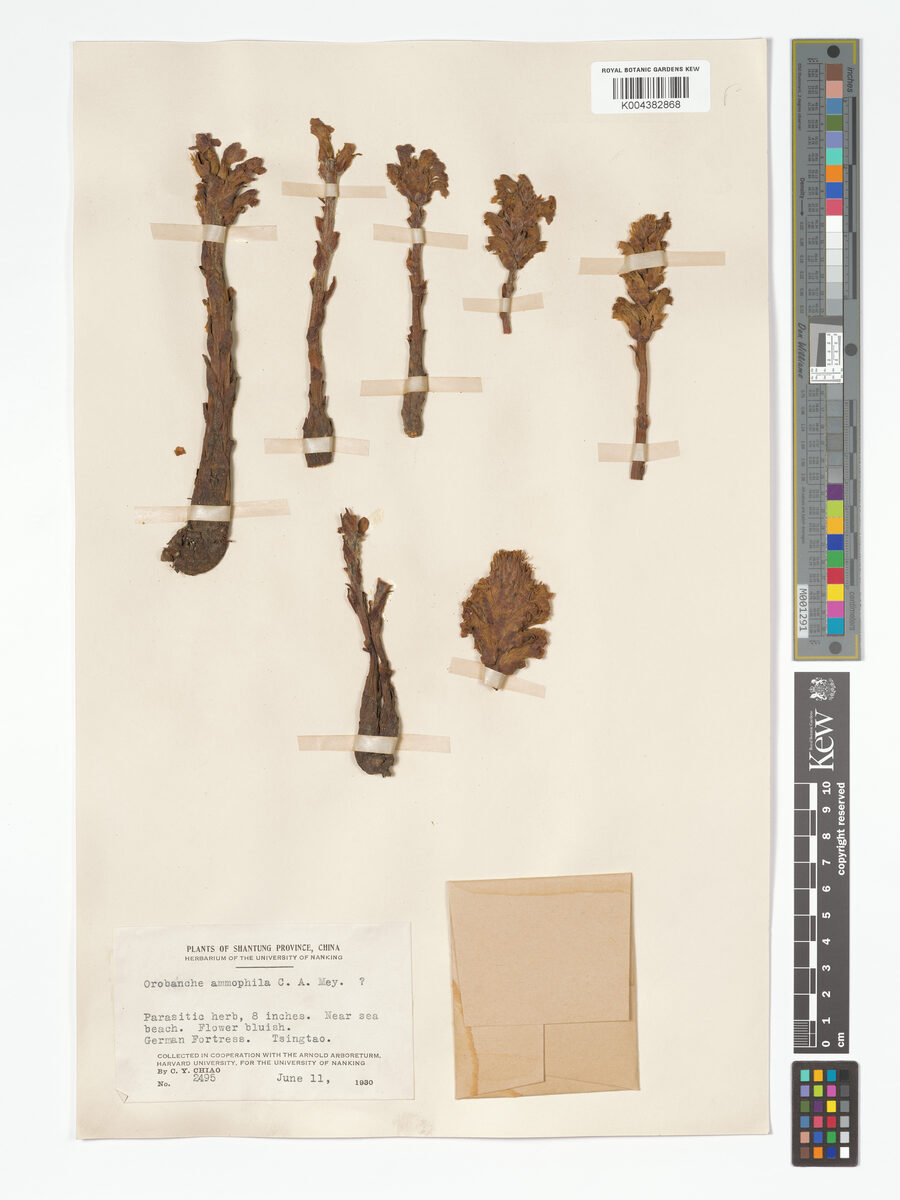
Orobanche fasciculata
Nutt.
Cancer root, Clustered broomrape
Wikipedia· cc-by-sa
Wikimedia Commons - Orobanche_fasciculata_8.jpg
iNaturalist· cc0
no rights reserved
iNaturalist· cc-by-nc
(c) Joey Santore, some rights reserved (CC BY-NC)
Summary
Source: WikipediaOrobanche fasciculata is a species of broomrape known by the common name clustered broomrape. It is native to much of western and central North America from Alaska to northern Mexico to the Great Lakes region, where it grows in many types of habitat. It is a parasite growing attached to the roots of other plants, usually members of the Asteraceae such as Artemisia; and other genera such as Eriodictyon and Eriogonum. This plant produces one or more stems from a bulbous root, growing erect to a maximum of about 20 centimeters in height. The stems, leaves and five-lobed flowers are covered by sticky hairs. As a parasite taking its nutrients from a host plant, it lacks chlorophyll as well as a water-storage system. It is variable in color, often yellowish or purple. The inflorescence is a raceme of up to 20 flowers, each on a pedicel up to 15 centimetres (5+7⁄8 in) long. Each flower has a calyx of hairy triangular sepals and a tubular corolla 1.5–3 cm (5⁄8–1+1⁄8 in) long. The flower is yellowish or purplish in color.
Description
A parasitic plant that grows attached to the roots of other plants especially the daisy family. It has a thick root and one or more stems. These are erect and 20 cm tall. It lacks leaves and chlorophyll and gets its nutrients from the other plant. There are up to 20 flowers in a group. The flowers are tube shaped and up to 3 cm long. They are yellow or purple.
Edible Uses
The entire plant is edible raw or cooked. It can be boiled in ashes, then peeled and eaten in a manner similar to potatoes.
Traditional Uses
The stems are eaten raw or boiled.
This uses section is brief — help expand it
Medicinal Uses
The root is pectoral. Chewed root has been applied as a dressing on wounds and open sores, and an infusion of the leaves is used as a wash on sores. Forms of the plant parasitic on sweet sage roots have been used to treat cancer. The dried and powdered plant is inserted in the rectum as a specific treatment for haemorrhoids.
Distribution
It is a temperate plant.
Where It Grows
Canada, Mexico, North America, USA,
Cultivation
We have very little information on this species and do not know if it will be hardy in Britain, though judging by its native range it should succeed outdoors in most parts of the country. It requires a well-drained soil and should succeed in sun or shade. A fully parasitic plant lacking in chlorophyll, it is entirely dependant upon its host plant for obtaining nutrient.
Propagation
No specific information is available for this species, but sowing seed in a greenhouse in a pot containing a host plant is suggested. Seed is probably best sown as soon as ripe where possible. It may also be feasible to sow seed in situ around a host plant.
Other Uses
None known.
Notes
There are about 140 Orobanche species.
Synonyms
References (4)
- Beckstrom-Sternberg, Stephen M., and James A. Duke. "The Foodplant Database." http://probe.nalusda.gov:8300/cgi-bin/browse/foodplantdb.(ACEDB version 4.0 - data version July 1994)
- Kermath, B. M., et al, 2014, Food Plants in the Americas: A survey of the domesticated, cultivated and wild plants used for Human food in North, Central and South America and the Caribbean. On line draft. p 591
- Moerman, D. F., 2010, Native American Ethnobotany. Timber Press. p 369
- Plants for a Future database, The Field, Penpol, Lostwithiel, Cornwall, PL22 0NG, UK. http://www.scs.leeds.ac.uk/pfaf/