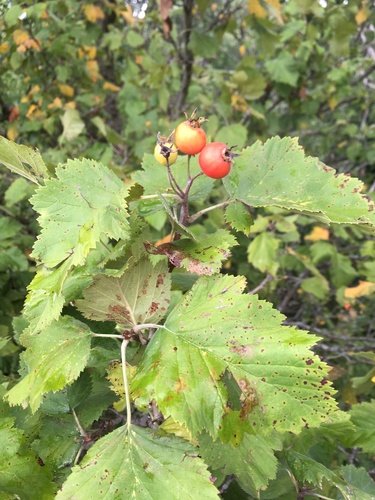
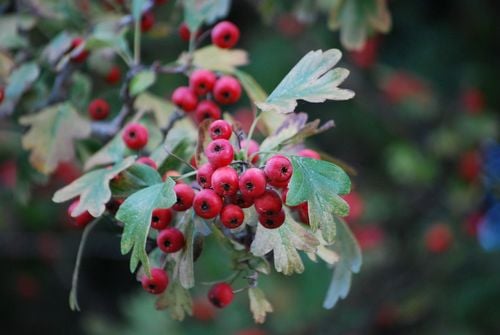
Amelanchier spicata
(Lam.) K.Koch.
iNaturalist· cc-by
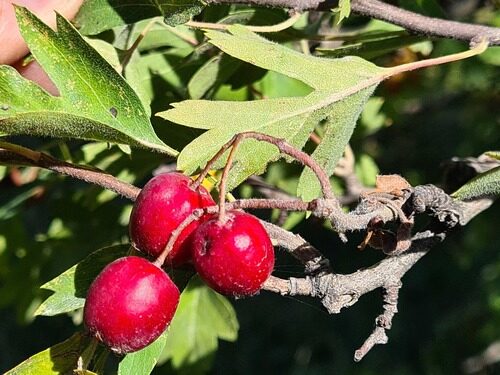
(c) Sarah Johnson, some rights reserved (CC BY), uploaded by Sarah Johnson
iNaturalist· cc-by-nc
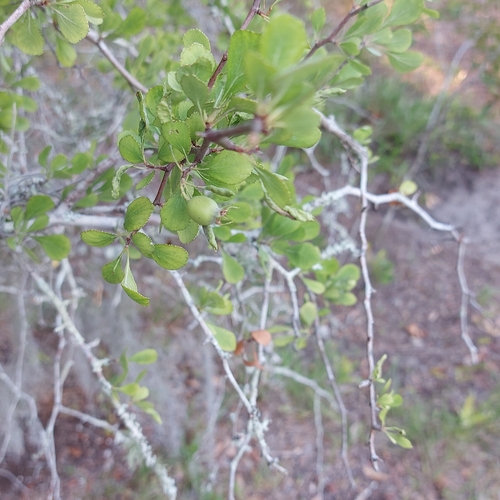
(c) Tatyana Zarubo, some rights reserved (CC BY-NC), uploaded by Tatyana Zarubo
iNaturalist· cc-by
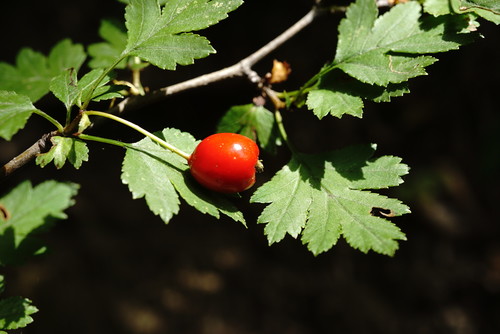
(c) Ульяна Лалак, some rights reserved (CC BY), uploaded by Ульяна Лалак
Summary
Deciduous shrub reaching 2 m tall. Hardy to UK zone 4 and tolerant of sandy, loamy, or heavy clay soils with mildly acidic to neutral pH. Grows in semi-shade or full sun and prefers moist soil. Flowers in May; bee-pollinated and self-fertile.
Description
A spreading shrub. It grows 2 m high. It produces suckers freely, forming thickets. The new leaves are very downy at first. The flowers are slightly pink. The fruit are purplish-black. Fruit are about 8 mm across.
Edible Uses
The fruit can be eaten raw or cooked — it is sweet and juicy, and rich in iron and copper. The berries are fairly small, around 8mm in diameter.
Traditional Uses
The fruit are eaten raw or cooked.
This uses section is brief — help expand it
Medicinal Uses
None known.
Distribution
It is a temperate plant. Plants grow naturally in dry rocky places in North America from Ontario to Michigan, Iowa, Pennsylvania and North Carolina. Plants are cold hardy to -25°C. It suits hardiness zones 4-9.
Where It Grows
Australia, Canada, Europe, North America, Norway, Scandinavia, Spain, USA,
Cultivation
It can be grown from seed, layering or suckers. Unless fresh seed are used, seed can take 18 months to germinate and layers can take 18 months to form roots.
Propagation
Seed is best harvested green, when fully formed but before the seed coat has hardened, then sown immediately in pots outdoors or in a cold frame. Stored seed obtained early in autumn can be given 4 weeks of warm stratification before being left out over winter, and should germinate in spring. Otherwise germination can be very slow, potentially taking 18 months or more. When seedlings are large enough to handle, prick them out into individual pots and grow on in a sheltered outdoor position, planting out once they reach 20cm or more. Where seed is plentiful, sow thinly in an outdoor seedbed and grow on for two years before moving to permanent positions during winter. Layering in spring takes around 18 months. Suckers can be divided in late winter, but they need to have been growing for 2 years beforehand to have developed roots. Once rooted, they can be planted directly into permanent positions.
Other Uses
None known.
Notes
There are about 25-30 Amelanchier species.
Synonyms
Also Known As
Junisotmispel
References (7)
- Beckstrom-Sternberg, Stephen M., and James A. Duke. "The Foodplant Database." http://probe.nalusda.gov:8300/cgi-bin/browse/foodplantdb.(ACEDB version 4.0 - data version July 1994)
- Bircher, A. G. & Bircher, W. H., 2000, Encyclopedia of Fruit Trees and Edible Flowering Plants in Egypt and the Subtropics. AUC Press. p 23
- Cundall, P., (ed.), 2004, Gardening Australia: flora: the gardener's bible. ABC Books. p 146
- Dendrologie 1:182. 1969
- Fisk, J. R. & Hoover, E., 2015, Wild Fruits of Minnesota. A Filed Guide. University of Minnesota p 8
Show all 7 references Hide references
- Girard, N. J., 2020, Sustainable Foraging of Wild Edible Plants in Norway. A Biocultural Approach. M. Sc. thesis Norwegian University. p 135
- Plants for a Future database, The Field, Penpol, Lostwithiel, Cornwall, PL22 0NG, UK. http://www.scs.leeds.ac.uk/pfaf/.