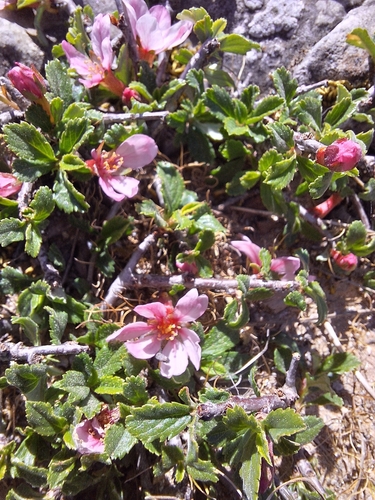
Rubus alceifolius
Poir.
Giant bramble
iNaturalist· cc-by-nc
(c) shibb, some rights reserved (CC BY-NC)
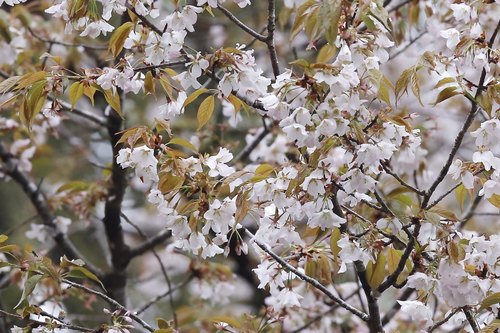
iNaturalist· cc-by-nc
(c) cyunf, some rights reserved (CC BY-NC)
iNaturalist· cc-by-nc
(c) cyunf, some rights reserved (CC BY-NC)
Description
A climbing shrub. It can be 6 m tall. The thorns on the stems are 4 mm long. The leaves have 5-7 lobes. The leaves are 5-20 cm long and wide. There on hairs on the top side and very hairy underneath. There are thorns along the midrib. The leaf stalks are 2-5 cm long and have thorns along the underside. The stipules are divided and spread out. The flowers can be single or in clusters in the axils of leaves or at the ends of branches. The flowers are white and 7-10 mm long. They have 5 petals. The fruit is an aggregate berry. It is orange or red and 2-3 cm long. There are many seeds.
Edible Uses
Fruit - raw or cooked. Juicy. Used to make jam. The aggregate, subglobose, red fruit is up to 18mm in diameter. Young shoots.
Traditional Uses
The ripe fruit are eaten raw.
This uses section is brief — help expand it
Medicinal Uses
The roots are astringent. They are boiled and used in the treatment of dysentery. The roots and leaves are used medicinally. The plant has been used in traditional medicine in La Réunion for the treatment of fever and inflammation. Alkaloids extracted from the roots may act to protect the liver. The extracts have exhibited high activity on the breast cancer tsFT210 cell line
Distribution
A tropical plant. It grows in warm regions. It grows in secondary undergrowth between 500 and 1800 m altitude.
Where It Grows
Asia, Australia, Cambodia, China, India, Indochina, Indonesia, Japan, Laos, Malaysia, Myanmar, Northeastern India, Philippines, SE Asia, Taiwan, Thailand, Vietnam,
Cultivation
Although found as far north as the warm temperate zone of central southern China (hardiness zone 8), the range of Rubus alceifolius extends mainly through the tropical zone of southeast Asia. Grows best in a sunny position, though older plants can tolerate considerable shade. Succeeds in a wide range of soils, preferring one that is well-drained. Rubus alceifolius is a robust, aggressive perennial scrambling shrub, spreading by long arching spiny stems, rooting at their tips, as well as by bird-dispersed seeds. It can develop dense impenetrable thickets. It is native to tropical southeast Asia but has been introduced to a number of other territories, most notably the Indian Ocean island of La Réunion, where it is one of the eight most threatening plant invaders to become established on the island and occurs not only on sites disturbed by people but also in primary forest with minimal disturbance. It can behave as a liana, climbing into the canopy of forest trees and increasing the risk of wind damage. It has been classified it as highly invasive in the tropics. In a joint project between USDA and the Weed Science Society of America it was identified among the highest-ranked potential future invasive weeds in the USA.
Propagation
Seed - germinates best if given a period of cold stratification prior to sowing in containers. Stored seed requires one month stratification at about 3°c and is best sown as early as possible in the growing season. Prick out the seedlings when they are large enough to handle and grow on until large enough to plant out. Cuttings of half-ripe wood in a frame. Tip layering towards the end of the growing season Division just before the plant comes into new growth or as it enters dormancy.
Other Uses
Most, if not all, thicket-forming species of Rubus have good erosion control value. They usually grow satisfactorily on barren and infertile soils and invade and occupy eroded areas. They also establish quickly on burns, old fields, and logged areas. Forming extensive and nearly impenetrable thickets, they can provide excellent cover for wildlife as well as nesting sites for small birds. They are often natural pioneer species, paving the way for woodlands to develop, but they should only really be used within their native range in order to avoid any risks of them invading other habitats.
Other Information
The ripe fruit are juicy and sweet.
Notes
It can become a weed. There are about 700 Rubus species.
Dangerous Lookalikes
This plant can be confused with the following toxic species. Always verify identification carefully before consuming any wild plant.
Red Baneberry
Actaea rubra
Walter Siegmund (talk)
Giant bramble
Rubus alceifolius
(c) shibb, some rights reserved (CC BY-NC)
Red Baneberry: Short herbaceous plant (no thorns), berries on thick red stems, each berry has a single seed, compound sharply-toothed leaves.
Giant bramble: Thorny woody canes (brambles), aggregate berry made of many drupelets, berries pull easily from receptacle.
Synonyms
Also Known As
Akar kupur, Asam susoh, Dum ngay, Dumdum, Fa lep, Gabei, Gachai, Inshumaring, Jetulipoka, Krak, Leo, Lidah kuching, Mam-xoi, Pasi payi, Sial-inu-chhu, Tampu rengat, Tikisambak
References (20)
- Altschul, S.V.R., 1973, Drugs and Foods from Little-known Plants. Notes in Harvard University Herbaria. Harvard Univ. Press. Massachusetts. no. 1420
- Baishya, S. Kr., et al, 2013, Survey of Wild Edible Fruits of Dhubri District, Assam, India. Plant Archives Vol 13 (1): 155-158
- Beasley, J., 2011, Plants of Tropical North Queensland - the compact guide. Footloose publications. p 125
- Cooper, W. and Cooper, W., 2004, Fruits of the Australian Tropical Rainforest. Nokomis Editions, Victoria, Australia. p 431
- Encycl. 6:247. 1804 "alcaefolius"
Show all 20 references Hide references
- Flora of China. 9:195-285, 2003 No. 116
- Fu, Yongneng, et al, 2003, Relocating Plants from Swidden Fallows to Gardens in Southwestern China. Economic Botany, 57(3): 389-402
- Ghorbani, A., et al, 2012, A comparison of the wild food plant use knowledge of ethnic minorities in Naban River Watershed Nature Reserve, Yunnan, SW China. Journal of Ethnobiology and Ethnomedicine; 8:17
- Jackes, B.R., 2001, Plants of the Tropics. Rainforest to Heath. An Identification Guide. James Cook University. p 76
- Jin, Chen et al, 1999, Ethnobotanical studies on Wild Edible Fruits in Southern Yunnan: Folk Names: Nutritional Value and Uses. Economic Botany 53(1) pp 2-14
- Kar, A., et al, 2013, Wild Edible Plant Resources used by the Mizos of Mizoram, India. Kathmandu University Journal of Science, Engineering and Technology. Vol. 9, No. 1, July, 2013, 106-126
- Lokho, K. & Narasimhan, D., 2013, Ethnobotany of Mao-Naga Tribe of Manipur, India. Pleione 7(2): 314-324
- Martin, M.A., 1971, Introduction L'Ethnobotanique du Cambodge. Centre National de la Recherche Scientifique. Paris.
- Patiri, B. & Borah, A., 2007, Wild Edible Plants of Assam. Geethaki Publishers. p 50 (As alcerifolius)
- Phon, P., 2000, Plants used in Cambodia. © Pauline Dy Phon, Phnom Penh, Cambodia. p 539
- Sarma, H., et al, 2010, Updated Estimates of Wild Edible and Threatened Plants of Assam: A Meta-analysis. International Journal of Botany 6(4): 414-423
- Singh, B., et al, 2012, Wild edible plants used by Garo tribes of Nokrek Biosphere Reserve in Meghalaya, India. Indian Journal of Traditional Knowledge. 11(1) pp 166-171
- Srivastava, R. C., 2010, Traditional knowledge of Nyishi (Daffla) tribe of Arunachal Pradesh. Indian Journal of Traditional Knowledge. 9(1):26-37
- Taram, M., et al, 2018, Wild Food Plant Resources of Komkar Adi Tribe of Upper Siang District in Arunachal Pradesh, India. Bulletin of Arunachal Forest Research, Vol. 33(2), 27-35
- www.efloras.org Flora of China Volume 9