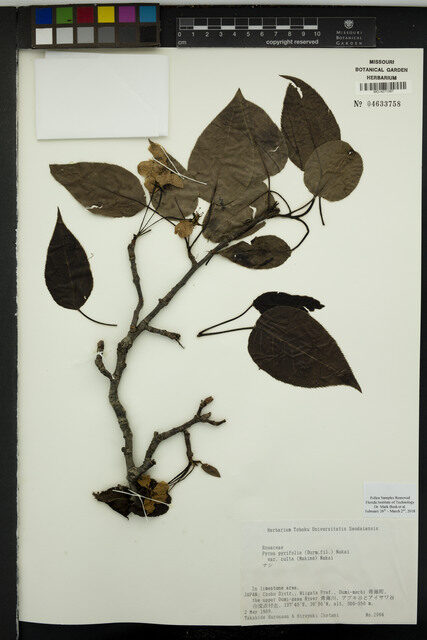
Amelanchier alnifolia var. semi-integrifolia
(Lindl.) C. L. Hitchc.
Pacific Serviceberry
gbif· cc-by-nc
Cesar Garcia Olmos
gbif· cc-by-nc
Andrew Simon
gbif· cc-by-nc
Chris McCarron
Summary
Source: WikipediaAmelanchier alnifolia, the saskatoon berry, Pacific serviceberry, western serviceberry, western shadbush, or western juneberry, is a shrub native to North America. It is a member of the rose family, and bears an edible berry-like fruit.
Description
A shrub or small tree. It grows up to 3 m high. It loses its leaves in the autumn especially in dry years. The leaves are oval and rounded at both ends. The upper surface is dark green and the lower surface is paler. The buds are purplish. The flowers occur in clusters. They are 4-7 cm long. The fruit are 10-12 mm across. They are purple and coated with a whitish powder. They are edible.
Edible Uses
With a sweet, nutty taste, the fruits have long been eaten by Indigenous peoples in Canada, fresh or dried. They are well known as an ingredient in pemmican, a preparation of dried meat to which saskatoon berries are added as flavour and preservative. They are used in saskatoon berry pie, jam, wine, cider, beers, and sugar-infused berries similar to dried cranberries used for breakfast cereals, trail mix, and snack foods. In 2004, the British Food Standards Agency suspended saskatoon berries from retail sales pending safety testing; the ban eventually was lifted.
Traditional Uses
The fruit can be eaten raw or cooked and used in puddings, pies and muffins. The fruit can be dried and eaten like raisins.
This uses section is brief — help expand it
Distribution
It is a temperate plant. It grows naturally in moist woods and open places in Western North America. Plants are hardy to cold to about -35°C.
Where It Grows
Australia, Canada, North America, USA,
Cultivation
It can be grown from seed, layering or suckers. Seed can take 18 months to germinate and layers can take 18 months to form roots.
Other Information
Formerly an important food for the North American Indians.
Notes
There are about 25-30 Amelanchier species.
Synonyms
References (8)
- Beckstrom-Sternberg, Stephen M., and James A. Duke. "The Foodplant Database." http://probe.nalusda.gov:8300/cgi-bin/browse/foodplantdb.(ACEDB version 4.0 - data version July 1994) (As Amelanchier alnifolia)
- Edward's Bot. Reg. 19: t. 1589. 1833 (As Amelanchier alnifolia)
- Farrar, J.L., 1995, Trees of the Northern United States and Canada. Iowa State University press/Ames p 368 (As Amelanchier alnifolia)
- Glowinski, L., 1999, The Complete Book of Fruit Growing in Australia. Lothian. p 51 (As Amelanchier alnifolia)
- Heller, C. A., 1962, Wild Edible and Poisonous Plants of Alaska. Univ. of Alaska Extension Service. p 36 (As Amelanchier florida)
Show all 8 references Hide references
- http://en.hortipedia.com
- Kermath, B. M., et al, 2014, Food Plants in the Americas: A survey of the domesticated, cultivated and wild plants used for Human food in North, Central and South America and the Caribbean. On line draft. p 55
- Plants for a Future database, The Field, Penpol, Lostwithiel, Cornwall, PL22 0NG, UK. http://www.scs.leeds.ac.uk/pfaf/.