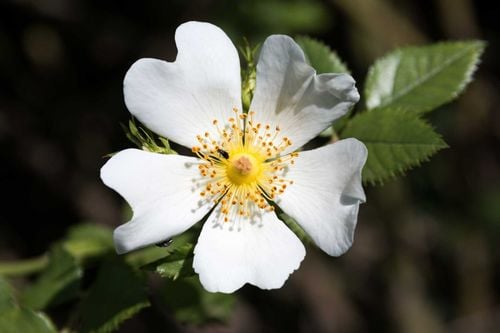
Geum urbanum
L.
Wood avens, Herb Bennet
iNaturalist· cc-by-nc
(c) Stephen Sentoff, some rights reserved (CC BY-NC)
iNaturalist· cc-by-nc
(c) David Renoult, some rights reserved (CC BY-NC), uploaded by David Renoult
iNaturalist· cc-by-nc
(c) Анна Новицкая, some rights reserved (CC BY-NC)
Summary
Source: WikipediaGeum urbanum, also known as wood avens, herb Bennet, colewort, clove root and St. Benedict's herb (Latin: herba benedicta), is a perennial plant in the rose family (Rosaceae), which grows in shady places (such as woodland edges and near hedgerows) in the temperate regions of Eurasia and North America.
Description
A small plant that keeps growing from year to year. It grows 60 cm high and spreads 50 cm wide. The stems are erect, hairy and branching. The leaves at the base have leaf stalks. They are harp shaped with leaflets along the stalk and double teeth around the edge. The lower stem leaves have 3 lobes and the upper leaves are simple. The flowers are yellow. They are small and occur singly. They occur at the ends of branches and have 5 petals.
Edible Uses
Young leaves can be cooked and eaten. The root, which grows up to 5cm long, is also cooked and used as a spice in soups and stews, or as a flavouring in ale. It is a substitute for cloves with a hint of cinnamon in the flavour and is best used in spring. The root can also be boiled to make a beverage.
Traditional Uses
The young shoots are used as a potherb. The rhizome is used as a spice in soups and sauces. The leaves are used for tea. It is used for flavouring ale.
Medicinal Uses
Wood avens is an astringent herb used principally to treat problems affecting the mouth, throat, and gastrointestinal tract. It tightens soft gums, heals mouth ulcers, makes a good gargle for infections of the pharynx and larynx, and reduces irritation of the stomach and gut. All parts of the plant, especially the root, are anti-inflammatory, antiseptic, aromatic, astringent, diaphoretic, febrifuge, stomachic, styptic, and tonic. An infusion taken internally treats diarrhoea, intestinal disorders, stomach upsets, irritable bowel syndrome, and liver disorders. Applied externally, it is used as a wash for haemorrhoids and vaginal discharges, and to treat skin afflictions including spots, freckles, and eruptions on the face. The root is best harvested in spring when most fragrant. It should be dried carefully and stored in a cool, dry, airtight container, then sliced and powdered only when needed. The powdered root had a strong reputation as a substitute for quinine in treating intermittent fevers.
Distribution
It is a temperate plant. It needs a light to medium well-drained soil. It needs an open sunny position. It is resistant to frost but sensitive to drought. It suits hardiness zone 7.
Where It Grows
Africa, Asia, Australia, Balkans, Bosnia, Britain, Caucasus, Central Asia, Czech Republic, Estonia, Europe, France, Germany, Himalayas, India, Iran, Iraq, Ireland, Italy, Luxembourg, Macedonia, Mediterranean, Middle East, Moldova, New Zealand, North Africa, Norway, Russia, Scandinavia, Siberia, Sicily, Slovakia, Slovenia, Spain, Sweden, Syria, Tajikistan, Tasmania, Turkey, Türkiye,
Cultivation
Easily grown in any moderately good garden soil that is well-drained. Prefers shade and a soil rich in organic matter. This species was widely cultivated as a pot-herb in the 16th century. The bruised or dried root is pleasantly aromatic with a clove-like fragrance. Plants self-sow freely when well-sited. Hybridizes freely with other members of this genus.
Propagation
Sow seed in spring or autumn in a cold frame. Once large enough to handle, prick seedlings into individual pots and plant out in summer. Divide plants in spring or autumn every 3–4 years to maintain vigour. Larger clumps can be replanted directly into permanent positions, while smaller clumps are best potted up and grown on in a cold frame until rooting well, then planted out in spring.
Other Uses
The freshly dug root has a clove-like fragrance; once dried, it can be placed in the linen cupboard to repel moths. The root contains about 9% tannin.
Notes
There are about 40 Geum species.
Synonyms
Also Known As
Avens, Blazenak, Cerentel, Clove-root, Herb benedict, Maamool, Meryemotu, Navadna sretena, Prestrit, Pristrit
References (25)
- Ambasta, S.P. (Ed.), 2000, The Useful Plants of India. CSIR India. p 235
- Bremness, L., 1994, Herbs. Collins Eyewitness Handbooks. Harper Collins. p 174
- Brown, D., 2002, The Royal Horticultural Society encyclopedia of Herbs and their uses. DK Books. p 224
- Cerne, M., 1992, Wild Plants from Slovenia used as Vegetables. Acta Horticulturae 318
- Ciocarlan, N. & Ghendov, V., 2015, Ethnobotanical and Ecological Studies of Wild Edible Plants from Bugeac Steppe, Republic of Moldova. Journal of EcoAgriTourism. Cailta terra Vol. 11(2):
Show all 25 references Hide references
- Ertug, F, Yenen Bitkiler. Resimli Türkiye Florası -I- Flora of Turkey - Ethnobotany supplement
- Facciola, S., 1998, Cornucopia 2: a Source Book of Edible Plants. Kampong Publications, p 199
- Hammer, K. & Spahillari, M., 1999, Crops of European origin. in Report of a networking group on minor crops. IPGRI p 44
- Hedrick, U.P., 1919, (Ed.), Sturtevant's edible plants of the world. p 328
- Hibbert, M., 2002, The Aussie Plant Finder 2002, Florilegium. p 111
- http://nordicfood lab/org/blog/2102/9/wild-edible-plants-an-overview
- Irving, M., 2009, The Forager Handbook, A Guide to the Edible Plants of Britain. Ebury Press p 268
- Kalle, R. & Soukand, R., 2012, Historical ethnobotanical review of wild edible plants of Estonia (1770s-1960s) Acta Societatis Botanicorum Poloniae 81(4):271-281
- Kiple, K.F. & Ornelas, K.C., (eds), 2000, The Cambridge World History of Food. CUP p 432, 1785
- Luczaj, L., 2012, Ethnobotanical review of wild edible plants of Slovakia. Acta Societatis Botanicorum Poloniae 81(4):245-255
- Michael, P., 2007, Edible Wild Plants and Herbs. Grub Street. London. p 123
- Pasta, S., et al, 2020, An Updated Checklist of the Sicilian Native Edible Plants: Preserving the Traditional Ecological Knowledge of Century-Old Agro-Pastoral Landscapes. Frontiers in Plant Science. Volume 11|Article 388
- Plants for a Future database, The Field, Penpol, Lostwithiel, Cornwall, PL22 0NG, UK. http://www.scs.leeds.ac.uk/pfaf/
- Redzic, S. J., 2006, Wild Edible Plants and their Traditional Use in the Human Nutrition in Bosnia-Herzegovina. Ecology of Food and Nutrition, 45:189-232
- Seidemann J., 2005, World Spice Plants. Economic Usage, Botany, Taxonomy. Springer. p 166
- Simkova, K. et al, 2014, Ethnobotanical review of wild edible plants used in the Czech Republic. Journal of Applied Botany and Food Quality 88, 49-67
- Sp. pl. 1:501. 1753
- Tasmanian Herbarium Vascular Plants list p 48 (As Geum urbanum var. strictum)
- Wiersema, J. H. & Leon, B., 2013, World Economic Plants. A Standard Reference CRC Press. 2nd Ed. p 322
- World Checklist of Useful Plant Species 2020. Royal Botanic Gardens, Kew