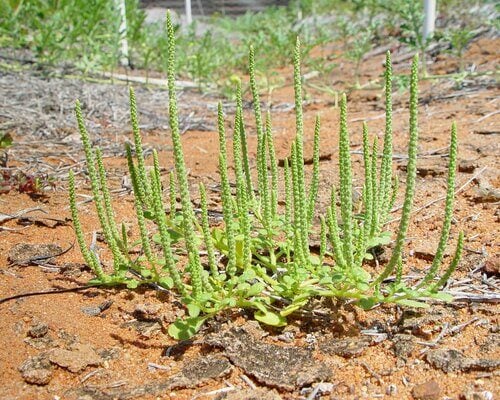
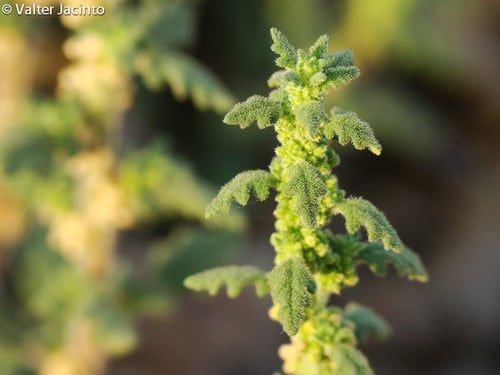
Amaranthus powellii
S. Watson
Powell’s amaranth
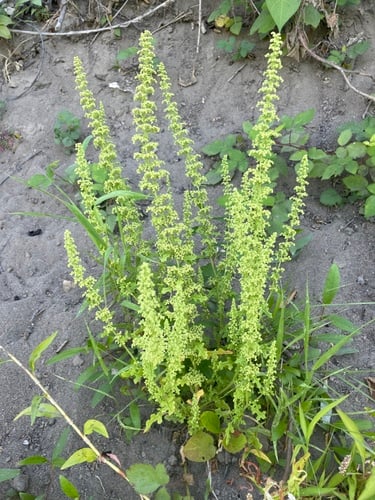
iNaturalist· cc-by-nc
(c) Martin A. Prinz, some rights reserved (CC BY-NC), uploaded by Martin A. Prinz
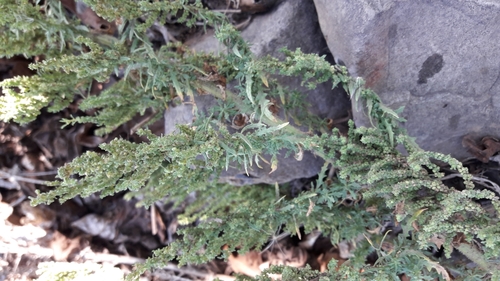
iNaturalist· cc-by-nc
(c) Phil Bendle, some rights reserved (CC BY-NC), uploaded by Phil Bendle
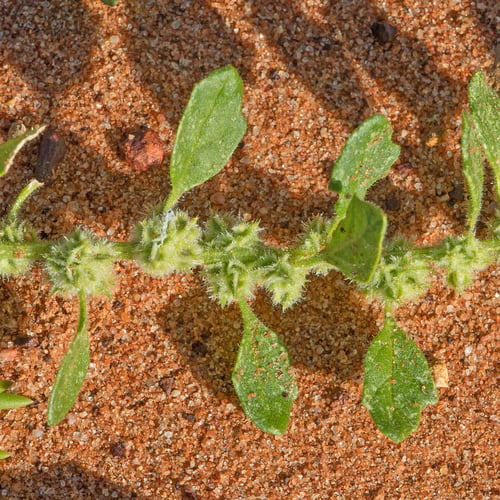
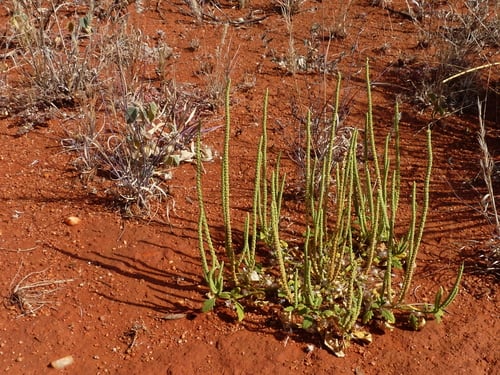
iNaturalist· cc-by-nc
(c) Andrew Nevin, some rights reserved (CC BY-NC), uploaded by Andrew Nevin
Summary
Source: WikipediaAmaranthus powellii is a species of amaranth known by the common names Powell's amaranth and green amaranth. It is native to the southwestern United States and northern Mexico, but it is common throughout most of the rest of the temperate Americas as a naturalized species. It has also been introduced to other continents, including Australia and Europe.
Description
A fast-growing annual reaching 1.5 m (5 ft) in height. Hardy to UK zone 6 but frost-tender. Monoecious flowers are wind-pollinated and self-fertile. Adapts to light sandy, medium loamy, and heavy clay soils with good drainage. Tolerates mildly acidic, neutral, and basic pH levels. Requires full sun, prefers moist soil, and shows drought tolerance. Cannot survive in shade.
Edible Uses
Powell's amaranth offers both leaves and seeds of high food value. The young leaves are tender and excellent eaten raw in salads or cooked as greens. Their flavor is spinach-like — mild with subtle nettle-like undertones and without harshness or sliminess — and even the stalks remain tender, making this one of the better wild leafy greens. The seeds are abundant, reddish-black, and nutritious. They can be harvested easily by tapping mature flower spikes, which release seeds readily, and require only minimal cleaning before storage. Seeds can be eaten raw, toasted, or boiled, or ground into flour. Toasting improves the flavor, giving a nutty, popcorn-like quality, though they tend to jump out of the pan. Boiled seeds produce a hearty grain-like mush. Their neutral, whole-grain flavor suits use in porridges, seed bars, or flours. Cooked whole, seeds become very gelatinous, but it is difficult to crush all of them in the mouth and some will pass through the digestive system without being assimilated.
Traditional Uses
The leaves are edible cooked. The seeds are ground into flour and cooked. CAUTION: This plant can accumulate nitrates if grown with high nitrogen inorganic fertilisers and these are poisonous.
Medicinal Uses
None known.
Known Hazards
No members of this genus are known to be poisonous, but when grown on nitrogen-rich soils they are known to concentrate nitrates in the leaves. This is especially noticeable on land where chemical fertilizers are used. Nitrates are implicated in stomach cancers, blue babies and some other health problems. It is inadvisable, therefore, to eat this plant if it is grown inorganically.
Distribution
It grows naturally in waste places in Eastern North America. It grows in temperate places. Tasmania Herbarium.
Where It Grows
Argentina, Australia, Balkans, Croatia, Ecuador, New Zealand, North America, South America*, Tasmania, USA,
Cultivation
Growing Conditions: Sun: Prefers full sun. Soil: Adaptable to a wide range of soils, thriving especially in disturbed, fertile soils. Moisture: Tolerates dry conditions but responds strongly to summer rains. Growth Habit: Upright annual, typically 0.5–1.5 m tall, with elongated flowering spikes that turn brown when mature. Habitat: Native to Southwestern North America, but now spread widely as a weed across the United States and introduced in other parts of the world. Found in disturbed soils, roadsides, agricultural fields, gardens, and waste places. Seeds usually mature from late summer into autumn. It will grow in Britain, though it should succeed as a spring-sown annual. The following notes are based on the general needs of the genus. Prefers a well-drained, fertile soil in a sunny position. Requires a hot sheltered position if it is to do well. Plants should not be given inorganic fertilizers, see notes above on toxicity. Most if not all members of this genus photosynthesize by a more efficient method than most plants. Called the 'C4 carbon-fixation pathway', this process is particularly efficient at high temperatures, in bright sunlight and under dry conditions. Annual, frost-tender. Best suited to zones 5–9, where warm summers support rapid growth.
Propagation
Sow seed in late spring in situ. An earlier sowing can be made in a greenhouse, with plants put out after the last expected frosts. Germination is usually rapid and good when the soil is warm, and a drop in temperature overnight aids germination. Cuttings of growing plants root easily.
Other Uses
Yellow and green dyes can be obtained from the whole plant. This species is also noted as a dynamic accumulator.
Notes
There are about 60 Amaranthus species.
Synonyms
Also Known As
Bledo
References (12)
- Beckstrom-Sternberg, Stephen M., and James A. Duke. "The Foodplant Database." http://probe.nalusda.gov:8300/cgi-bin/browse/foodplantdb.(ACEDB version 4.0 - data version July 1994)
- Hussey, B.M.J., Keighery, G.J., Cousens, R.D., Dodd, J., Lloyd, S.G., 1997, Western Weeds. A guide to the weeds of Western Australia. Plant Protection Society of Western Australia. p 80
- Hyde-Wyatt, B.H. & Morris D.I., 1975, Tasmanian Weed Handbook. Dept of Ag Tasmania. p 73
- Kermath, B. M., et al, 2014, Food Plants in the Americas: A survey of the domesticated, cultivated and wild plants used for Human food in North, Central and South America and the Caribbean. On line draft. p 53
- Lazarides, M. & Hince, B., 1993, Handbook of Economic Plants of Australia, CSIRO. p 17
Show all 12 references Hide references
- Luczaj et al, 2013, Wild vegetable mixes sold in the markets of Dalmatia (southern Croatia). Journal of Ethnobiology and Ethnomedicine. 8:2
- Mapes, C. & Basurto, F., 2016, Biodiversity and Edible Plants of Mexico. Chapter 5 in R. Lira, et al. (eds.), Ethnobotany of Mexico, Ethnobiology, Springer. p 114
- Paczkowska, G. & Chapman, A.R., 2000, The Western Australian Flora. A Descriptive Catalogue. Western Australian Herbarium. p 137
- Plants for a Future database, The Field, Penpol, Lostwithiel, Cornwall, PL22 0NG, UK. http://www.scs.leeds.ac.uk/pfaf/
- Proc. Amer. Acad. Arts. 10:347. 1875
- Skinner, G. & Brown, 1981, C., Simply Living. A gatherer's guide to New Zealand's fields, forests and shores. Reed. p 5
- Torre, de la L., et al, 2008, Enciclopedia de las Plantas Útiles del Ecuador. Herbario QCA. Pontificia Universidad Católica del Ecuador. p 155