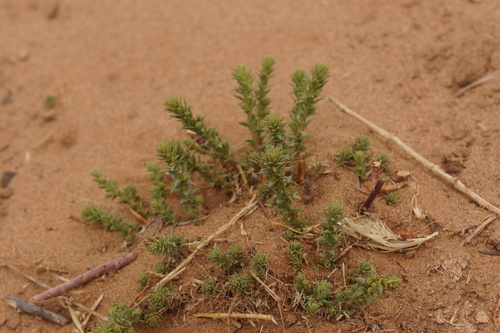
Amaranthus polygonoides
L.
Tropical amaranth
iNaturalist· cc-by-nc
(c) krancmm, some rights reserved (CC BY-NC), uploaded by krancmm
iNaturalist· cc-by
(c) Sam Kieschnick, some rights reserved (CC BY)
Summary
Source: WikipediaAmaranthus polygonoides is a species of flowering plant found in North America and the Caribbean. It goes by the common name of tropical amaranth.
Description
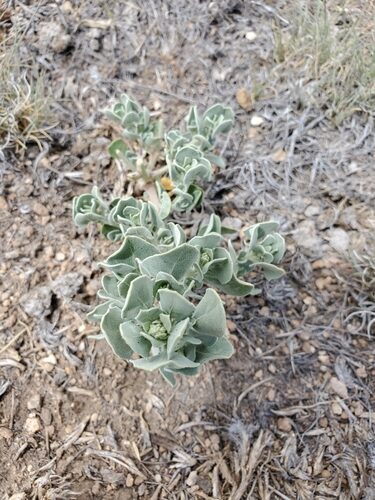
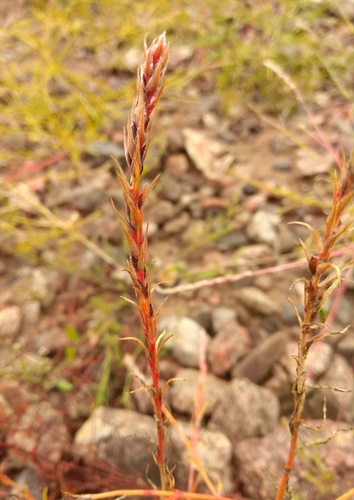
A small annual plant. It can be erect or lie over. It grows 10-50 cm high. It has soft spikes on young shoots. The leaves are narrowly oval and 3 cm long by 1.5 cm wide. The flowers are in congested clusters in the axils of leaves. The seeds are dark brown and shiny. They are lens shaped and 1 mm across.
Edible Uses
The young shoots and leaves are cooked and eaten as a vegetable, either fried or used in curries.
Traditional Uses
The young shoots and leaves are cooked and eaten as a vegetable. They are fried or used in curries.
This uses section is brief — help expand it
Distribution
It is a tropical plant. It grows from sea level up to 500 m altitude. It is best with a pH of 5.5-7.5, It grows best with a temperature between 23°-30°C.
Where It Grows
Asia, Bahamas*, Belize, Central America, Dominican Republic, Haiti*, Honduras, India, Jamaica*, Lesser Antilles, Malaysia, Mexico*, North America, Northeastern India, Pakistan, SE Asia, South America*, Sri Lanka, Virgin Islands, West Indies*,
Cultivation
Plants can be grown from seeds. Seeds are best mixed with sand to enable an even distribution. They can be sown direct or transplanted.
Production
The first harvest can begin after 2 weeks but is better after 5-7 weeks. Plants can be uprooted or the tops picked out. Yields of 30-60 tons per hectare are possible.
Notes
There are about 60 Amaranthus species. It is high in proVitamin A.
Nutrition
| Part | Moisture | kJ | kcal | Protein | Vit A | Vit C | Iron | Zinc |
|---|---|---|---|---|---|---|---|---|
| Leaves | 85.9 | — | — | 4.3 | 53 | — | 5 | — |
Synonyms
Also Known As
Araikkirai, Dagalikeere soppu, Mati khutura, Punniyaku, Sirukeerai, Sirri kura, Tandulja, Walu tampala
References (12)
- Harisha, R. P. & Padmavathy, S., 2013, Knowledge and Use of Wild Edible Plants in Two Communities in Malai Madeshwara Hills, Southern India. International Journal of Botany 9(2): 64-72.
- Pl. jamaic. pug. 27. 1759
- Kuhnlein, H. V., et al, 2009, Indigenous Peoples' food systems. FAO Rome p 191
- Kuvar, S. D. & Shinde, R. D., 2019, Wild Edible Plants used by Kokni Tribe of Nasik District, Maharashtra. Journal of Global Biosciences. Volume 8, Number 2, 2019, pp. 5936-5945
- Macmillan, H.F. (Revised Barlow, H.S., et al), 1991, Tropical Planting and Gardening. Sixth edition. Malayan Nature Society. Kuala Lumpur. p 356
Show all 12 references Hide references
- Martin, F.W. & Ruberte, R.M., 1979, Edible Leaves of the Tropics. Antillian College Press, Mayaguez, Puerto Rico. p 173
- Patiri, B. & Borah, A., 2007, Wild Edible Plants of Assam. Geethaki Publishers. p 108
- Pegu, R., et al, 2013, Ethnobotanical study of Wild Edible Plants in Poba Reserved Forest, Assam, India. Research Journal of Agriculture and Forestry Sciences 1(3):1-10
- Plants of Haiti Smithsonian Institute http://botany.si.edu
- Rajapaksha, U., 1998, Traditional Food Plants in Sri Lanka. HARTI, Sri Lanka. p 34
- Rodriguez-Amaya, D. B., 1999, Carotenoides y Prepracion de Alimentos. University Estadual de Campinas, Brasil, Ph.D. thesis. p 19
- Terra, G.J.A., 1973, Tropical Vegetables. Communication 54e Royal Tropical Institute, Amsterdam, p 23