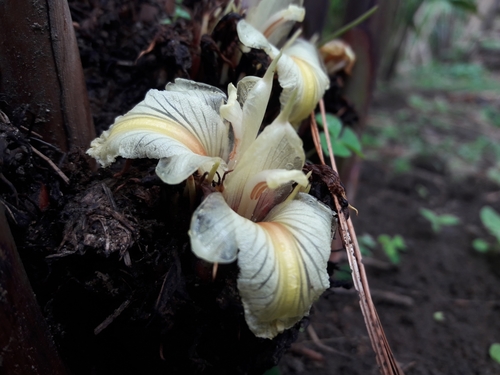
Alpinia officinarum
Hance
Lesser galangal
iNaturalist· cc-by-nc
(c) Mahesh A, some rights reserved (CC BY-NC), uploaded by Mahesh A
iNaturalist· cc-by-nc
(c) Mahesh A, some rights reserved (CC BY-NC), uploaded by Mahesh A
iNaturalist· cc-by-nc
(c) Mahesh A, some rights reserved (CC BY-NC), uploaded by Mahesh A
Summary
Source: WikipediaAlpinia officinarum, known as lesser galangal, is a plant in the ginger family, cultivated in Southeast Asia. It originated in China, where its name ultimately derives. It can grow 1.5 to 2 m high, with long leaves and reddish-white flowers. The rhizomes, known as galangal, are valued for their sweet spicy flavor and aromatic scent. These are used throughout Asia in curries and perfumes, and were previously used widely in Europe. They are also used as a herbal remedy.
Description
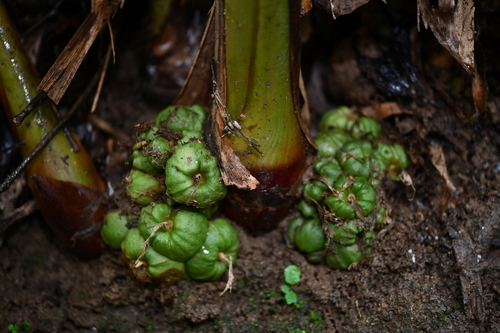
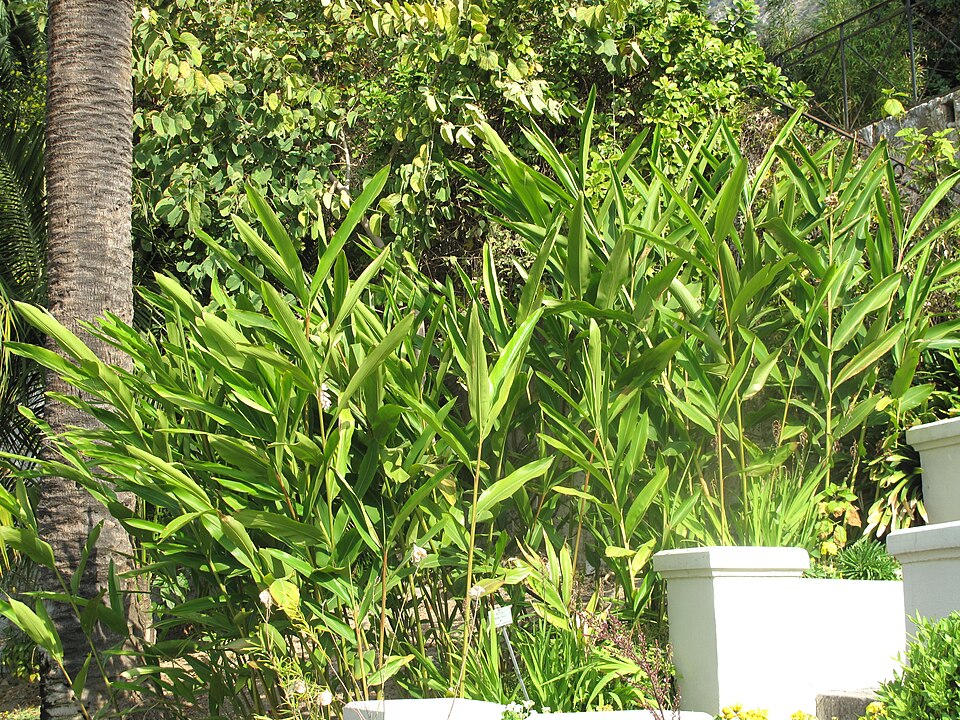
A herb. The false stem 1-1.5 m tall. The rhizome is elongated. The leaves do not have stalks. The leaf blade in narrow and 20-30 cm long by 1.2-2.5 cm wide. The flower stalk is erect and 6-10 cm long. The flowers are borne singly. They are white with a red veined lip. The fruit is a capsule which is red and round. It is about 1 cm across.
Edible Uses
The galangal rhizomes were widely used in ancient and medieval Europe, where they were reputed to smell of roses and taste of sweet spice. Its use in Europe has dramatically declined. In Asia the rhizomes are ground to powder for use in curries, drinks, and jellies. In India an extract is used in perfumes, and Tartars prepare a tea with it. Alpinia officinarum contains high concentrations of the flavonol galangin. Historically, the rhizomes were reputed to have stimulant and digestive effects.
Traditional Uses
The rhizome is used to flavour food. It is used in curry powder blends. It has a flavour like a mixture of pepper and ginger. The leaves are also eaten.
Medicinal Uses
The rhizome of lesser galangal is a bitter, aromatic, stimulant herb that acts mainly on the digestive system. It is more aromatic and pungent than galangal (Alpinia galanga,) but contains more or less the same compounds, although in lesser galangal they are present in larger quantities. The local use of both species is approximately the same. The rhizome is also carminative, relieves pain, lowers fevers and controls bacterial and fungal infections. The roots are harvested when 4 - 6 years old and can be used fresh or dried. The rhizomes are widely used in Vietnam for treating stomach problems including dyspepsia, flatulence, vomiting, gastralgia, colic, diarrhoea, fever and malaria, and are locally applied to infected gums. In Thailand, they are used as a carminative and for indigestion. The seeds are used in China, for treating heartburn, cholera, toothache, ague and colds.
Distribution
A tropical plant. It grows in S China. In XTBG Yunnan.
Where It Grows
Asia, Australia, Cambodia, China, East Timor, India, Indochina, Japan, Laos, Malaysia, Myanmar, SE Asia, Timor-Leste, Vietnam,
Cultivation
A plant for the warmer, moister tropics, preferring high humidity and a temperature that does not fall below 15°c. It grows best in areas where annual daytime temperatures are within the range 19 - 27°c, but can tolerate 15 - 36°c. It prefers a mean annual rainfall in the range 1,500 - 3,000mm, but tolerates 1,100 - 4,000mm. Prefers a well-drained, humus-rich soil and a position in partial shade. Prefers a pH in the range 4.5 - 5.5, tolerating 4 - 6.
Propagation
Seed - best sown as soon as ripe. Sow in containers and keep at around 20c. Division of the rootstock as new growth begins. Very easy.
Other Uses
The rhizome is the source of true galangal oil used in perfume compositions to which it imparts unique, warm, spicy notes.
Notes
It is used in medicine. There are about 200-230 Alpinia species. They are mostly tropical and subtropical.
Synonyms
Also Known As
Chinese ginger, Galangale, Gao liang jiang, San bai, Small galangal
References (29)
- Ambasta S.P. (Ed.), 2000, The Useful Plants of India. CSIR India. p 31
- Arora, R. K., 2014, Diversity in Underutilized Plant Species - An Asia-Pacific Perspective. Bioversity International. p 99
- Bircher, A. G. & Bircher, W. H., 2000, Encyclopedia of Fruit Trees and Edible Flowering Plants in Egypt and the Subtropics. AUC Press. p 21
- Bremness, L., 1994, Herbs. Collins Eyewitness Handbooks. Harper Collins. p 144
- Brouk, B., 1975, Plants Consumed by Man. Academic Press, London. p 301
Show all 29 references Hide references
- Chen, I., et al, 2008, Antioxidant and Antimicrobial Activities of Zingiberaceae Plants in Taiwan. Plant Foods for Human Nutritition, 63:15-20
- Facciola, S., 1998, Cornucopia 2: a Source Book of Edible Plants. Kampong Publications, p 247
- Hemphill, I, 2002, Spice Notes Macmillan. p 186
- Heywood, V.H., Brummitt, R.K., Culham, A., and Seberg, O., 2007, Flowering Plant Families of the World. Royal Botanical Gardens, Kew. p 408
- Hu, Shiu-ying, 2005, Food Plants of China. The Chinese University Press. p 325
- J. Linn. Soc., Bot. 13:6. 1873
- Kiple, K.F. & Ornelas, K.C., (eds), 2000, The Cambridge World History of Food. CUP p 433, 1776
- Larsen, K., Ibrahim, H., Khaw, S.H., & Saw, L.G., 1999, Gingers of Peninsula Malaysia and Singapore. Natural History Publications (Borneo). p 9
- Lim, T. K., 2015, Edible Medicinal and Non Medicinal Plants. Volume 9, Modified Stems, Roots, Bulbs. Springer p 7
- Lu, C.L., Zhao, H. Y. and Jiang, J. G., 2013, Evaluation of multi-activites of 14 edible species from Zingiberaceae. Int. J. Food Sci Nutr. 64(1):28-35
- Macmillan, H.F. (Revised Barlow, H.S., et al), 1991, Tropical Planting and Gardening. Sixth edition. Malayan Nature Society. Kuala Lumpur. p 380
- Martin, F.W. & Ruberte, R.M., 1979, Edible Leaves of the Tropics. Antillian College Press, Mayaguez, Puerto Rico. p 225
- Ogle, B. M., et al, 2003, Food, Feed or Medicine: The Multiple Functions of Edible Wild Plants in Vietnam. Economic Botany 57(1): 103-117
- Peter, K. V. (Ed.), 2004, Handbook of Herbs and Spices Vol. 2 Woodhead Publishing and CRC Press. p
- Purseglove, J.W., 1972, Tropical Crops. Monocotyledons. Longmans p 521 (As Languas officinarum)
- Seidemann J., 2005, World Spice Plants. Economic Usage, Botany, Taxonomy. Springer. p 31
- Solomon, C., 2001, Encyclopedia of Asian Food. New Holland. p 165
- Terra, G.J.A., 1973, Tropical Vegetables. Communication 54e Royal Tropical Institute, Amsterdam, p 20
- Uphof,
- Valder, P., 1999, The Garden Plants of China. Florilegium. p 350
- Wiersema, J. H. & Leon, B., 2013, World Economic Plants. A Standard Reference CRC Press. 2nd Ed. p 40
- World Checklist of Useful Plant Species 2020. Royal Botanic Gardens, Kew
- Wu Delin, Larsen, K., Zingiberaceae. Flora of China.
- Yasukawa, K., Medicinal and Edible Plants as Cancer Preventive Agents. Drug Discovery Research in Pharmacognosy. p185 www.intechopen.com