Alpinia novae-pommeraniae
Schum.
gbif· cc0
President and Fellows of Harvard College
gbif· cc0
President and Fellows of Harvard College
Description
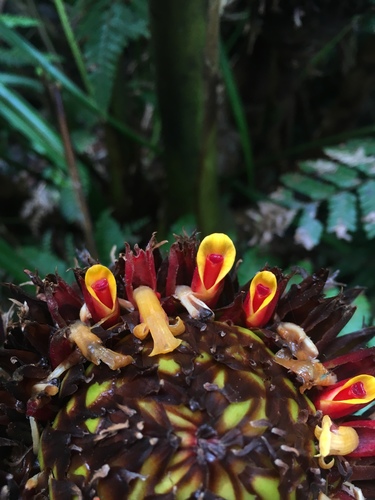
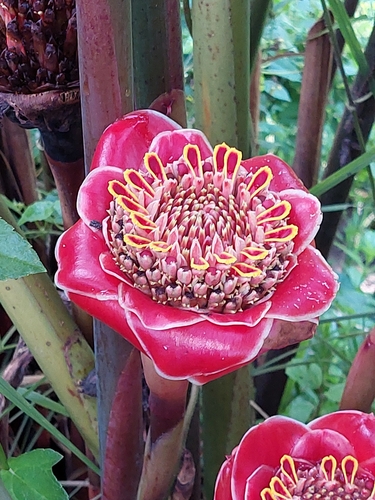
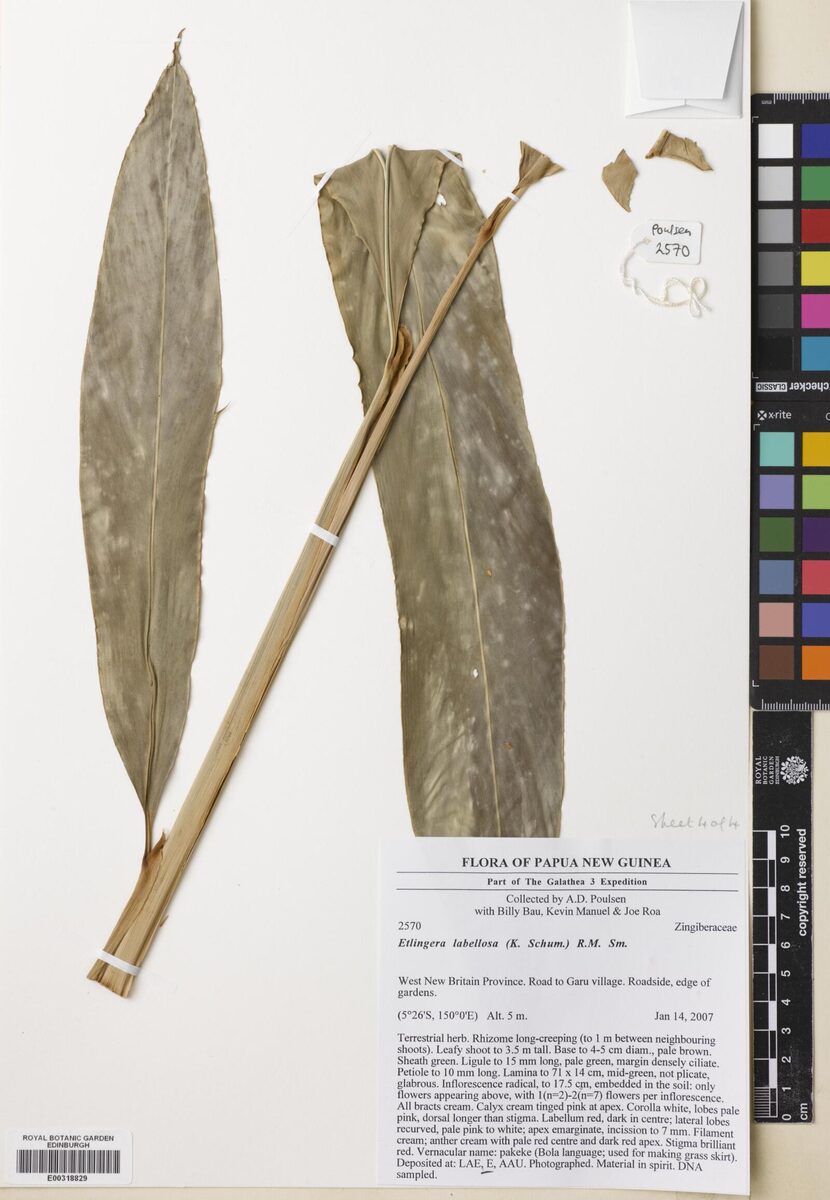
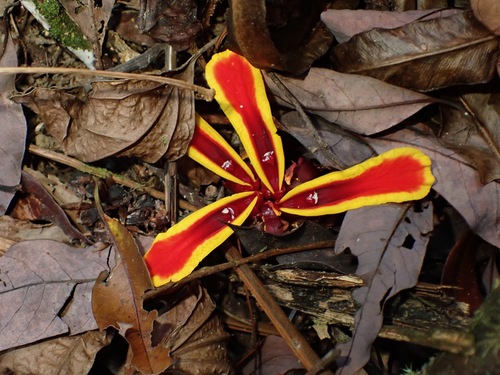
A ginger family plant which has a yellow sweet smelling rhizome or underground stem. The leaves are long and narrow like a sword, with a long tapering point. They are ranked in opposite pairs of leaflets along the stem. The leaves are 40 to 75 cm long and 8 to 16 cm wide. The edges of the leaves are smooth without teeth although they are slightly wavy. The top of the leaf surfaces are smooth and without hairs but under the leaf there are some fine hairs. The leaf stalk has a channel along its 8 to 15 cm length on the upper side. The flower occurs at the end of the leaf stalk and is stalked. The petals are yellow on the edges, then a brown stripe before becoming dark red in the middle. The seed capsule is round and 2 to 3 cm across. At an early stage the seed capsule has small hairs but later becomes smooth and orange or red.
Traditional Uses
Although the rhizome has a sweet smell it is unsure if it is used for flavouring.
This uses section is brief — help expand it
Medicinal Uses
Used as medicine.
Distribution
A tropical plant. It grows in undisturbed primary forest. It can easily be transplanted or grown.
Where It Grows
New Caledonia, Pacific, Papua New Guinea, PNG, Solomon Islands, Vanuatu,
Notes
There are about 200-230 Alpinia species. They are mostly tropical and subtropical. It is used as medicine.
Also Known As
Libadumala
References (3)
- French, B.R., 2010, Food Plants of Solomon Islands. A Compendium. Food Plants International Inc. p 293
- Peekel, P.G., 1984, (Translation E.E.Henty), Flora of the Bismarck Archipelago for Naturalists, Division of Botany, Lae, PNG. p 103, 102
- www.pngplants.org