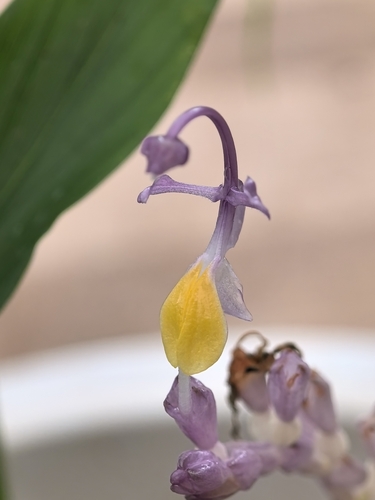
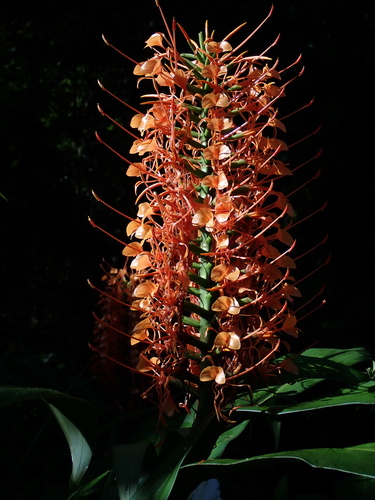
Alpinia malaccensis
(Burm. f.) Roscoe
Malacca galangal, Giant white shell ginger
iNaturalist· cc-by-sa
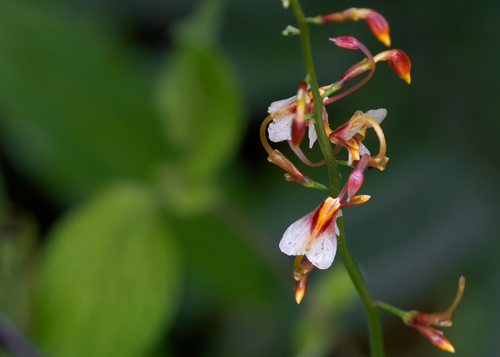
(c) Wie146, some rights reserved (CC BY-SA)
iNaturalist· cc-by-sa
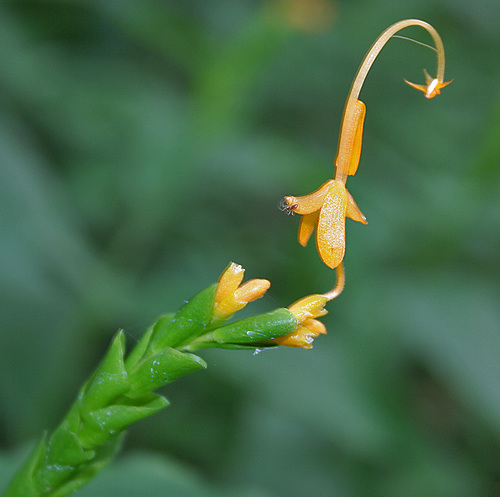
(c) Wie146, some rights reserved (CC BY-SA)
iNaturalist· cc-by-sa
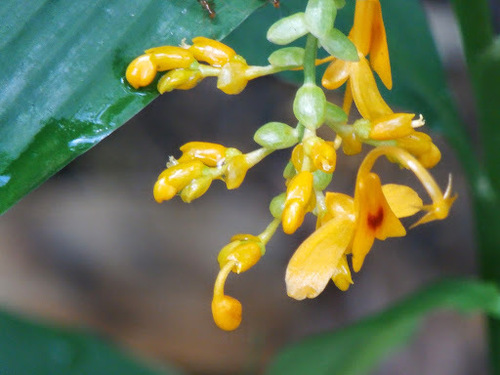
(c) Wie146, some rights reserved (CC BY-SA)
Summary
Source: WikipediaAlpinia malaccensis is a plant in the family Zingiberaceae cultivated for ornamental and medicinal purposes. It is a native of Indonesia and Malaysia. An oil is obtained from its leaves and rhizomes. It has many medicinal properties.
Description
A ginger family herb. The false stem is about 3 m tall. The leaf stalk is 2 cm long. It is grooved. The leaf blade is sword shaped. It is 90 cm long by 15 cm wide. It is hairy underneath. It tapers to the tip. The flower raceme is erect. It is 35 cm long. The fruit is a capsule and is yellow and round. It is 2 cm across.
Edible Uses
The rhizome is occasionally used as a dried spice. The flower buds have a sweet taste and are a popular food in Thailand. The young flowers are eaten fresh, and fruits and shoots are also edible.
Traditional Uses
The rhizome is occasionally used as a spice. They are dried. The flower buds have a sweet taste.
This uses section is brief — help expand it
Medicinal Uses
The pounded rhizome is used to cure wounds and sores. The rhizomes were chewed in the Moluccas, together with betel nut (Areca catechu) to make the voice strong and clear. An infusion of the ripe and unripe fruits, with a little salt, is taken as an emetic. A decoction of the fruit or the crushed seed is applied for gastralgia with tympanites. A decoction is used for bathing feverish people.
Distribution
A tropical plant. It grows in S China. In the Cairns Botanical Gardens. In Indonesia it grows up to 1,500 m above sea level. In Yunnan.
Where It Grows
Asia, Australia, Bangladesh, Bhutan, Cambodia, China, Himalayas, India, Indochina, Indonesia, Laos, Malaysia, Myanmar, Northeastern India, Papua New Guinea, PNG, Philippines, SE Asia, Sri Lanka, Thailand, Tibet, Vietnam,
Cultivation
Plants can be grown from seeds or division of the rhizome.
Propagation
Seed - Division of the rhizome.
Other Uses
All plant parts are fragrant, and contain essential oils.
Other Information
The young flower is a popular food in Thailand. It is cultivated.
Notes
It is grown as an ornamental. There are about 200-230 Alpinia species. They are mostly tropical and subtropical.
Nutrition
| Part | Moisture | kJ | kcal | Protein | Vit A | Vit C | Iron | Zinc |
|---|---|---|---|---|---|---|---|---|
| Fruit | — | — | — | — | — | — | — | — |
| Pith | 85 | — | — | 1.6 | — | — | — | — |
Synonyms
Also Known As
Bunglai laki, Gong, Kaa paa, Laja gowah, Lengkuas malaka, Mao ban shan jiang, Min-taya-taba, Saliyeridumpa, Tara, Tar-gang
References (25)
- Ambasta S.P. (Ed.), 2000, The Useful Plants of India. CSIR India. p 31
- Anderson, E. F., 1993, Plants and people of the Golden Triangle. Dioscorides Press. p 202
- Arora, R. K., 2014, Diversity in Underutilized Plant Species - An Asia-Pacific Perspective. Bioversity International. p 99
- Bircher, A. G. & Bircher, W. H., 2000, Encyclopedia of Fruit Trees and Edible Flowering Plants in Egypt and the Subtropics. AUC Press. p 21
- Burkill, I.H., 1966, A Dictionary of the Economic Products of the Malay Peninsula. Ministry of Agriculture and Cooperatives, Kuala Lumpur, Malaysia. Vol 2 (I-Z) p 1332 (As Languas malaccensis)
Show all 25 references Hide references
- Cruz-Garcia, G. S., & Price, L. L., 2011, Ethnobotanical investigation of 'wild' food plants used by rice farmers in Kalasin, Northeast Thailand. Journal of Ethnobiology and Ethnomedicine 7:33
- Johnson, N., 2002, Environmental Change in northern Thailand: Impact on Wild Edible Plant Availability. Ecology of Food and Nutrition, 41: 5, 373-399
- Larsen, K., Ibrahim, H., Khaw, S.H., & Saw, L.G., 1999, Gingers of Peninsula Malaysia and Singapore. Natural History Publications (Borneo). p 61
- Lembaga Biologi Nasional, 1977, Ubi-Ubian, Balai Pustaka, Jakarta. p 54
- Li, S., et al, 2020, Monpa, memory, and change: an ethnobotanical study of plant use in Mêdog County, South-east Tibet, China. Journal of Ethnobiology and Ethnomedicine. (2020) 16:5 p 24
- Lim, T. K., 2015, Edible Medicinal and Non Medicinal Plants. Volume 9, Modified Stems, Roots, Bulbs. Springer p 7
- Priyadi, H., et al, Five hundred plant species in Gunung Halimun Salak National Park West Java. A checklist including Sundanese names, distribution and use. CIFOR, FFPRI, SLU p 124 (As Catimbium malaccensis)
- PROSEA handbook Volume 13 Spices. p 273
- Salvi, J. et al, 2016, A review: Underutilized wild edible plants as a potential source of alternative nutrition. International Journal of Botany Studies. Volume 1; Issue 4; May 2016; Page No. 32-36
- Seidemann J., 2005, World Spice Plants. Economic Usage, Botany, Taxonomy. Springer. p 30
- Singh, B. et al, 2012, Wild edible plants used by Garo tribes of Nokrek Biosphere Reserve in Meghalaya, India. Indian Journal of Traditional Knowledge. 11(1) pp 166-171
- Srivastava, R. C., 2009, Traditional knowledge of Adi tribe of Arunachal Pradesh on plants. Indian Journal of Traditional Knowledge. 8(2): 146-153
- Sukarya, D. G., (Ed.) 2013, 3,500 Plant Species of the Botanic Gardens of Indonesia. LIPI p 1058
- Suksri, S., et al, 2005, Ethnobotany in Bung Khong Long Non-Hunting Area, Northeast Thailand. Kasetsart J., (Nat. Sci) 39: 519-533
- Teron, R. & Borthakur, S. K., 2016, Edible Medicines: An Exploration of Medicinal Plants in Dietary Practices of Karbi Tribal Population of Assam, Northeast India. In Mondal, N. & Sen, J.(Ed.) Nutrition and Health among tribal populations of India. p 157
- Trans. Linn. Soc. London 8:345. 1807
- World Checklist of Useful Plant Species 2020. Royal Botanic Gardens, Kew
- Wu Delin, Larsen, K., Zingiberaceae. Flora of China.
- www.pngplants.org
- Zeven, A. C. & de West, J. M. J., 1982, Dictionary of cultivated plants and their regions of diversity. Wageningen. p 64