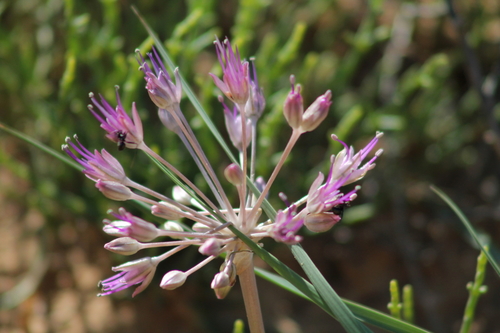
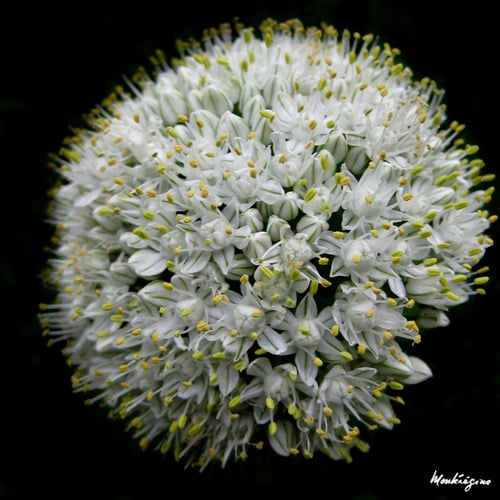
Allium triquetrum
L.
Triangular garlic, Three-cornered leek
iNaturalist· cc-by
(c) Lucas Carbone, some rights reserved (CC BY), uploaded by Lucas Carbone
iNaturalist· cc-by
(c) Isaac Krone, some rights reserved (CC BY), uploaded by Isaac Krone
iNaturalist· cc-by
(c) Nina Kerr, some rights reserved (CC BY), uploaded by Nina Kerr
Summary
Source: WikipediaAllium triquetrum is a bulbous flowering plant in the genus Allium native to the Mediterranean basin. It is known in English as three-cornered leek or three-cornered garlic, in Australia as angled onion, and in New Zealand as onion weed. Both the English name and the specific epithet triquetrum refer to the three-cornered shape of the flower stalks.
Description
An onion family plant. It is a plant which continues to grow from year to year by re-sprouting from the rootstock. It grows to 50 cm high and spreads 30 cm across. The stem is erect. The stem is triangular in cross section. The leaves are narrow and flat. They are 25 cm long and develop in a clump. The flower stem has a triangle shape. It has white flowers with 6 petals. These droop. They are on one side of the stalk. It has a garlic smell.
Edible Uses
The bulb is small — up to 20mm in diameter — with a mild garlic flavour suitable for use raw in salads or cooked as a flavouring. Harvest in early summer once the plant has died back; bulbs store well for at least 6 months. Leaves are available from late autumn through spring and make a good leek substitute. Young leaves are pleasant raw in salads, while older leaves work well cooked as a vegetable or flavouring. Their flavour is milder and more delicate than onion. The flowers can be eaten raw — juicy with a mild garlic taste, they serve as a tasty and decorative garnish on salads.
Traditional Uses
The bulbs are used in salads. They are also cooked. The young leaves are eaten. The flowers can be added to salads.
This uses section is brief — help expand it
Medicinal Uses
No specific medicinal uses have been recorded for this species, but as a member of the Allium genus it is a generally beneficial addition to the diet. Like its relatives, it contains sulphur compounds responsible for its onion-like flavour. Eaten regularly, these compounds help lower blood cholesterol, support digestive health, and tone the circulatory system.
Known Hazards
Although no individual reports regarding this species have been seen, there have been cases of poisoning caused by the consumption, in very large quantities and by some mammals, of certain members of this genus. Dogs seem to be particularly susceptible.
Distribution
It grows in temperate places. It is frost resistant but drought tender. It grows in damp, shaded places. In colder climates it needs well-drained positions. Tasmania Herbarium.
Where It Grows
Africa, Albania, Algeria, Argentina, Australia, Britain, Europe, Falklands, France, Ireland, Italy, Mediterranean, Morocco, New Zealand, North Africa, Portugal, Sicily, South America, Spain, Tasmania, USA,
Cultivation
Prefers a rich moist but well-drained soil. Shade tolerant, it is easily grown in a cool leafy soil and grows well in light moist woodland. Plants are not very hardy outside the milder areas of Britain, they tolerate temperatures down to between -5 and -10°c. The bulbs should be planted fairly deeply. The seeds have an oil-bearing appendage which is attractive to ants. The ants carry the seed away to eat the oil and then discard the seed, thus aiding dispersal of the plant. Grows well with most plants, especially roses, carrots, beet and chamomile, but it inhibits the growth of legumes. This plant is a bad companion for alfalfa, each species negatively affecting the other. The flowers are sweetly scented. The picked flowers can remain fresh for several weeks. Members of this genus are rarely if ever troubled by browsing deer.
Propagation
Seed is best sown as soon as it is ripe in a greenhouse or cold frame, where it germinates quickly. Seedlings can be grown on under glass for the first year, then planted out as dormant bulbs in late summer of the following year if sufficiently developed — otherwise grow on in pots for another year. Stored seed can be sown in spring in a greenhouse. Alternatively, divide plants in summer after they have died down. Division is very easy and the offsets can be planted directly into their permanent positions.
Other Uses
The plant's juice can be used as a moth repellent, and the whole plant is said to deter insects and moles generally. The plant is also noted for its scent.
Notes
There are about 300-700 Allium species. Most species of Allium are edible (Flora of China). All alliums are edible but they may not all be worth eating! It can become invasive. They have also been put in the family Alliaceae.
Synonyms
Also Known As
Agghiu sarvaggiu, Angled onion, Purris, Pras e eger, Three cornered garlic, Toum lberry
References (28)
- Blamey, M and Grey-Wilson, C., 2005, Wild flowers of the Mediterranean. A & C Black London. p 485
- Bodkin, F., 1991, Encyclopedia Botanica. Cornstalk publishing, p 66
- Curtis, W.M., & Morris, D.I., 1994, The Student's Flora of Tasmania. Part 4B St David's Park Publishing, Tasmania, p 392
- Dashorst, G.R.M., and Jessop, J.P., 1998, Plants of the Adelaide Plains & Hills. Botanic Gardens of Adelaide and State Herbarium. p 162
- Facciola, S., 1998, Cornucopia 2: a Source Book of Edible Plants. Kampong Publications, p 7
Show all 28 references Hide references
- Food Composition Tables for use in Africa FAO http://www.fao.org/infoods/directory No. 729
- Geraci, A., et al, 2018, The wild taxa utilized as vegetables in Sicily (Italy): a traditional component of the Mediterranean diet. Journal of Ethnobiology and Ethnomedicine (2018) 14:14
- Hussey, B.M.J., Keighery, G.J., Cousens, R.D., Dodd, J., Lloyd, S.G., 1997, Western Weeds. A guide to the weeds of Western Australia. Plant Protection Society of Western Australia. p 16
- Irving, M., 2009, The Forager Handbook, A Guide to the Edible Plants of Britain. Ebury Press p 336
- Jardin, C., 1970, List of Foods Used In Africa, FAO Nutrition Information Document Series No 2.p 53
- Lamp, C & Collet F., 1989, Field Guide to Weeds in Australia. Inkata Press. p 10
- Lazarides, M. & Hince, B., 1993, Handbook of Economic Plants of Australia, CSIRO. p 14
- Low, T., 1991, Wild Herbs of Australia and New Zealand. Angus & Robertson. p 105 (Drawing)
- Low, T., 1992, Bush Tucker. Australia’s Wild Food Harvest. Angus & Robertson. p 180
- Marinelli, J. (Ed), 2004, Plant. DK. p 444
- Nassif, F., & Tanji, A., 2013, Gathered food plants in Morocco: The long forgotten species in Ethnobotanical Research. Life Science Leaflets 3:17-54
- Nimis, P. L., et al, 2015, A guide to the vascular plants of the temporary ponds of Sardinia (Italy) p114
- Paczkowska, G. & Chapman, A.R., 2000, The Western Australian Flora. A Descriptive Catalogue. Western Australian Herbarium. p 29
- Pasta, S., et al, 2020, An Updated Checklist of the Sicilian Native Edible Plants: Preserving the Traditional Ecological Knowledge of Century-Old Agro-Pastoral Landscapes. Frontiers in Plant Science. Volume 11|Article 388
- Pieroni, A. & Soukand, R., 2017, The disappearing wild food and medicinal plant knowledge in a few mountain villages of North-Eastern Albania. Journal of Applied Botany and Food Quality 90, 58 - 67
- Plants for a Future database, The Field, Penpol, Lostwithiel, Cornwall, PL22 0NG, UK. http://www.scs.leeds.ac.uk/pfaf
- Signorini, M. A., et al, 2009, Plants and traditional knowledge: An ethnobotanical investigation on Monte Ortobene (Nuoro, Sardinia). Journal or Ethnobiology and Ethnomedicine, 5:6
- Sp. pl. 1:300. 1753
- Tasmanian Herbarium Vascular Plants list p 68
- Terra, G.J.A., 1973, Tropical Vegetables. Communication 54e Royal Tropical Institute, Amsterdam, p 20
- Upson, R., & Lewis R., 2014, Updated Vascular Plant Checklist and Atlas for the Falkland Islands. Falklands Conservation and Kew.
- Whiting, J. et al, 2004, Tasmania's Natural Flora. Tasmania's Natural Flora Editorial Committee PO Box 194, Ulverstone, Tasmania, Australia 7315 p 362
- Woodward, P., 1996, Garlic and Friends. The History, Growth and Use of Edible Alliums. Hyland House. p 161