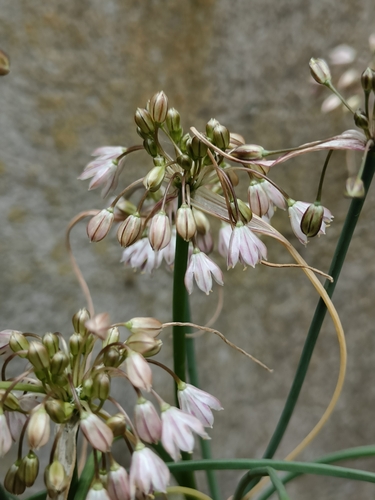
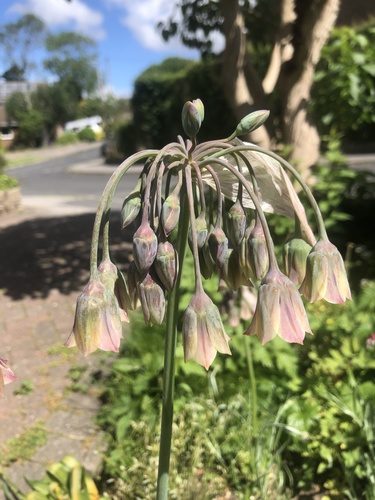
Allium sativum var. ophioscorodon
L.; (Link) Doll
Rocambole, Italian garlic, Top-setting garlic
gbif· cc-by-nc
Christine Hecher
gbif· cc-by-nc
Christine Hecher
gbif· cc-by-nc
Christine Hecher
Description
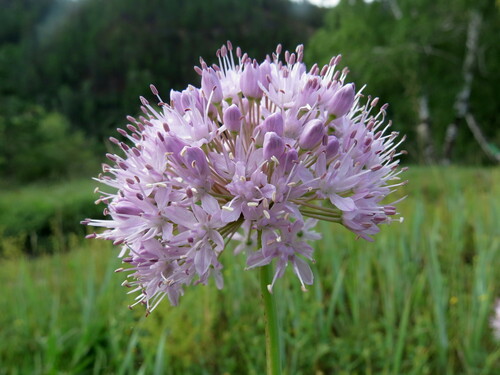
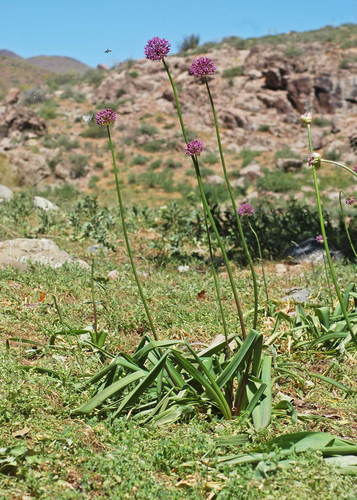
An onion family plant. The flower stalk coils then straightens. At the top there is a clusters of bulbils.
This description is brief — help expand it
Edible Uses
Garlic is widely used around the world for its pungent flavor as a seasoning or condiment. The garlic plant's bulb is the most commonly used part of the plant. With the exception of the single clove types, garlic bulbs are normally divided into numerous fleshy sections called cloves. Garlic cloves are used for consumption (raw or cooked) or for medicinal purposes. They have a characteristic pungent, spicy flavor that mellows and sweetens considerably with cooking. The distinctive aroma is mainly due to organosulfur compounds including allicin present in fresh garlic cloves and ajoene which forms when they are crushed or chopped. A further metabolite allyl methyl sulfide is responsible for garlic breath. Other parts of the garlic plant are also edible. The leaves and flowers (bulbils) on the head (spathe) are sometimes eaten. They are milder in flavor than the bulbs, and are most often consumed while immature and still tender. Immature garlic is sometimes pulled, rather like a scallion, and sold as "green garlic". When green garlic is allowed to grow past the "scallion" stage, but not permitted to fully mature, it may produce a garlic "round", a bulb like a boiling onion, but not separated into cloves like a mature bulb. Green garlic imparts a garlic flavor and aroma in food, minus the spiciness. Green garlic is often chopped and stir-fried or cooked in soup or hot pot in Southeast Asian (i.e. Vietnamese, Thai, Myanmar, Lao, Cambodian, Singaporean), and Chinese cookery, and is very abundant and low-priced. Additionally, the immature flower stalks (scapes) of the hardneck are sometimes marketed for uses similar to asparagus in stir-fries. Inedible or rarely eaten parts of the garlic plant include the "skin" covering each clove and root cluster. The papery, protective layers of "skin" over various parts of the plant are generally discarded during preparation for most culinary uses, though in Korea immature whole heads are sometimes prepared with the tender skins intact. The root cluster attached to the basal plate of the bulb is the only part not typically considered palatable in any form. An alternative is to cut the top off the bulb, coat the cloves by dribbling olive oil (or other oil-based seasoning) over them, and roast them in an oven. Garlic softens and can be extracted from the cloves by squeezing the (root) end of the bulb, or individually by squeezing one end of the clove. In Korea, heads of garlic are heated over the course of several weeks; the resulting product, called black garlic, is sweet and syrupy, and is used in the US, Europe and Australia, either produced domestically or imported. Garlic may be applied to different kinds of bread, usually in a medium of butter or oil, to create a variety of classic dishes, such as garlic bread, garlic toast, bruschetta, crostini, and canapé. The flavor varies in intensity and aroma with the different cooking methods. It is often paired with onion, tomato, or ginger. Immature scapes are tender and edible. They are also known as "garlic spears", "stems", or "tops". Scapes generally have a milder taste than the cloves. They are often used in stir frying or braised like asparagus. Garlic leaves are a popular vegetable in many parts of Asia. The leaves are cut, cleaned, and then stir-fried with eggs, meat, or vegetables. Garlic powder is made from dehydrated garlic and can be used as a substitute for fresh garlic, though the taste is not quite the same. Garlic salt combines garlic powder with table salt. Numerous cuneiform records show that garlic has been cultivated in Mesopotamia for at least 4,000 years. The use of garlic in China and Egypt also dates back thousands of years. Well-preserved garlic was found in the tomb of Tutankhamun (c. 1325 BC). It was consumed by ancient Greek and Roman soldiers, sailors, and rural classes (Virgil, Eclogues ii. 11), and, according to Pliny the Elder (Natural History xix. 32), by the African peasantry. Garlic was placed by the ancient Greeks on the piles of stones at crossroads, as a supper for Hecate (Theophrastus, Characters, The Superstitious Man). In classical antiquity, garlic was a highly favored food among Jews, to the extent that the Mishnah uses the nickname "garlic eaters" (Mishnah, Nedarim 3:10). Garlic was rare in traditional English cuisine (though it is said to have been grown in England before 1548) but has been a common ingredient in Mediterranean Europe. Translations of the c. 1300 Assize of Weights and Measures, an English statute generally dated to the 13th century, indicate a passage as dealing with standardized units of garlic production, sale, and taxation—the hundred of 15 ropes of 15 heads each—but the Latin version of the text may refer to herring rather than garlic.
Traditional Uses
The bulb and the bulbils are used to flavour food. The young leaves are used for flavouring. The young flowers spears are eaten.
This uses section is brief — help expand it
Medicinal Uses
Garlic has been used for traditional medicine in diverse cultures such as in Korea, Egypt, Japan, China, Rome, and Greece. In his Natural History, Pliny gave a list of conditions in which garlic was considered beneficial (N.H. xx. 23). Galen, writing in the second century, eulogized garlic as the "rustic's theriac" (cure-all) (see F. Adams' Paulus Aegineta, p. 99). Alexander Neckam, a writer of the 12th century (see Wright's edition of his works, p. 473, 1863), discussed it as a palliative for the heat of the sun in field labor. In the 17th century, Thomas Sydenham valued it as an application in confluent smallpox, and William Cullen's Materia Medica of 1789 found some dropsies cured by it alone.
Known Hazards
The scent of garlic is known to linger upon the human body and cause bad breath (halitosis) and body odor. This is caused by allyl methyl sulfide (AMS). AMS is a volatile liquid which is absorbed into the blood during the metabolism of garlic-derived sulfur compounds; from the blood it travels to the lungs (and from there to the mouth, causing garlic breath) and skin, where it is exuded through skin pores. Since digestion takes several hours, and release of AMS several hours more, the effect of eating garlic may be present for a long time. Washing the skin with soap is only a partial and imperfect solution to the smell. Studies have shown sipping milk at the same time as consuming garlic can significantly neutralize bad breath. Mixing garlic with milk in the mouth before swallowing reduced the odor better than drinking milk afterward. Plain water, mushrooms, and basil may also reduce the odor; the mix of fat and water found in milk, however, was the most effective. Garlic breath is allegedly alleviated by eating fresh parsley. Abundant sulfur compounds in garlic are also responsible for turning garlic green or blue during pickling and cooking. Under these conditions (i.e., acidity, heat) the sulfur-containing compound alliin reacts with common amino acids to make pyrroles, clusters of carbon-nitrogen rings. These rings can be linked together into polypyrrole molecules. Ring structures absorb particular wavelengths of light and thus appear colored. The two-pyrrole molecule looks red, the three-pyrrole molecule looks blue, and the four-pyrrole molecule looks green (like chlorophyll, a tetrapyrrole). Like chlorophyll, the pyrrole pigments are safe to eat. Upon cutting, similar to a color change in onion caused by reactions of amino acids with sulfur compounds, garlic can turn green. The green, dry "folds" in the center of the garlic clove are especially pungent. The sulfur compound allicin, produced by crushing or chewing fresh garlic, produces other sulfur compounds: ajoene, allyl polysulfides, and vinyldithiins. Aged garlic lacks allicin, but may have some activity due to the presence of S-allylcysteine. Some people suffer from allergies to garlic and other species of Allium. Symptoms can include irritable bowel, diarrhea, mouth and throat ulcerations, nausea, breathing difficulties, and, in rare cases, anaphylaxis. Garlic-sensitive people show positive tests to diallyl disulfide, allylpropyldisulfide, allylmercaptan, and allicin, all of which are present in garlic. People who suffer from garlic allergies are often sensitive to many other plants, including onions, chives, leeks, shallots, garden lilies, ginger, and bananas. Several reports of serious burns resulting from garlic being applied topically for various purposes, including naturopathic uses and acne treatment, indicate care must be taken for these uses, usually testing a small area of skin using a low concentration of garlic. On the basis of numerous reports of such burns, including burns to children, topical use of raw garlic, as well as insertion of raw garlic into body cavities, is discouraged. In particular, topical application of raw garlic to young children is not advisable. The side effects of long-term garlic supplementation are largely unknown. Possible side effects include gastrointestinal discomfort, sweating, dizziness, allergic reactions, bleeding, and menstrual irregularities. Some breastfeeding mothers have found, after consuming garlic, that their babies can be slow to feed, and have noted a garlic odor coming from them. Conversely an experiment showed, "infants were attached to the breast for longer periods of time and sucked more when the milk smelled like garlic". If higher-than-recommended doses of garlic are taken with anticoagulant medications, this can lead to a higher risk of bleeding. Garlic may interact with warfarin, saquinavir, antihypertensives, calcium channel blockers, the quinolone family of antibiotics such as ciprofloxacin, and hypoglycemic drugs, as well as other medications. The American Veterinary Medical Association considers garlic to be toxic to pets.
Distribution
It is a temperate plant.
Where It Grows
Africa, Australia, Canada, North Africa, North America,
Notes
There are about 300-700 Allium species. Most species of Allium are edible (Flora of China). All alliums are edible but they may not all be worth eating! They have also been put in the family Alliaceae.
Synonyms
Also Known As
Serpent garlic, Spanish garlic
References (9)
- Facciola, S., 1998, Cornucopia 2: a Source Book of Edible Plants. Kampong Publications, p 6
- Jardin, C., 1970, List of Foods Used In Africa, FAO Nutrition Information Document Series No 2.p 53
- Lim, T. K., 2015, Edible Medicinal and Non Medicinal Plants. Volume 9, Modified Stems, Roots, Bulbs. Springer p 5
- Plants for a Future database, The Field, Penpol, Lostwithiel, Cornwall, PL22 0NG, UK. http://www.scs.leeds.ac.uk/pfaf/
- Rhein. Fl. 197. 1843
Show all 9 references Hide references
- Seidemann J., 2005, World Spice Plants. Economic Usage, Botany, Taxonomy. Springer. p 24
- Small, E., 2009, Top 100 Food Plants. The world's most important culinary crops. NRC Research Press. p 273
- Wiersema, J. H. & Leon, B., 2013, World Economic Plants. A Standard Reference CRC Press. 2nd Ed. p 35
- Woodward, P., 1996, Garlic and Friends. The History, Growth and Use of Edible Alliums. Hyland House. p 1