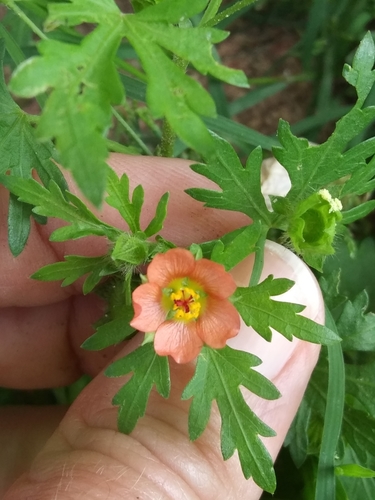
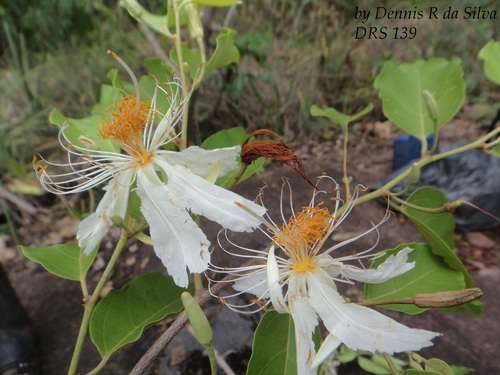
Hibiscus tiliaceus
L.
Cotton Tree, Beach Hibiscus, Country mallow, Sea hibiscus, Yellow mallow
wikimedia· cc-by-sa
Vincenzo defifoot (via Wikimedia Commons)
wikimedia· cc-by
Marcia Stefani (via Wikimedia Commons)
wikimedia· cc0
Francisco Manuel Blanco (O.S.A.) (via Wikimedia Commons)
iNaturalist· cc-by-nc
(c) Ann Stafford, some rights reserved (CC BY-NC)
iNaturalist· cc-by-nc
(c) Ann Stafford, some rights reserved (CC BY-NC)
iNaturalist· cc-by-nc
(c) accidentalshrike, some rights reserved (CC BY-NC)
Summary
Source: WikipediaHibiscus tiliaceus, commonly known as the sea hibiscus or coast cottonwood, is an evergreen species of flowering tree in the mallow family, Malvaceae, with a pantropical distribution along coastlines. It has also been introduced to Florida and New Zealand. It has been debated whether this species is native or introduced to Hawaii.
Description
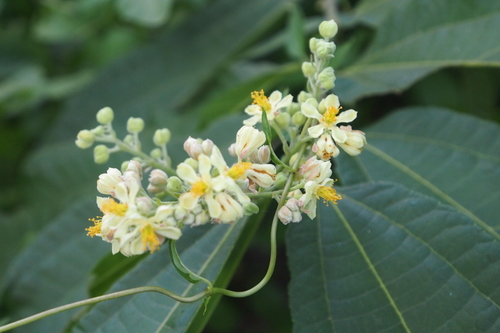
A tree which keeps its leaves throughout the year. It is small and spreading. It grows to 5-9 m tall and spreads to 3-6 m across. The stem is erect and short. The bark is grey and smooth. The branches spread widely. The crown has an open texture. The leaves are light green. They can be round or heart-shaped. They are 12 cm long. They are densely hairy underneath. They have a short pointed tip. The flowers are yellow and have a deep pink/purple centre. They are 12 cm across. They have 5 overlapping petals. The flowers are in the axils of the upper leaves. The fruit is a hairy partly woody capsule. It is 2 cm across and brown and splits open when ripe. It contains several small kidney shaped seeds. There are same named varieties. The plant varies a lot.
Edible Uses
The wood of H. tiliaceus has a specific gravity of 0.6. It has been used in a variety of applications, such as seacraft construction, firewood, and wood carvings. It is easy to plane and turns well, so it is regarded by many as a high quality furniture wood. Plant fibers taken from the stems have traditionally been used in rope making, while its bark has been used like cork, in sealing cracks in boats. The bark and roots may be boiled to make a cooling tea to cool fevers, and its young leafy shoots may be eaten as vegetables. Native Hawaiians used the wood to make ʻiako (spars) for waʻa (outrigger canoes), mouo (fishing net floats), and ʻau koʻi (adze handles). Kaula ʻilihau (cordage) was made from the bast fibers. Hau would be used to make ʻama (canoe floats) if the preferred wiliwili (Erythrina sandwicensis) was unavailable. Hibiscus tiliaceus is widely used in Asian countries, especially Taiwan, as a subject for the art of bonsai. The finest specimens are taken from Kenting National Park. Lending itself to free grafting, the leaf size is reduced fairly quickly. Its leaves are also used in cooking, as trays for steamed rice cakes (粿). In Indonesia H. tiliaceus is also used for fermenting tempeh. The undersides of the leaves are covered in downy hairs known technically as trichomes to which the mold Rhizopus oligosporus can be found adhering in the wild. Soybeans are pressed into the leaf, and stored. Fermentation occurs resulting in tempeh. Indigenous Australians traditionally used the inner bark of the tree to craft fishing nets and ropes, particularly for use with dugong and turtle harpoons. The wood was also employed in the making of shields. Medicinally, the inner bark and sapwood were soaked in water and heated with hot stones, producing a liquid that was applied to wash wounds. Strips of bark were additionally used as natural bandages, wrapped around injuries to cover and close them.
Traditional Uses
Roots, flowers and young leaves can be eaten. They flowers can be dipped in batter and fried. The leaves are also fermented into a sauce. The bark, shoots and sap wood are recorded as eaten in New Caledonia. The slimy sap and bark are eaten. The stalks are sucked. The shoots are stripped of their bark and burnt then the ashes added to dished for flavour.
Distribution
It grows in warm temperate regions. It can grow in the tropics and subtropics. It suits light soils in an open, sunny position. The soils are best to be well drained but moist. It is damaged by frost. It can tolerate drought and salt spray. It often grows naturally near the seashore. It grows along most tropical coasts in tidal forests. It will grow in soils with pH between 5.0 and 8.5. In Samoa it grows from sea level to 650 m altitude. It does not grow well on atolls. It grows on the edges of mangroves. It can grow in arid places. It suits hardiness zones 10-12.
Where It Grows
Africa, American Samoa, Andamans, Angola, Asia, Australia, Bahamas, Bangladesh, Belize, Bhutan, Bougainville, British Indian Ocean Terr., BIOT, Cambodia, Cameroon, Caribbean, Caroline Islands, Central Africa, Central America, China, Christmas Island, Chuuk, Colombia, Comoros, Congo, Cook Islands, Costa Rica, Côte d'Ivoire, Cuba, Dominica, East Africa, East Timor, Easter Island, Ecuador, Equatorial-Guinea, Eswatini, Fiji, French Polynesia, FSM, Gabon, Gambia, Ghana, Grenada, Guadeloupe, Guatemala, Guianas, Guinea, Guinée, Guinea-Bissau, Guyana, Haiti, Hawaii, Himalayas, India, Indochina, Indonesia, Ivory Coast, Jamaica, Japan, Kenya, Kiribati, Laos, Liberia, Madagascar, Malaysia, Maldives, Mariana Islands, Marquesas, Marshall Islands, Martinique, Mauritius, Mexico, Micronesia, Mozambique, Myanmar, Nauru, New Caledonia, Nicaragua, Nigeria, Niue, Norfolk Island, North America, Pacific, Pakistan, Palau, Panama, Papua New Guinea, PNG, Peru, Philippines, Puerto Rico, Reunion, Rotuma, Samoa, Sao Tome and Principe, SE Asia, Senegal, Seychelles, Sierra Leone, Singapore, Solomon Islands, South Africa, Southern Africa, South America, Sri Lanka, Suriname, Swaziland, Tahiti, Taiwan, Tanzania, Thailand, Timor-Leste, Tonga, Trinidad-Tobago, Tropical America, Tuvalu, USA, Vanuatu, Venezuela, Vietnam, Wallis & Futuna, West Africa, West Indies, Yap, Zimbabwe,
Cultivation
Plants can be grown from seed or cuttings. Seed remain viable after floating in sea water for several months.
Production
It is a fast growing plant. Plants can be heavily pruned and will shoot again.
Other Information
It tends to be a famine food eaten when other foods are in short supply.
Notes
There are about 300 Hibiscus species.
Nutrition
| Part | Moisture | kJ | kcal | Protein | Vit A | Vit C | Iron | Zinc |
|---|---|---|---|---|---|---|---|---|
| Flower | 78.8 | 507 | 121 | 5.3 | — | 5 | — | — |
Synonyms
Also Known As
Ai-fau, Attu parathi, Bade-luti, Baharu, Bamede, Bameo, Bane-bane, Bane, Baniah, Baro, Baru-baru, Baru, Bebane, Belapata, Bola, Bourao, Bup tra, Burao, Butsu raava, Chelwa, Coast Cottonwood, Coast hibiscus, Cottonwood, Cuan bast, Darah-darah, Dhiggaa, Emajagua, Epainta, Ermall, Etagogu, Fau, Fautu'u, Fou, Gaal', Hau, Huang jin, Kalau, Kali bang-bang, Kayu baru, Kilife, Langkubing, Lenya-shaw, Linden hibiscus, Lo, Mahoe, Majagua, Menoa, N'farande, Nirparathi, Nwohwea, Pago, Pah, Pauat, Paw-talay, Purau, Purundu, Safed chika, Sea Hibiscus, Tapai-tapai, Te kiaiai, Te rau, Thinban, Tra lam cheo, Unfarande, Vau ndamu, Vau, Vo, Vole, Wulolo, Yellow mallow tree, Ye-ngan-shaw
References (92)
- Abbiw, D.K., 1990, Useful Plants of Ghana. West African uses of wild and cultivated plants. Intermediate Technology Publications and the Royal Botanic Gardens, Kew. p 42
- Ambasta, S.P. (Ed.), 2000, The Useful Plants of India. CSIR India. p 268
- Anon., 2003, Native Plants for the Fitzroy basin. Society for Growing Australian Plants Inc. (Rockhampton Branch) p 60
- Barrau, J., 1976, Subsistence Agriculture in Melanesia. Bernice P. Bishop Museu, Bulletin 219 Honolulu Hawaii. Kraus reprint. p 56
- Barwick, M., 2004, Tropical and Subtropical Trees. A Worldwide Encyclopedic Guide. Thames and Hudson p 220
Show all 92 references Hide references
- Bircher, A. G. & Bircher, W. H., 2000, Encyclopedia of Fruit Trees and Edible Flowering Plants in Egypt and the Subtropics. AUC Press. p 3 (As Abelmoschus guineensis)
- Bodkin, F., 1991, Encyclopedia Botanica. Cornstalk publishing, p 558
- Borrell, O.W., 1989, An Annotated Checklist of the Flora of Kairiru Island, New Guinea. Marcellin College, Victoria Australia. p 97
- Bourret, D., 1981, Bonnes-Plantes de Nouvelle-Caledonie et des Loyaute. ORSTOM. p 68
- Brock, J., 1993, Native Plants of Northern Australia, Reed. p 223
- Burkill, H. M., 1985, The useful plants of west tropical Africa, Vol. 4. Kew.
- Burkill, I.H., 1966, A Dictionary of the Economic Products of the Malay Peninsula. Ministry of Agriculture and Cooperatives, Kuala Lumpur, Malaysia. Vol 1 (A-H) p 1193
- Cabalion, P. and Morat, P., 1983, Introduction le vegetation, la flore et aux noms vernaculaires de l'ile de Pentcoste (Vanuatu), In: Journal d'agriculture traditionnelle et de botanique appliquee JATBA Vol. 30, 3-4
- Calvert, G., 2010, The Burdekin Delta Tree Guide. Lower Burdekin Landcare Association., Inc., Ayr p 103
- Clarke, W.C. & Thaman, R.R., 1993, Agroforestry in the Pacific Islands: Systems for sustainability. United Nations University Press. New York. p 242
- Cooper, W. and Cooper, W., 2004, Fruits of the Australian Tropical Rainforest. Nokomis Editions, Victoria, Australia. p 278
- Cowie, I, 2006, A Survey of Flora and vegetation of the proposed Jaco-Tutuala-Lore National Park. Timor-Lests (East Timor) www.territorystories.nt/gov.au p 50
- Cribb, A.B. & J.W., 1976, Wild Food in Australia, Fontana. p 109
- Cronin, L., 1989, The Concise Australian Flora. Reed. p 94
- Cundall, P., (ed.), 2004, Gardening Australia: flora: the gardener's bible. ABC Books. p 704
- DARLINGTON & AMMAL,
- Elevitch, C.R.(ed.), 2006, Traditional Trees of the Pacific Islands: Their Culture, Environment and Use. Permanent Agriculture Resources, Holualoa, Hawaii. p 393
- Etherington, K., & Imwold, D., (Eds), 2001, Botanica's Trees & Shrubs. The illustrated A-Z of over 8500 trees and shrubs. Random House, Australia. p 382
- Facciola, S., 1998, Cornucopia 2: a Source Book of Edible Plants. Kampong Publications, p 148
- Flora of Australia Volume 49, Oceanic Islands 1, Australian Government Publishing Service, Canberra. (1994) p 116
- Flora of Pakistan. www.eFloras.org
- Foreman, D. B., 1971, A checklist of the Vascular Plants of Bougainville with Descriptions of some Common Forest Trees. Botany Bulletin No. 5. Department of Botany. p 122
- Franklin, J., Keppel, G., & Whistler, W., 2008, The vegetation and flora of Lakeba, Nayau and Aiwa Islands, Central Lau Group, Fiji. Micronesica 40(1/2): 169–225, 2008
- French, B.R., 2010, Food Plants of Solomon Islands. A Compendium. Food Plants International Inc. p 338
- GAMMIE,
- Gardner, S., et al, 2000, A Field Guide to Forest Trees of Northern Thailand, Kobfai Publishing Project. p 74
- Hardwick, G., 2001, Economically Useful Plants for Northern Australia: Master Species List. Crusader eBooks.
- Haslam, S., 2004, Noosa's Native Plants. Noosa Integrated Catchment Assn. Inc. p 131
- Hearne, D.A., & Rance, S.J., 1975, Trees for Darwin and Northern Australia. AGPS, Canberra p 77, Pl 21
- Hedrick, U.P., 1919, (Ed.), Sturtevant's edible plants of the world. p 346
- Hibbert, M., 2002, The Aussie Plant Finder 2002, Florilegium. p 139
- Hiddins, L., 1999, Explore Wild Australia with the Bush Tucker Man. Penguin Books/ABC Books. p 137
- Hinton, B & B., 1982, A Wilderness in Bloom. Wildflowers of tropical Australia. p 20
- Holliday, I., 1989, A Field Guide to Australian Trees. Hamlyn. p 232
- Hu, Shiu-ying, 2005, Food Plants of China. The Chinese University Press. p 541
- Jackes, B.R., 2001, Plants of the Tropics. Rainforest to Heath. An Identification Guide. James Cook University. p 62
- Jones D, L, 1986, Ornamental Rainforest Plants in Australia, Reed Books, p 225
- Krishen P., 2006, Trees of Delhi, A Field Guide. DK Books. p 63
- Lamoureux, C.H., 1976, Trailside Plants of Hawaii's National Parks. Hawaii Natural History Association. p 50
- Lazarides, M. & Hince, B., 1993, Handbook of Economic Plants of Australia, CSIRO. p 132
- Levitt, D., 1981, Plants and people. Aboriginal uses of plants on Groote Eylandt. Australian Institute of Aboriginal Studies, Canberra. p 99
- Liefting, A., et al, Samoan plant names. http://en.wikipedia.org
- Lim, T. K., 2015, Edible Medicinal and Non Medicinal Plants. Volume 9, Modified Stems, Roots, Bulbs. Springer p 47
- Live and Learn, Common Plants of the Maldives. 52pp p 15
- Llamas, K.A., 2003, Tropical Flowering Plants. Timber Press. p 257
- Lord, E.E., & Willis, J.H., 1999, Shrubs and Trees for Australian gardens. Lothian. p 175
- Lovelock, C., & Clarke, S., 1999, Field Guide to the Mangroves of Queensland. Australian Institute of Marine Science. p 42
- Massal, E. and Barrau, J., 1973, Food Plants of the South Sea Islands. SPC Technical Paper No 94. Noumea, New Caledonia. p 38
- McMakin, P.D., 2000, Flowering Plants of Thailand. A Field Guide. White Lotus. p 78
- Melzer, R. & Plumb, J., 2011, Plants of Capricornia. Belgamba, Rockhampton. p 172
- Molyneux, B. and Forrester, S., 1997, The Austraflora A-Z of Australian Plants. Reed. p 124
- Nicholson, N & H., 1996, Australian Rainforest Plants 3, Terania Rainforest Publishing. NSW. p 35
- Norrington, L., & Campbell, C., 2001, Tropical Food Gardens. Bloomings Books. p 65
- Palgrave, K.C., 1996, Trees of Southern Africa. Struik Publishers. p 584
- Peekel, P.G., 1984, (Translation E.E.Henty), Flora of the Bismarck Archipelago for Naturalists, Division of Botany, Lae, PNG. p 363, 362
- Radke, P & A, Sankowsky, G & N., 1993, Growing Australian Tropical Plants. Frith & Frith, Australia. p 43
- Recher, P, 2001, Fruit Spirit Botanical Gardens Plant Index. www.nrg.com.au/~recher/ seedlist.html p 6
- Royal Botanic Gardens, Kew (1999). Survey of Economic Plants for Arid and Semi-Arid Lands (SEPASAL) database. Published on the Internet; http://www.rbgkew.org.uk/ceb/sepasal/internet [Accessed 3rd May 2011]
- Scarth-Johnson, V., 2000, National Treasures. Flowering Plants of Cooktown and Northern Australia. Vera Scarth-Johnson Gallery Association. Cooktown, Australia. p 88
- Schatz, G.E., 2001, Generic Tree Flora of Madagascar. Royal Botanical Gardens, Kew and Missouri Botanical Garden. p 248
- Selvam, V., 2007, Trees and shrubs of the Maldives. RAP Publication No. 2007/12 p 104
- Slik, F., www.asianplant.net
- Smith, A.C., 1981, Flora Vitiensis Nova, Lawaii, Kuai, Hawaii, Volume 2 p 417
- Sp. pl. 2:694. 1753
- Staples, G.W. and Herbst, D.R., 2005, A tropical Garden Flora. Bishop Museum Press, Honolulu, Hawaii. p 390
- Stone, B.,
- Sujanapal, P., & Sankaran, K. V., 2016, Common Plants of Maldives. FAO & Kerala FRI, p 265
- Sukarya, D. G., (Ed.) 2013, 3,500 Plant Species of the Botanic Gardens of Indonesia. LIPI p 324
- Sukenti, K., et al, 2016, Ethnobotanical study on local cuisine of the Sasak tribe in Lombok Island, Indonesia. Journal of Ethnic Foods. 3 (2016) 189-200 p 198
- Swaminathan, M.S., and Kochnar, S.L., 2007, An Atlas of Major Flowering Trees in India. Macmillan. p 41
- Swaziland's Flora Database http://www.sntc.org.sz/flora
- Tang ya, Malvaceae. Flora of China. p
- Thaman, R. R., 1987, Plants of Kiribati: A listing and analysis of vernacular names. Atoll Research Bulletin No. 296
- Thaman, R. R, 2016, The flora of Tuvalu. Atoll Research Bulletin No. 611. Smithsonian Institute p 98
- Tiwi Plants and Animals. 2001, Aboriginal flora and fauna knowledge from Bathurst and Melville Islands, northern Australia. Northern Territory Botanical Bulletin; No. 24 p 60
- Topp, J. M. W., 1988, An Annotated Check List of the Flora of Diego Garcia, British Ocean Territory. Atoll Research Bulletin No. 313
- Townsend, K., 1994, Across the Top. Gardening with Australian Plants in the tropics. Society for Growing Australian Plants, Townsville Branch Inc. p 256
- Townsend, K., 1999, Field Guide to Plants of the Dry Tropics. Society for Growing Australian Plants, Townsville Branch Inc. p 118
- Valder, P., 1999, The Garden Plants of China. Florilegium. p 292
- van Wyk, B, van Wyk, P, and van Wyk B., 2000, Photographic guide to Trees of Southern Africa. Briza. p 177
- Walter, A. & Lebot, V., 2007, Gardens of Oceania. ACIAR Monograph No. 122. CD-ROM minor species p 14
- Whistler, W.A., 2004, Rainforest Trees of Samoa. Isle Botanica Honolulu, Hawaii. p 94
- Wightman, G. M. & Andrews, M.R., 1989, Plants of Northern Territory Monsoon Vine Forests (Vol 1). Conservation Commission of Northern Territory. p 50
- Williams, J.B., Harden, G.J., and McDonald, W.J.F., 1984, Trees and shrubs in rainforests of New South Wales and Southern Queensland. Univ. of New England, Armidale. p 65
- World Checklist of Useful Plant Species 2020. Royal Botanic Gardens, Kew
- Yuncker, T.G., 1959, Plants of Tonga, Bernice P. Bishop Museum, Hawaii, Bulletin 220. p 184
- Zizka, G., 1991, Flowering Plants of Easter Island. Palmarum Hortus Francofurtensis