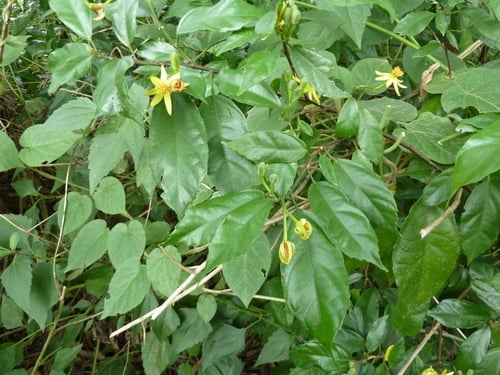
Hibiscus radiatus
Cav.
Ruby hibiscus
iNaturalist· cc-by-nc-nd
(c) Ale Türkmen (The Butterfly Project Mexico), some rights reserved (CC BY-NC-ND), uploaded by Ale Türkmen (The Butterfly Project Mexico)
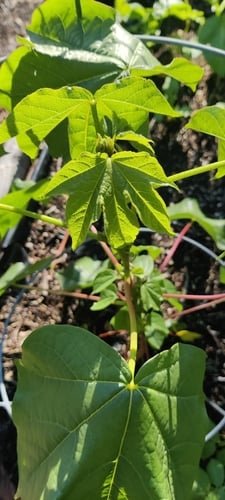
iNaturalist· cc-by-nc
(c) auried, some rights reserved (CC BY-NC)
Summary
Source: WikipediaHibiscus radiatus (commonly known as monarch rosemallow) is native to southern and southeast Asia. It has 15 cm (5.9 in) mauve flowers that have a purple center and yellow anthers. Leaves are dentate, with upper leaves lobed into three, five, or seven parts. Leaves are mistaken as marijuana, but radiatus' stems have small thorns. It is frequently grown as a vegetable or medicinal herb.
Description
A shrub. It keeps growing from year to year. It grows from 0.5-2 m tall. It can be upright or lie over. The leaf stalk is 3-11 cm long and spiny. The leaf blade is wide and often with 3 lobes on the lower stem and 3-5 lobes arranged like fingers on a hand higher up the stem. There are teeth around the edge. Leaves are 5-12 cm long by 4-15 cm wide. The flowers occur singly in the axils of leaves. Flowers are purple or red. The fruit is a round capsule about 15 mm across. It has flat long spines. The seeds are triangle shaped. They are brown and about 4 mm across.
Edible Uses
The leaves are edible.
Traditional Uses
The sour leaves are eaten.
This uses section is brief — help expand it
Medicinal Uses
The plant has medicinal uses.
Distribution
A tropical plant. It grows in the rainforest. In Argentina it grows below 500 m above sea level.
Where It Grows
Africa, Argentina, Asia, Bangladesh, Brazil, Central African Republic, CAR, China, Colombia, Cuba, Dominican Republic, El Salvador, Eswatini, French Guiana, Guianas, Guyana, Himalayas, Honduras, India*, Indochina, Indonesia, Laos, Mexico, Myanmar, Northeastern India, Paraguay, SE Asia*, South Africa, Southern Africa, South America, Suriname, Swaziland, Thailand, Trinidad-Tobago, Venezuela, Vietnam, Winward Is.,
Cultivation
This species is often confused with H. cannabinus, but it is an allotetraploid hybrid of H. cannabinus and perhaps H. surattensis.
Propagation
Propagate by seed, or by stem, tip or cane cuttings.
Other Uses
A fibre obtained from the bark is used for cordage and textiles. The plant attracts bees, butterflies and hummingbirds and can be grown in containers.
Other Information
It is cultivated.
Notes
There are about 220 Hibiscus species.
Synonyms
Also Known As
Fu she ci fu rong, Kembang sepatu merah, Monarch rosemallow
References (13)
- Ambasta, S.P. (Ed.), 2000, The Useful Plants of India. CSIR India. p 267
- Burkill, I.H., 1966, A Dictionary of the Economic Products of the Malay Peninsula. Ministry of Agriculture and Cooperatives, Kuala Lumpur, Malaysia. Vol 1 (A-H) p 1187
- Diss. 3:150, t. 54, fig. 2. 1787
- Kew Plants of the World Online
- Martin, F.W. & Ruberte, R.M., 1979, Edible Leaves of the Tropics. Antillian College Press, Mayaguez, Puerto Rico. p 203
Show all 13 references Hide references
- Pham-Hoang Ho, 1999, An Illustrated Flora of Vietnam. Nha Xuat Ban Tre. p 524
- Seidemann J., 2005, World Spice Plants. Economic Usage, Botany, Taxonomy. Springer. p 177
- Swaziland's Flora Database http://www.sntc.org.sz/flora
- Tang ya, Malvaceae. Flora of China. p
- Terra, G.J.A., 1973, Tropical Vegetables. Communication 54e Royal Tropical Institute, Amsterdam, p 50
- Wiersema, J. H. & Leon, B., 2013, World Economic Plants. A Standard Reference CRC Press. 2nd Ed. p 349
- World Checklist of Useful Plant Species 2020. Royal Botanic Gardens, Kew
- Zeven, A. C. & de West, J. M. J., 1982, Dictionary of cultivated plants and their regions of diversity. Wageningen. p 76