Hibiscus mechowii
Garcke
iNaturalist· cc-by-nc
(c) bahatiguy, some rights reserved (CC BY-NC)
iNaturalist· cc-by-nc
(c) bahatiguy, some rights reserved (CC BY-NC)
Description
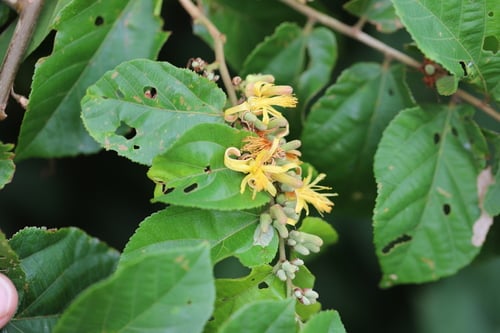
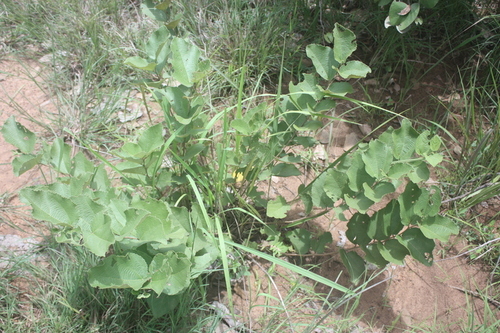
A shrubby plant. It grows 2 m high. The young stems have sparse prickles. The leaf blade is 15 cm long and wide. It is almost round. It is wedge shaped at the base. It has lobes 12 cm long and 2 cm wide. There are teeth along the edge. The flowers are 5-6 cm across. They are yellow with red centres. They occur singly in the axils of leaves. The fruit is a capsule 35 mm long by 25 mm wide. The seeds are 3.5 mm long by 2 mm wide. They are kidney shaped.
Edible Uses
The leaves and flowers are eaten as vegetables.
Medicinal Uses
The leaves are used to make a cough medicine in the treatment of pulmonary problems.
Distribution
A tropical plant.
Where It Grows
Africa, Angola, Botswana, Burkina Faso, Central Africa, Congo DR, East Africa, Guinea-Bissau, Sudan, Tanzania, West Africa, Zambia,
Cultivation
Plants can be grown from seeds.
Propagation
Seed - sow in situ or in containers. Germination is usually fairly rapid and no special pretreatment is needed, although germination will be faster if the seed is abraded or soaked prior to sowing. Prick out container-grown seedlings into individual pots when they are large enough to handle and plant them out into their permanent positions when they are 10cm or more tall.
Other Uses
A fibre is obtained from the bark. It is used for making nets and also for wrapping steamed manioc.
Other Information
In some places it is cultivated for the edible leaves.
Notes
There are about 220 Hibiscus species.
Synonyms
References (11)
- Burkill, H. M., 1985, The useful plants of west tropical Africa, Vol. 4. Kew.
- Flora Zambesiaca. http://apps.kew.org/efloras (As Hibiscus mechowii)
- Grivetti, L. E., 1980, Agricultural development: present and potential role of edible wild plants. Part 2: Sub-Saharan Africa, Report to the Department of State Agency for International Development. p 70
- Jardin, C., 1970, List of Foods Used In Africa, FAO Nutrition Information Document Series No 2.p 81
- Koni, J. & Bostoen, K., 2008, Noms et usages des plantes utiles chez les Nsong. (RD Congo, Bandundu, bantu B85F). University of Gothenburg
Show all 11 references Hide references
- Latham, P., 2004, Useful Plants of Bas-Congo province. Salvation Army & DFID p 150
- Linnaea 43:121. 1881
- Peters, C. R., O'Brien, E. M., and Drummond, R.B., 1992, Edible Wild plants of Sub-saharan Africa. Kew. p 144
- Scudder, 1971,
- Smith, P.M., 1979, Roselle, in Simmonds, N.W., (ed), Crop Plant Evolution. Longmans. London. p 316
- World Checklist of Useful Plant Species 2020. Royal Botanic Gardens, Kew