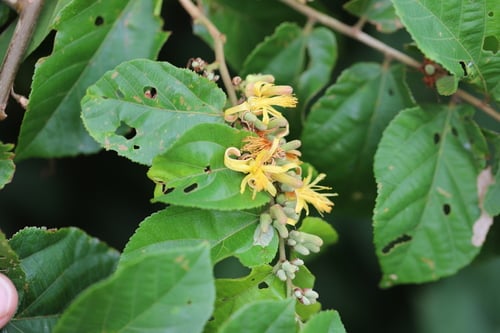
Hibiscus geranioides
Cunn. ex Benth.
Dwarf native hibiscus
iNaturalist· cc-by-nc
(c) Ian McMaster, some rights reserved (CC BY-NC), uploaded by Ian McMaster
iNaturalist· cc-by-nc
(c) greg n, some rights reserved (CC BY-NC)
iNaturalist· cc-by-nc
(c) greg n, some rights reserved (CC BY-NC)
Description
A herb which grows for one or two years. It grows 30-60 cm high and spreads 30-50 cm across. The stems are erect. There are only a few branches. It has a few rigid hairs and bristles. The leaves are 2-4 cm long by 2-3 cm wide. They are deeply divided into 3-5 lobes. They are dark green with stiff hairs on both surfaces. There are teeth along the edge. The flowers are 2-3 cm across and pink. They occur singly in the axils of the upper leaves. The fruit is a capsule 1 cm long by 1 cm wide. It is round and smooth. The seeds are smooth.
Edible Uses
The fruit is edible.
Distribution
A tropical plant. It grows in northern Australia. It suits tropical, subtropical and warm temperate climates. It can grow in full sun or light shade. It needs well drained soil. It can tolerate some frosts.
Where It Grows
Australia*,
Cultivation
Plants can be grown from seed or cuttings.
Notes
There are about 220 Hibiscus species.
Also Known As
Pelparr
References (3)
- Elliot, W.R., & Jones, D.L., 1990, Encyclopedia of Australian Plants suitable for cultivation. Vol 5. Lothian. 358
- Leiper, G & Houser, J., Mutooroo. Plant Use by Australian Aboriginal People. Assembly press, Queensland.
- Paczkowska, G. & Chapman, A.R., 2000, The Western Australian Flora. A Descriptive Catalogue. Western Australian Herbarium. p 289