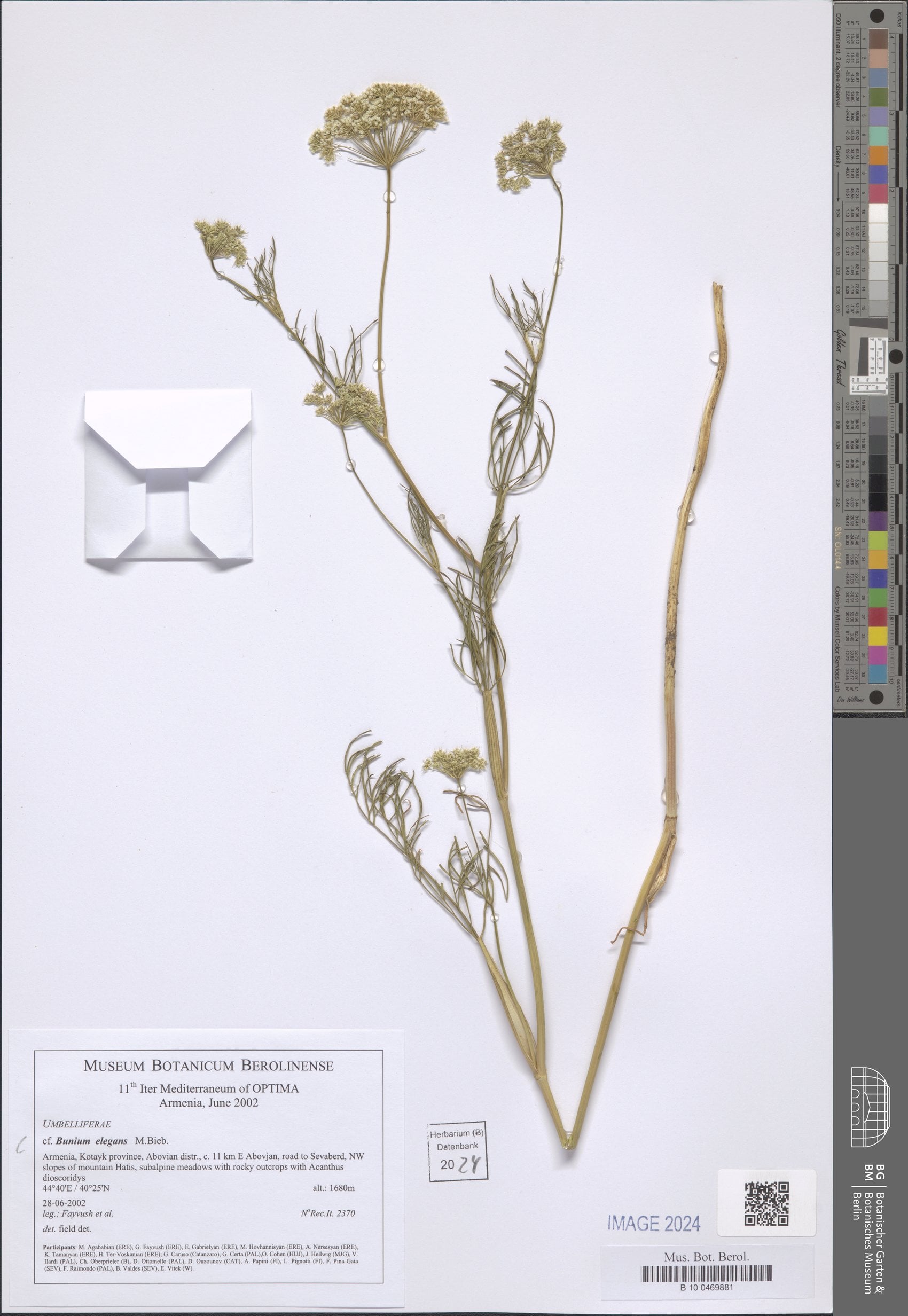
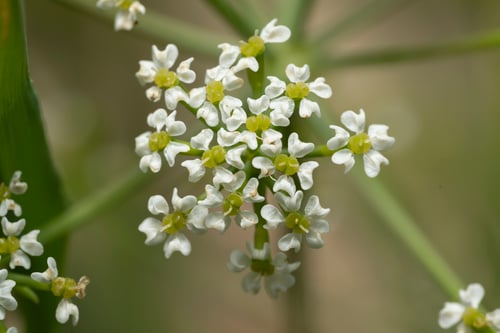
Heracleum lanatum
Michx.
American cow parsnip
iNaturalist· cc-by-nc
(c) deathcap, some rights reserved (CC BY-NC)
iNaturalist· cc-by-nc
(c) Chris Schmidt, some rights reserved (CC BY-NC)
iNaturalist· cc-by-nc
(c) Sequoia Janirella Wrens, some rights reserved (CC BY-NC)
Description
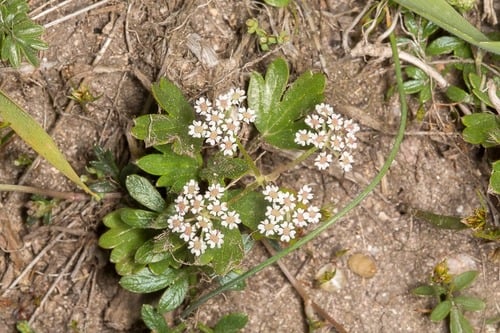
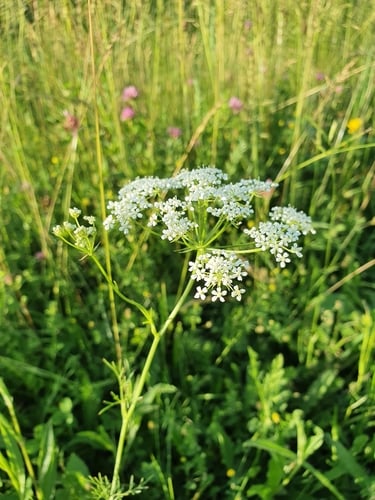
A herb. It has a stout leafy stem. It can be 2 m tall. The stems are hollow. The leaves are compound with 3 leaflets. They are 30 cm wide. The flowers are small and white. They have a sweet scent. They are in large compounds groups on equal length stalks. The fruit are dry and like nuts.
Edible Uses
The tender roots are cooked and eaten. The shoots and young leaves are eaten both cooked and raw. The dried seeds are used as flavouring and in chutney and pickles. Leaf stalks must be peeled before use as the peel contains a photosensitizing chemical.
Traditional Uses
The tender roots are cooked and eaten. The shoots and young leaves are eaten cooked and raw. The dried seeds are used as flavouring. They are also used for chutney and pickles. The leaf stalks must be peeled before being used as the peel contains a chemical that can make make skin sensitive to light and cause rashes. Caution: Similar looking plants can be poisonous.
Known Hazards
Similar looking plants can be poisonous. The leaf stalk peel contains a chemical that can make skin sensitive to light and cause rashes.
Distribution
It grows in subarctic America. It grows amongst willows and in sheltered hollows near alpine streams in the Rocky Mountains. It grows in moist ground.
Where It Grows
Alaska, Asia, Canada, India, Northeastern India, North America, Sikkim, USA,
Notes
Caution: Some similar looking plants are poisonous.
Nutrition
| Part | Moisture | kJ | kcal | Protein | Vit A | Vit C | Iron | Zinc |
|---|---|---|---|---|---|---|---|---|
| Stems | 95 | 84 | 20 | 0.2 | — | 3.5 | 0.4 | 0.2 |
| Leaves | 95 | 71 | 17 | 0.2 | — | — | — | — |
Synonyms
Also Known As
Chem-men, Chimping, Tarnaq, Xwiq'
References (19)
- Beckstrom-Sternberg, Stephen M., and James A. Duke. "The Foodplant Database." http://probe.nalusda.gov:8300/cgi-bin/browse/foodplantdb.(ACEDB version 4.0 - data version July 1994)
- Cormack, R. G. H., 1967, Wild Flowers of Alberta. Commercial Printers Edmonton, Canada. p 223
- Etkin, N.L. (Ed.), 1994, Eating on the Wild Side, Univ. of Arizona.
- Facciola, S., 1998, Cornucopia 2: a Source Book of Edible Plants. Kampong Publications, 19
- Fl. bor.-amer. 1:166. 1803
Show all 19 references Hide references
- Guil-Guerrero, J. L., et al, 2001, Edible Wild Plants. in Recent Progress in Medicinal Plants Vol. 8 Sci. Tech publishing, Texas
- Hedrick, U.P., 1919, (Ed.), Sturtevant's edible plants of the world. p 341
- Heller, C. A., 1962, Wild Edible and Poisonous Plants of Alaska. Univ. of Alaska Extension Service. p 61
- Jernigan, K. (Ed.), 2012, A Guide to the Ethnobotany of the Yukon-Kuskokwim Region. Draft.
- Kiple, K.F. & Ornelas, K.C., (eds), 2000, The Cambridge World History of Food. CUP p 1764
- Kuhnlein, H. V., et al, 2009, Indigenous Peoples' food systems. FAO Rome p 33
- Lim, T. K., 2015, Edible Medicinal and Non Medicinal Plants. Volume 9, Modified Stems, Roots, Bulbs. Springer p 46
- Lim, T. K., Edible Medicinal and Non-Medicinal Plants Volume 7 Flowers
- MacKinnon, A., et al, 2009, Edible & Medicinal Plants of Canada. Lone Pine. p 297 (As Heracleum maximum)
- Porsild, A.E., 1974, Rocky Mountain Wild Flowers. Natural History Series No. 2 National Museums of Canada. p 292
- Scotter, G. W., & Flygare, H., 1993, Wildflowers of the Canadian Rockies. Hurtig. p 58
- Stubbs, R. D., 1966, An investigation of the Edible and Medicinal Plants used by the Flathead Indians. MA thesis University of Montana. p 70
- Turner, N., 1995, Food Plants of Coastal First Peoples. Royal BC Museum Handbook p 58
- Turner, N., 1997, Food Plants of Interior First Peoples. Royal BC Museum Handbook p 78